O'Connell Lauren, Winter Des C, Aherne Carol M
Conway Institute of Biomolecular and Biomedical Research, School of Medicine, University College Dublin, Dublin, Ireland.
Centre for Colorectal Disease, St. Vincents' University Hospital, Dublin, Ireland.
Front Pediatr. 2021 Feb 17;9:624045. doi: 10.3389/fped.2021.624045. eCollection 2021.
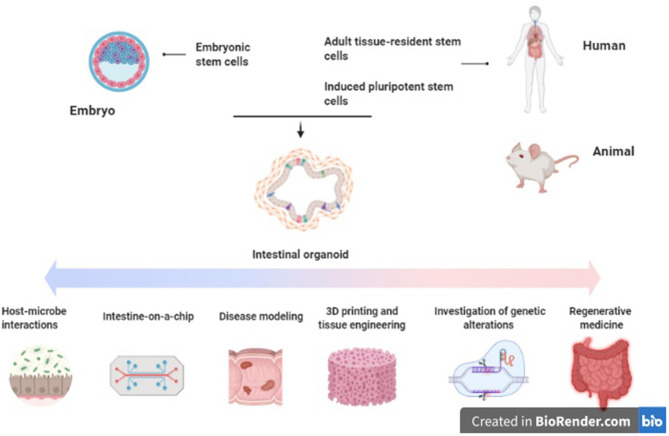
Inflammatory bowel disease (IBD) is a chronic relapsing-remitting immune-mediated disorder affecting the gut. It is common in Westernized regions and is increasing in incidence in developing countries. At a molecular level, intrinsic deficiencies in epithelial integrity, mucosal barrier function, and mechanisms of immune response and resolution contribute to the development of IBD. Traditionally two platforms have been utilized for disease modeling of IBD; monolayer cell culture and animal models. Both models have limitations, including cost, lack of representative cell types, lack of complexity of cellular interactions in a living organism, and xenogeneity. Organoids, three-dimensional cellular structures which recapitulate the basic architecture and functional processes of the organ of origin, hold potential as a third platform with which to investigate the pathogenesis and molecular defects which give rise to IBD. Organoids retain the genetic and transcriptomic profile of the tissue of origin over time and unlike monolayer cell culture can be induced to differentiate into most adult intestinal cell types. They may be used to model intestinal host-microbe interactions occurring at the mucosal barrier, are amenable to genetic manipulation and can be co-cultured with other cell lines of interest. Bioengineering approaches may be applied to render a more faithful representation of the intestinal epithelial niche. In this review, we outline the concept of intestinal organoids, discuss the advantages and disadvantages of the platform comparative to alternative models, and describe the translational applications of organoids in IBD.
炎症性肠病(IBD)是一种影响肠道的慢性复发-缓解型免疫介导疾病。它在西方化地区很常见,在发展中国家的发病率也在上升。在分子水平上,上皮完整性、黏膜屏障功能以及免疫反应和消退机制的内在缺陷导致了IBD的发生。传统上,IBD疾病建模使用了两种平台;单层细胞培养和动物模型。这两种模型都有局限性,包括成本、缺乏代表性细胞类型、缺乏生物体中细胞相互作用的复杂性以及异种性。类器官是三维细胞结构,概括了起源器官的基本结构和功能过程,作为研究导致IBD的发病机制和分子缺陷的第三个平台具有潜力。随着时间的推移,类器官保留了起源组织的遗传和转录组特征,并且与单层细胞培养不同,可以被诱导分化为大多数成人肠道细胞类型。它们可用于模拟在黏膜屏障处发生的肠道宿主-微生物相互作用,易于进行基因操作,并且可以与其他感兴趣的细胞系共培养。生物工程方法可用于更忠实地呈现肠道上皮生态位。在这篇综述中,我们概述了肠道类器官的概念,讨论了该平台相对于其他模型的优缺点,并描述了类器官在IBD中的转化应用。