Woolcock Institute of Medical Research, University of Sydney, Glebe, New South Wales, Australia.
School of Pharmacy, University of Sydney, Camperdown, New South Wales, Australia.
Int J Chron Obstruct Pulmon Dis. 2021 Mar 2;16:519-533. doi: 10.2147/COPD.S288792. eCollection 2021.
To evaluate the effectiveness of a pilot community pharmacy care model for patients with chronic obstructive pulmonary disease (COPD) to improve: 1) inhaler technique; 2) medication adherence; and 3) uptake of non-pharmacological treatment and prevention activities.
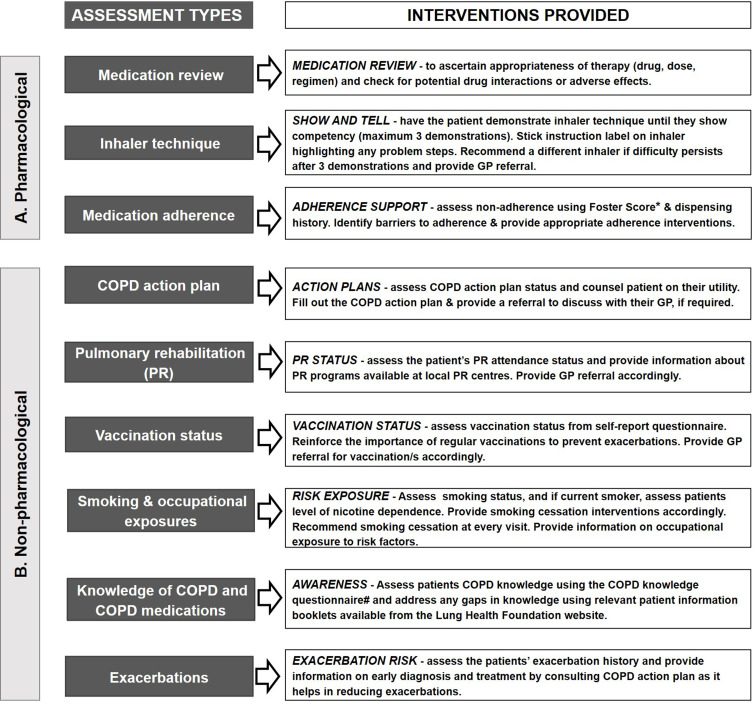
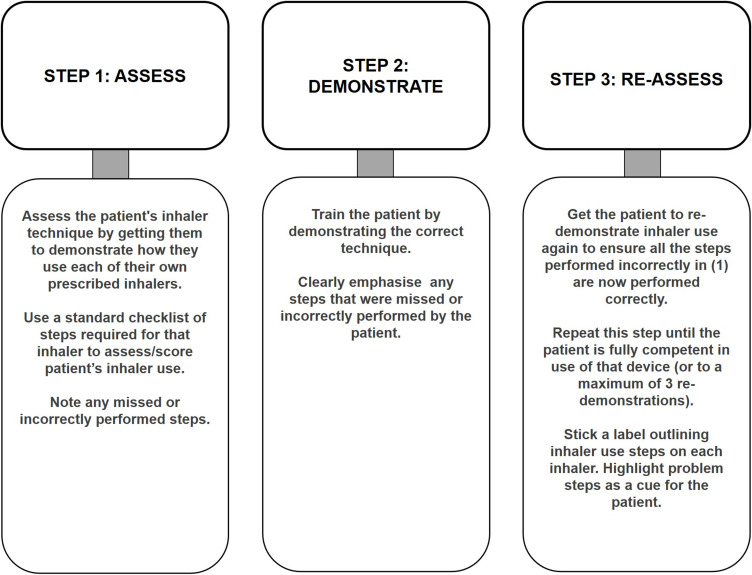
Forty "host" pharmacies in Sydney were invited to recruit eligible patients and to provide a counselling room/area in their pharmacy for service provision. Eligible patients were referred to two "consultant" pharmacists, specifically trained to deliver a specialized pharmacy COPD service which involved 3 in-pharmacy visits and 2 follow-up phone calls over a 6-month period. The service consisted of 1) inhaler technique assessment; 2) medication adherence assessment; and 3) referrals to the patient's general practitioner (GP) to facilitate the uptake of non-pharmacological resources as well as to review COPD medications/devices, as required. Pre-post analyses were conducted using paired Student's -test and Wilcoxon Signed Rank Test for independent variables and chi-squared tests for proportional data.
Nine "host" pharmacies recruited 40 patients, of whom 37 completed the baseline Visit and 27 completed all Visits. A total of 270 interventions were provided by the "consultant" pharmacists with most provided at Visit 1 (176). The most common interventions were addressing patient gaps in COPD knowledge and inhaler technique. A total of 119 referrals were made to GPs for various reasons, the most common being for a COPD action plan, pulmonary rehabilitation, or pneumonia vaccination. There were significant improvements pre-post intervention in inhaler use competence, COPD knowledge, immunization rate for pneumonia, exacerbation rate and COPD plan ownership.
In this pilot study, the specialized pharmacy-based COPD care model delivered by "consultant" pharmacists in community pharmacies provided significant health benefits for patients. Further research is needed to assess the model's effectiveness in a larger population as well as when measured against standard care.
评估针对慢性阻塞性肺疾病(COPD)患者的试点社区药房护理模式的有效性,以改善:1)吸入器技术;2)药物依从性;和 3)非药物治疗和预防活动的采用。
邀请悉尼的 40 家“主办”药房招募符合条件的患者,并在其药房内提供一个咨询室/区域以提供服务。符合条件的患者被转介给两位“顾问”药剂师,他们专门接受过提供专门的药房 COPD 服务的培训,该服务包括在 6 个月内进行 3 次店内访问和 2 次随访电话。该服务包括 1)吸入器技术评估;2)药物依从性评估;和 3)转介给患者的全科医生(GP),以促进非药物资源的采用,并根据需要审查 COPD 药物/设备。使用配对学生 t 检验和 Wilcoxon 符号秩检验进行独立变量的预-后分析,以及卡方检验进行比例数据的分析。
9 家“主办”药房招募了 40 名患者,其中 37 名患者完成了基线就诊,27 名患者完成了所有就诊。“顾问”药剂师共提供了 270 次干预,其中大部分是在就诊 1 时提供的(176 次)。最常见的干预措施是解决 COPD 知识和吸入器技术方面的患者差距。共有 119 次向 GP 转诊,原因各不相同,最常见的原因是制定 COPD 行动计划、肺康复或肺炎疫苗接种。干预前后吸入器使用能力、COPD 知识、肺炎免疫率、加重率和 COPD 计划拥有率均有显著改善。
在这项试点研究中,由社区药房的“顾问”药剂师提供的专门的基于药房的 COPD 护理模式为患者带来了显著的健康益处。需要进一步的研究来评估该模式在更大人群中的有效性,以及与标准护理相比的效果。