Medical Microbiology and Immunology Department, Faculty of Medicine, Zagazig University, Zagazig, Egypt.
Clinical Pathology Department, Faculty of Medicine, Cairo University, Cairo, Egypt.
PLoS One. 2021 Jan 20;16(1):e0245672. doi: 10.1371/journal.pone.0245672. eCollection 2021.
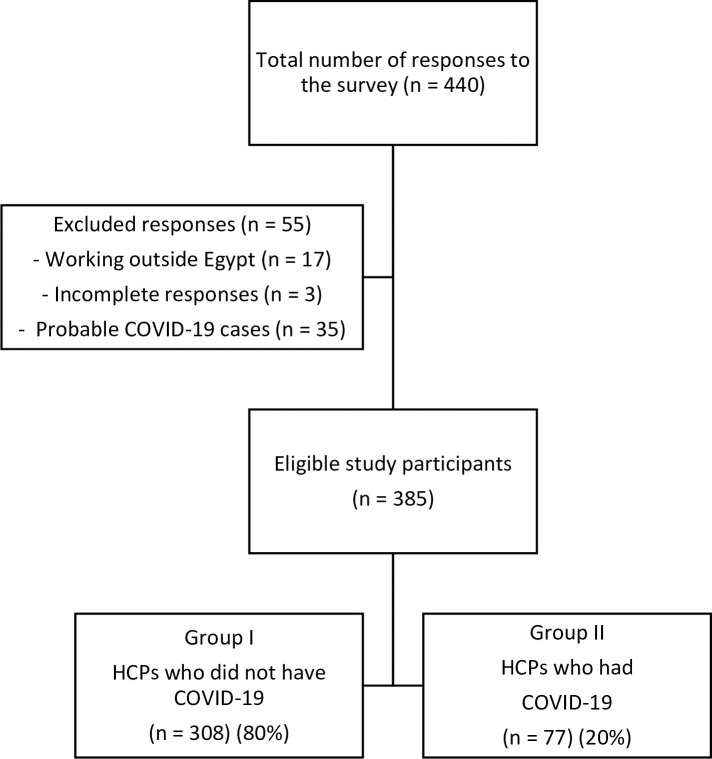
A limited number of publications have identified risk factors for Corona Virus Disease 2019 (COVID-19) among Healthcare Providers (HCPs). We aimed to assess the clinical and epidemiological characteristics and the predicting factors related to COVID-19 among HCPs in Egypt. A comparative cross-sectional study was conducted among HCPs via an online questionnaire. Out of 440 responses, a total of 385 complete responses were analyzed. The responders' mean age was 37.5±9.4 years, 215 (55.8%) of the participants were males. They included 77 (20%) confirmed COVID-19 cases; most of them had mild (58.6%) or moderate symptoms (30%), and (9.1%) were asymptomatic. Almost all sustained infection while on duty (97.4%). The sources of infection were either infected patients (39%), colleagues (22.1%), household contacts (5.2%) or uncertain (33.8%). The sources were symptomatic in only 62.3% of cases. Asymptomatic or pre-symptomatic sources accounted for 37.7% of the cases. Exposure occurred during healthcare provision in 66.3% of the cases. The presence of co-morbidities (OR = 2.53, CI 1.47-4.38, P = 0.001), working more than 8 hours per day in isolation hospital (OR = 3.09, CI 1.02-9.35, P = 0.046), training on hand hygiene (OR = 2.31, CI 1.05-5.08, P = 0.038) and adherence to IPC measures (OR = 2.11, CI 1.16-3.81, P = 0.014) were the significant predictors of COVID-19. In conclusion, COVID-19 occurred in 20% of responders. Silent spread from asymptomatic or presymptomatic patients, and infected colleagues in hospital settings is an alarming sign. Proactive infection prevention and control measures are highly encouraged on both strategic and operational levels. Reconsideration of surveillance strategy and work-related regulations in healthcare settings are warranted.
在医疗保健提供者(HCP)中,少数出版物已经确定了 2019 年冠状病毒病(COVID-19)的危险因素。我们旨在评估埃及 HCP 中与 COVID-19 相关的临床和流行病学特征以及预测因素。通过在线问卷对 HCP 进行了比较性横断面研究。在 440 份答复中,共分析了 385 份完整答复。应答者的平均年龄为 37.5±9.4 岁,215 名(55.8%)参与者为男性。其中包括 77 例(20%)确诊的 COVID-19 病例;大多数患者症状轻微(58.6%)或中度(30%),9.1%无症状。几乎所有感染者在工作时都受到感染(97.4%)。感染源是感染患者(39%),同事(22.1%),家庭接触者(5.2%)或不确定(33.8%)。仅在 62.3%的病例中,来源有症状。无症状或症状前来源占病例的 37.7%。在 66.3%的情况下,接触发生在提供医疗保健期间。共存疾病的存在(OR = 2.53,CI 1.47-4.38,P = 0.001),在隔离医院每天工作超过 8 小时(OR = 3.09,CI 1.02-9.35,P = 0.046),手部卫生培训(OR = 2.31,CI 1.05-5.08,P = 0.038)和遵守感染预防和控制措施(OR = 2.11,CI 1.16-3.81,P = 0.014)是 COVID-19 的重要预测指标。总之,20%的应答者发生了 COVID-19。无症状或症状前患者和医院环境中感染的同事的沉默传播是一个令人震惊的迹象。在战略和运营层面上,强烈鼓励采取积极主动的感染预防和控制措施。有必要重新考虑医疗保健环境中的监测策略和与工作相关的法规。