Kitanishi Takuma, Umaba Ryoko, Mizuseki Kenji
Department of Physiology, Osaka City University Graduate School of Medicine, Osaka 545-8585, Japan.
PRESTO, Japan Science and Technology Agency (JST), Kawaguchi, Saitama 332-0012, Japan.
Sci Adv. 2021 Mar 10;7(11). doi: 10.1126/sciadv.abf1913. Print 2021 Mar.
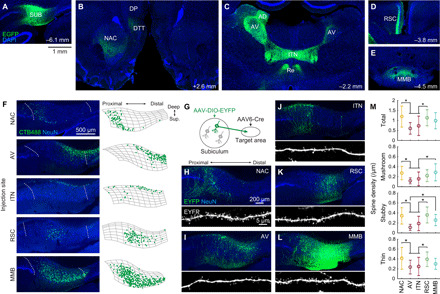
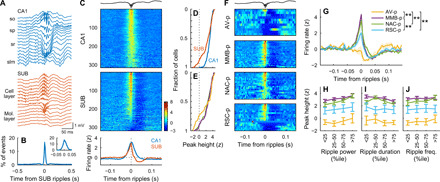
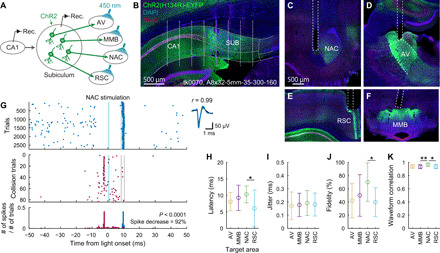
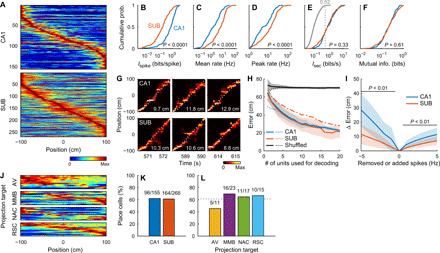
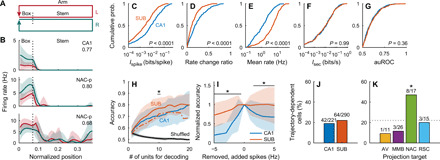
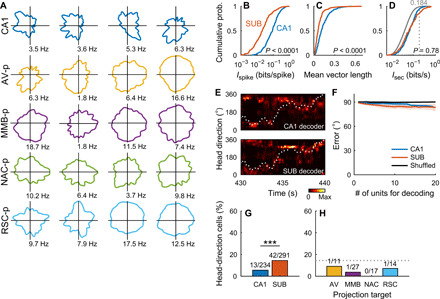
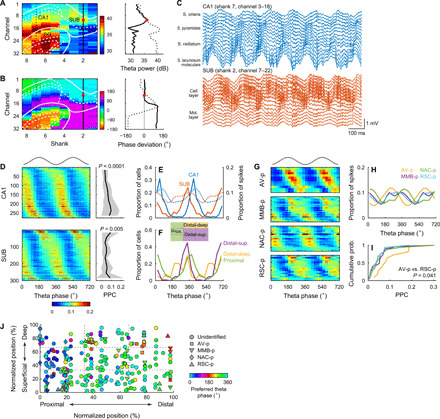
The dorsal hippocampus conveys various information associated with spatial navigation; however, how the information is distributed to multiple downstream areas remains unknown. We investigated this by identifying axonal projections using optogenetics during large-scale recordings from the rat subiculum, the major hippocampal output structure. Subicular neurons demonstrated a noise-resistant representation of place, speed, and trajectory, which was as accurate as or even more accurate than that of hippocampal CA1 neurons. Speed- and trajectory-dependent firings were most prominent in neurons projecting to the retrosplenial cortex and nucleus accumbens, respectively. Place-related firing was uniformly observed in neurons targeting the retrosplenial cortex, nucleus accumbens, anteroventral thalamus, and medial mammillary body. Theta oscillations and sharp-wave/ripples tightly controlled the firing of projection neurons in a target region-specific manner. In conclusion, the dorsal subiculum robustly routes diverse navigation-associated information to downstream areas.
背侧海马体传递与空间导航相关的各种信息;然而,这些信息如何分布到多个下游区域仍不清楚。我们通过在大鼠海马下脚(主要的海马输出结构)的大规模记录过程中使用光遗传学识别轴突投射来对此进行研究。海马下脚神经元表现出对位置、速度和轨迹的抗噪声表征,其准确性与海马CA1神经元相当,甚至更高。分别投射到压后皮质和伏隔核的神经元中,速度依赖性和轨迹依赖性放电最为突出。在投射到压后皮质、伏隔核、腹前丘脑和内侧乳头体的神经元中均观察到与位置相关的放电。θ振荡和尖波/涟漪以靶区域特异性方式紧密控制投射神经元的放电。总之,背侧海马下脚有力地将各种与导航相关的信息传递到下游区域。