Lai Benjamin F L, Lu Rick X, Hu Yangshuo, Davenport Huyer Locke, Dou Wenkun, Wang Erika Y, Radulovich Nikolina, Tsao Ming S, Sun Yu, Radisic Milica
Institute of Biomaterials and Biomedical Engineering, University of Toronto, Toronto, Ontario, Canada.
Department of Chemical Engineering and Applied Chemistry, University of Toronto, Toronto, Ontario, Canada.
Adv Funct Mater. 2020 Nov 25;30(48). doi: 10.1002/adfm.202000545. Epub 2020 Jun 8.
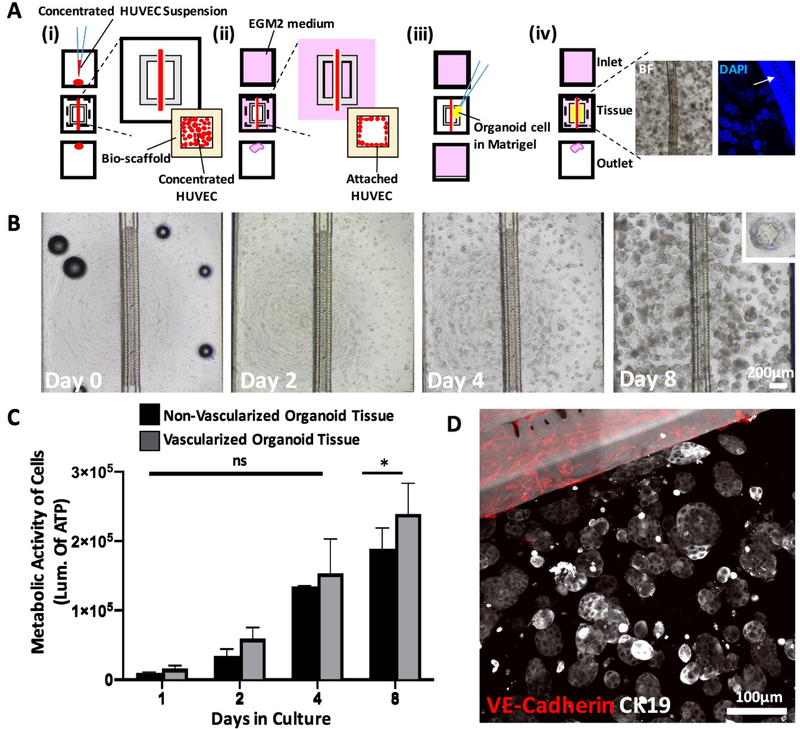
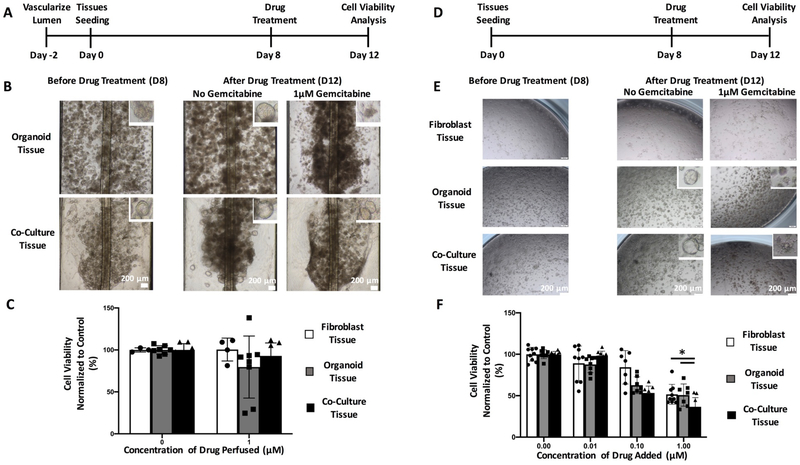
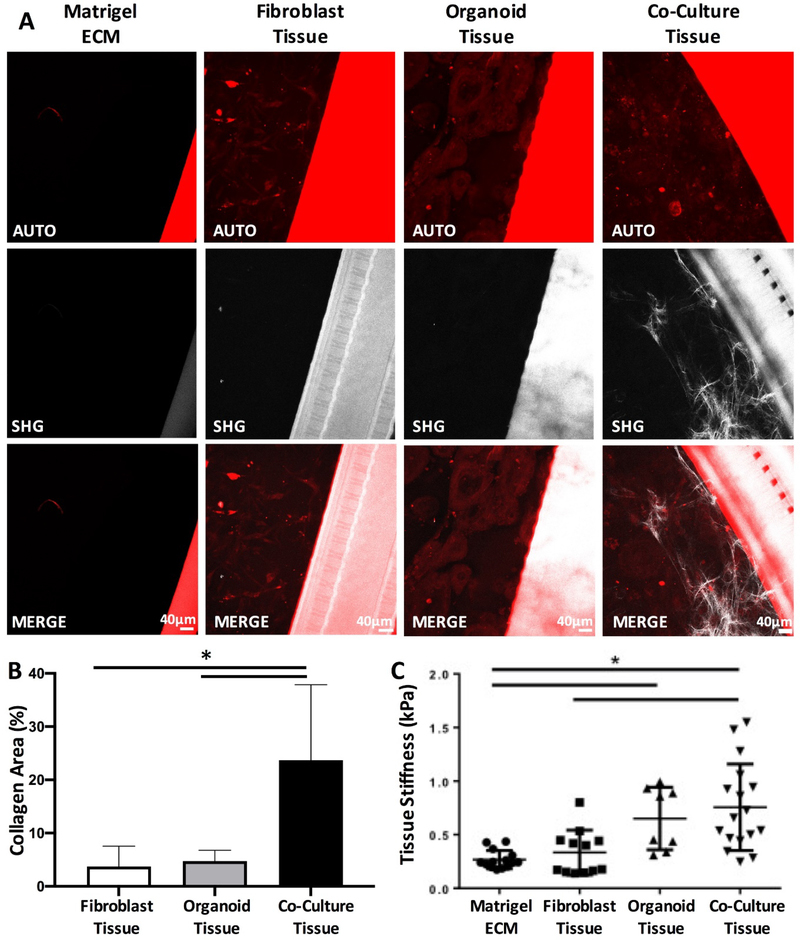
Tumor progression relies heavily on the interaction between the neoplastic epithelial cells and their surrounding stromal partners. This cell cross-talk affects stromal development, and ultimately the heterogeneity impacts drug efflux and efficacy. To mimic this evolving paradigm, we have micro-engineered a three-dimensional (3D) vascularized pancreatic adenocarcinoma tissue in a tri-culture system composed of patient derived pancreatic organoids, primary human fibroblasts and endothelial cells on a perfusable InVADE platform situated in a 96-well plate. Uniquely, through synergistic engineering we combined the benefits of cellular fidelity of patient tumor derived organoids with the addressability of a plastic organ-on-a-chip platform. Validation of this platform included demonstrating the growth of pancreatic tumor organoids by monitoring the change in metabolic activity of the tissue. Investigation of tumor microenvironmental behavior highlighted the role of fibroblasts in symbiosis with patient organoid cells, resulting in a six-fold increase of collagen deposition and a corresponding increase in tissue stiffness in comparison to fibroblast free controls. The value of a perfusable vascular network was evident in drug screening, as perfusion of gemcitabine into a stiffened matrix did not show the dose-dependent effects on tumor viability as those under static conditions. These findings demonstrate the importance of studying the dynamic synergistic relationship between patient cells with stromal fibroblasts, in a 3D perfused vascular network, to accurately understand and recapitulate the tumor microenvironment.
肿瘤进展在很大程度上依赖于肿瘤上皮细胞与其周围基质细胞之间的相互作用。这种细胞间的相互作用影响基质的发育,最终这种异质性会影响药物外排和疗效。为了模拟这种不断演变的模式,我们在一个三维(3D)血管化胰腺腺癌组织的三培养系统中进行了微工程,该系统由患者来源的胰腺类器官、原代人成纤维细胞和内皮细胞组成,置于96孔板中的可灌注InVADE平台上。独特的是,通过协同工程,我们将患者肿瘤来源类器官的细胞保真度优势与塑料芯片器官平台的可寻址性结合起来。该平台的验证包括通过监测组织代谢活性的变化来证明胰腺肿瘤类器官的生长。对肿瘤微环境行为的研究突出了成纤维细胞与患者类器官细胞共生的作用,与无成纤维细胞的对照组相比,胶原沉积增加了六倍,组织硬度相应增加。在药物筛选中,可灌注血管网络的价值显而易见,因为将吉西他滨灌注到硬化基质中并未显示出与静态条件下对肿瘤活力的剂量依赖性影响。这些发现证明了在三维灌注血管网络中研究患者细胞与基质成纤维细胞之间动态协同关系对于准确理解和重现肿瘤微环境的重要性。