Radford Jason, Joseph Kenneth
Department of Political Science, Northeastern University, Boston, MA, United States.
Department of Computer Science and Engineering, University at Buffalo, Buffalo, NY, United States.
Front Big Data. 2020 May 19;3:18. doi: 10.3389/fdata.2020.00018. eCollection 2020.
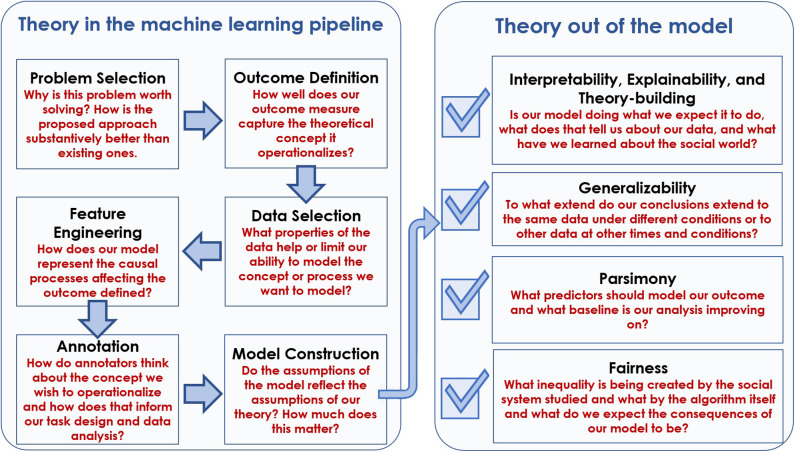
Research at the intersection of machine learning and the social sciences has provided critical new insights into social behavior. At the same time, a variety of issues have been identified with the machine learning models used to analyze social data. These issues range from technical problems with the data used and features constructed, to problematic modeling assumptions, to limited interpretability, to the models' contributions to bias and inequality. Computational researchers have sought out technical solutions to these problems. The primary contribution of the present work is to argue that there is a limit to these technical solutions. At this limit, we must instead turn to social theory. We show how social theory can be used to answer basic methodological and interpretive questions that technical solutions cannot when building machine learning models, and when assessing, comparing, and using those models. In both cases, we draw on related existing critiques, provide examples of how social theory has already been used constructively in existing work, and discuss where other existing work may have benefited from the use of specific social theories. We believe this paper can act as a guide for computer and social scientists alike to navigate the substantive questions involved in applying the tools of machine learning to social data.
机器学习与社会科学交叉领域的研究为社会行为提供了重要的新见解。与此同时,用于分析社会数据的机器学习模型也存在各种问题。这些问题涵盖了从所用数据和构建特征的技术问题,到有问题的建模假设,再到有限的可解释性,以及模型对偏见和不平等的影响。计算研究人员一直在寻求这些问题的技术解决方案。本研究的主要贡献在于指出这些技术解决方案存在局限性。在此限度下,我们必须转而求助于社会理论。我们展示了在构建机器学习模型以及评估、比较和使用这些模型时,社会理论如何能够用来回答技术解决方案无法解决的基本方法论和解释性问题。在这两种情况下,我们借鉴了现有的相关批评意见,给出了社会理论在现有研究中如何得到有效应用的实例,并讨论了其他现有研究在哪些方面可能因使用特定社会理论而受益。我们相信本文可为计算机科学家和社会科学家提供指导,帮助他们应对将机器学习工具应用于社会数据时所涉及的实质性问题。