State Key Laboratory for Biology of Plant Disease and Insect Pests, Institute of Plant Protection, Chinese Academy of Agricultural Sciences, Beijing, China.
School of Agriculture, Yangtze University, Jingzhou, China.
Sci Rep. 2021 Mar 11;11(1):5773. doi: 10.1038/s41598-021-85281-8.
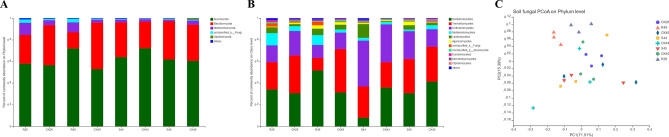
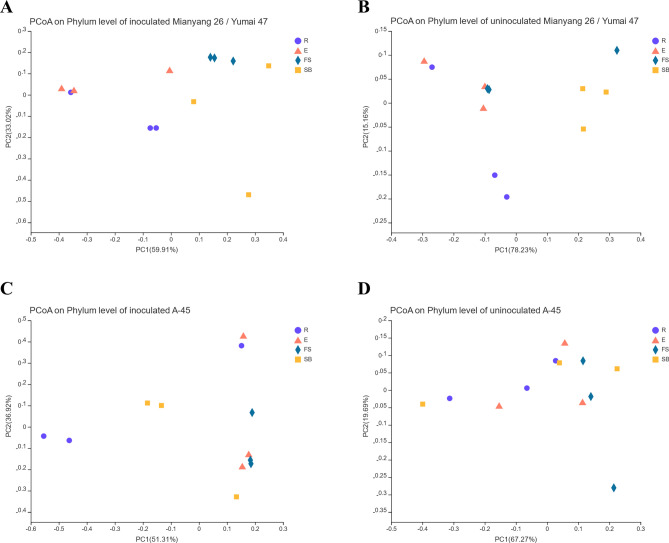
Dwarf bunt of wheat, which is caused by Tilletia controversa J.G. Kühn, is a soil-borne disease which may lead up to an 80% loss of yield together with degradation of the quality of the wheat flour by production of a fishy smell. In this study, high-throughput sequencing technology was employed to characterize the microbial composition of wheat tissues (roots, spikes, first stem under the ear, and stem base) and rhizosphere soil of wheat varieties that are resistant and susceptible to T. controversa. We observed that the soil fungal community abundance and diversity were higher in resistant varieties than in susceptible varieties in both inoculated and uninoculated wheat, and the abundances of Sordariomycetes and Mortierellomycetes increased in the resistant varieties infected with T. controversa, while the abundances of Dothideomycetes and Bacteroidia increased in the susceptible varieties. Regarding the bacteria present in wheat tissues, the abundances of Chloroflexi, Bacteroidetes, Gemmatimonadetes, Verrucomicrobia and Acidobacteria in the ear and the first stem under the ear were higher than those in other tissues. Our results indicated that the abundances of Sordariomycetes, Mortierellomycetes, Leotiomycetes, Chryseobacterium and Massilia were higher in T. controversa-infected resistant varieties than in their controls, that Dothideomycetes, Bacteroidia, Nocardioides and Pseudomonas showed higher abundances in T. controversa-infected susceptible varieties, and that Curtobacterium, Exiguobacterium, Planococcus, and Pantoea may have higher abundances in both T. controversa-infected susceptible and resistant varieties than in their own controls.
小麦矮腥黑粉病由腥黑粉菌(Tilletia controversa J.G. Kühn)引起,是一种土传病害,可导致高达 80%的减产,并因产生鱼腥味而降低小麦面粉的质量。在这项研究中,我们采用高通量测序技术来描述对腥黑粉菌具有抗性和敏感性的小麦品种的根、穗、第一耳下茎和茎基部等小麦组织以及根际土壤的微生物组成。我们观察到,与敏感品种相比,在接种和未接种小麦中,抗性品种的土壤真菌群落丰度和多样性更高,接种腥黑粉菌后,Sordariomycetes 和 Mortierellomycetes 的丰度在抗性品种中增加,而 Dothideomycetes 和 Bacteroidia 的丰度在敏感品种中增加。就小麦组织中的细菌而言,在穗和第一耳下茎中,Chloroflexi、Bacteroidetes、Gemmatimonadetes、Verrucomicrobia 和 Acidobacteria 的丰度高于其他组织。我们的结果表明,与对照相比,在感染腥黑粉菌的抗性品种中,Sordariomycetes、Mortierellomycetes、Leotiomycetes、Chryseobacterium 和 Massilia 的丰度更高,在感染腥黑粉菌的敏感品种中,Dothideomycetes、Bacteroidia、Nocardioides 和 Pseudomonas 的丰度更高,而 Curtobacterium、Exiguobacterium、Planococcus 和 Pantoea 可能在感染腥黑粉菌的敏感和抗性品种中的丰度都高于其自身对照。