Schuuring Mark J, Išgum Ivana, Cosyns Bernard, Chamuleau Steven A J, Bouma Berto J
Amsterdam University Medical Centers -Location Academic Medical Center, Department of Cardiology, University of Amsterdam, Amsterdam, Netherlands.
Amsterdam University Medical Centers -Location Academic Medical Center, Department of Biomedical Engineering and Physics, University of Amsterdam, Amsterdam, Netherlands.
Front Cardiovasc Med. 2021 Feb 23;8:648877. doi: 10.3389/fcvm.2021.648877. eCollection 2021.
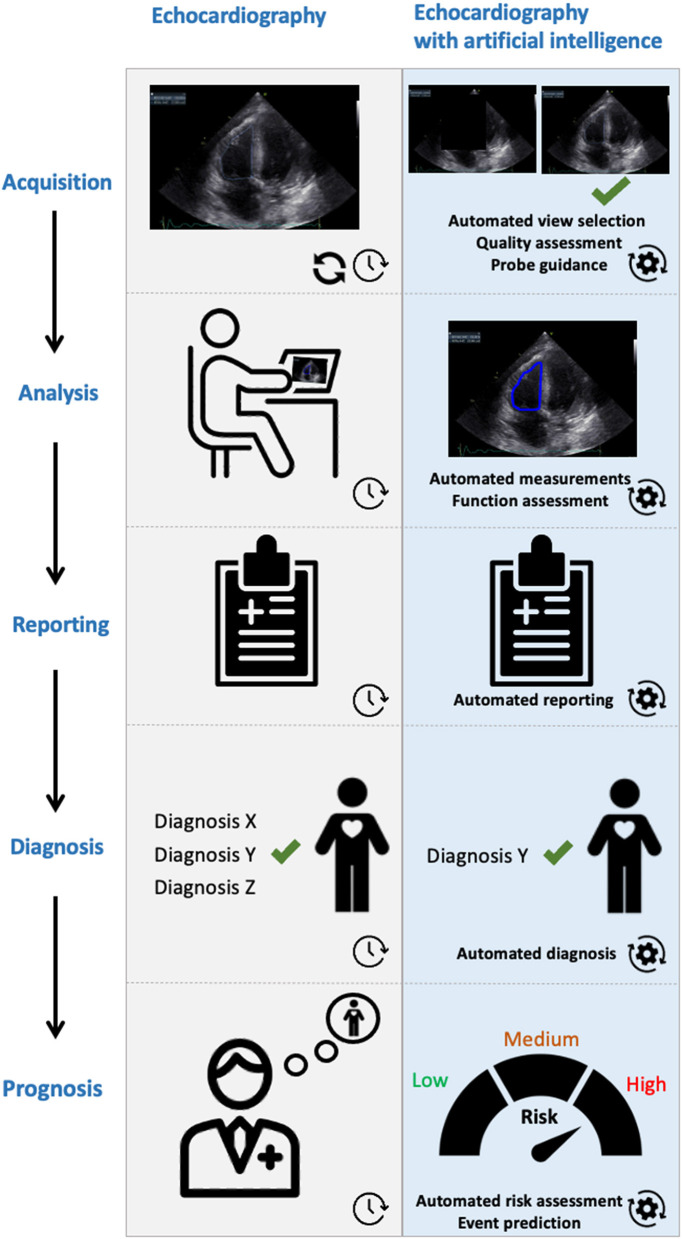
Echocardiography is widely used because of its portability, high temporal resolution, absence of radiation, and due to the low-costs. Over the past years, echocardiography has been recommended by the European Society of Cardiology in most cardiac diseases for both diagnostic and prognostic purposes. These recommendations have led to an increase in number of performed studies each requiring diligent processing and reviewing. The standard work pattern of image analysis including quantification and reporting has become highly resource intensive and time consuming. Existence of a large number of datasets with digital echocardiography images and recent advent of AI technology have created an environment in which artificial intelligence (AI) solutions can be developed successfully to automate current manual workflow. We report on published AI solutions for echocardiography analysis on methods' performance, characteristics of the used data and imaged population. Contemporary AI applications are available for automation and advent in the image acquisition, analysis, reporting and education. AI solutions have been developed for both diagnostic and predictive tasks in echocardiography. Left ventricular function assessment and quantification have been most often performed. Performance of automated image view classification, image quality enhancement, cardiac function assessment, disease classification, and cardiac event prediction was overall good but most studies lack external evaluation. Contemporary AI solutions for image acquisition, analysis, reporting and education are developed for relevant tasks with promising performance. In the future major benefit of AI in echocardiography is expected from improvements in automated analysis and interpretation to reduce workload and improve clinical outcome. Some of the challenges have yet to be overcome, however, none of them are insurmountable.
超声心动图因其便携性、高时间分辨率、无辐射以及成本低而被广泛应用。在过去几年中,欧洲心脏病学会已推荐在大多数心脏疾病中使用超声心动图进行诊断和预后评估。这些建议导致进行的研究数量增加,每项研究都需要认真处理和审查。包括量化和报告在内的图像分析标准工作模式已变得资源高度密集且耗时。大量数字超声心动图图像数据集的存在以及人工智能技术的最新出现,创造了一个可以成功开发人工智能(AI)解决方案以自动化当前手动工作流程的环境。我们报告已发表的用于超声心动图分析的人工智能解决方案,包括方法性能、所用数据的特征以及成像人群。当代人工智能应用可用于图像采集、分析、报告和教育的自动化及创新。已经开发出用于超声心动图诊断和预测任务的人工智能解决方案。左心室功能评估和量化最为常见。自动图像视图分类、图像质量增强、心脏功能评估、疾病分类和心脏事件预测的性能总体良好,但大多数研究缺乏外部评估。当代用于图像采集、分析、报告和教育的人工智能解决方案是针对相关任务开发的,具有良好的性能。未来,人工智能在超声心动图中的主要益处预计来自自动分析和解释的改进,以减少工作量并改善临床结果。然而,一些挑战仍有待克服,但没有一个是无法克服的。