Zhuang Zian, Cao Peihua, Zhao Shi, Han Lefei, He Daihai, Yang Lin
Department of Applied Mathematics, Hong Kong Polytechnic University, Hong Kong, China.
Clinical Research Center, Zhujiang Hospital, Southern Medical University, Guangzhou, China.
Ann Transl Med. 2021 Feb;9(3):200. doi: 10.21037/atm-20-5248.
The 76-day lockdown of Wuhan city has successfully contained the first wave of the coronavirus disease 2019 (COVID-19) outbreak. However, to date few studies have evaluated the hospital bed shortage for COVID-19 during the lockdown and none for non-COVID-19 patients, although such data are important for better preparedness of the future outbreak.
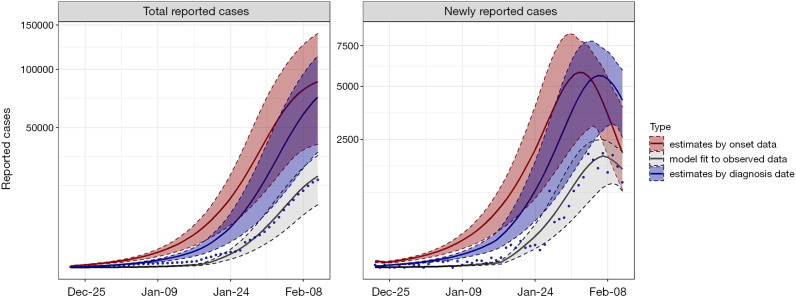
We built a compartmental model to estimate the daily numbers of hospital bed shortage for patients with mild, severe and critical COVID-19, taking account of underreport and diagnosis delay.
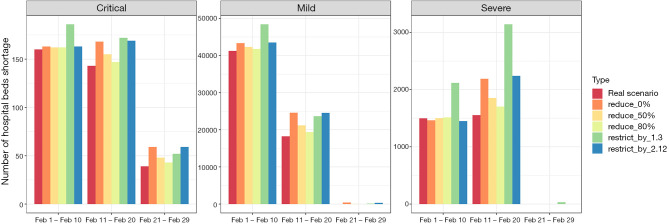
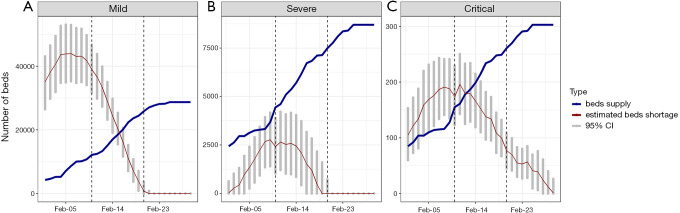
The maximal daily shortage of inpatient beds for mild, severe and critical COVID-19 patients was 43,960 (95% confidence interval: 35,246, 52,929), 2,779 (1,395, 4,163) and 196 (143, 250) beds in early February 2020. An earlier or later lockdown would have greatly increased the shortage of hospital beds in Wuhan. The overwhelmed healthcare system might have delayed the provision of health care to both COVID-19 and non-COVID-19 patients during the lockdown. The second wave in Wuhan could have occurred in June 2020 if social distancing measures had waned in early March 2020. The hospital bed shortage was estimated much smaller in the potential second wave than in the first one.
Our findings suggest that the timing and strength of lockdown is important for the containment of the COVID-19 outbreaks. The healthcare needs of non-COVID-19 patients in the pandemic warrant more investigations.
武汉市76天的封城成功遏制了2019年冠状病毒病(COVID-19)的第一波疫情。然而,迄今为止,很少有研究评估封城期间COVID-19患者的医院床位短缺情况,对于非COVID-19患者则没有相关研究,尽管这些数据对于更好地应对未来疫情很重要。
我们建立了一个分区模型,以估计轻症、重症和危重症COVID-19患者每日的医院床位短缺数量,同时考虑了漏报和诊断延迟的情况。
2020年2月初,轻症、重症和危重症COVID-19患者住院床位的最大每日短缺量分别为43960张(95%置信区间:35246,52929)、2779张(1395,4163)和196张(143,250)。封城时间提前或推迟都会大幅增加武汉的医院床位短缺情况。不堪重负的医疗系统可能在封城期间延迟了对COVID-19患者和非COVID-19患者的医疗服务提供。如果2020年3月初社会 distancing措施减弱,武汉可能在2020年6月出现第二波疫情。预计第二波疫情中的医院床位短缺情况比第一波要小得多。
我们的研究结果表明,封城的时间和力度对于遏制COVID-19疫情很重要。疫情期间非COVID-19患者的医疗需求值得更多研究。