Students' Scientific Group at 2nd Department of Surgery, Jagiellonian University Medical College, Jakubowskiego 2 st., 30-688, Krakow, Poland.
2nd Department of General Surgery, Jagiellonian University Medical College, Jakubowskiego 2 st., 30-688, Krakow, Poland.
Obes Surg. 2021 Jul;31(7):2994-3004. doi: 10.1007/s11695-021-05341-w. Epub 2021 Mar 13.
Bariatric surgery is the most effective obesity treatment. Weight loss varies among patients, and not everyone achieves desired outcome. Identification of predictive factors for weight loss after bariatric surgery resulted in several prediction tools proposed. We aimed to validate the performance of available prediction models for weight reduction 1 year after surgical treatment.
The retrospective analysis included patients after Roux-en-Y gastric bypass (RYGB) or sleeve gastrectomy (SG) who completed 1-year follow-up. Postoperative body mass index (BMI) predicted by 12 models was calculated for each patient. The correlation between predicted and observed BMI was assessed using linear regression. Accuracy was evaluated by squared Pearson's correlation coefficient (R). Goodness-of-fit was assessed by standard error of estimate (SE) and paired sample t test between estimated and observed BMI.
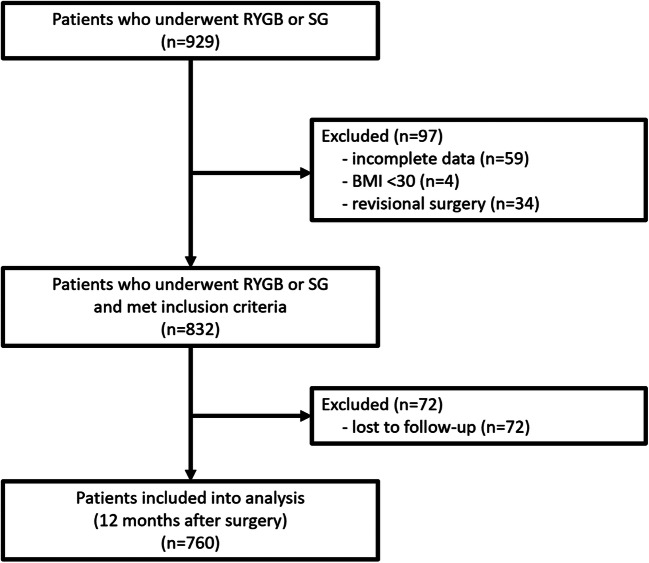
Out of 760 patients enrolled, 509 (67.00%) were women with median age 42 years. Of patients, 65.92% underwent SG and 34.08% had RYGB. Median BMI decreased from 45.19 to 32.53kg/m after 1 year. EWL amounted to 62.97%. All models presented significant relationship between predicted and observed BMI in linear regression (correlation coefficient between 0.29 and 1.22). The best predictive model explained 24% variation of weight reduction (adjusted R=0.24). Majority of models overestimated outcome with SE 5.03 to 5.13kg/m.
Although predicted BMI had reasonable correlation with observed values, none of evaluated models presented acceptable accuracy. All models tend to overestimate the outcome. Accurate tool for weight loss prediction should be developed to enhance patient's assessment.
减重手术是治疗肥胖症最有效的方法。患者的减重效果因人而异,并非所有人都能达到预期效果。确定减重手术的减重预测因素,可导致提出了几种预测工具。我们旨在验证目前用于预测减重手术后 1 年体重减轻的预测模型的性能。
回顾性分析包括接受 Roux-en-Y 胃旁路术(RYGB)或袖状胃切除术(SG)并完成 1 年随访的患者。为每位患者计算 12 种模型预测的术后体重指数(BMI)。使用线性回归评估预测 BMI 与观察 BMI 之间的相关性。通过平方 Pearson 相关系数(R)评估准确性。通过估计 BMI 和观察 BMI 之间的标准误差(SE)和配对样本 t 检验评估拟合优度。
共纳入 760 例患者,其中 509 例(67.00%)为女性,中位年龄为 42 岁。65.92%的患者行 SG,34.08%的患者行 RYGB。术后 1 年 BMI 从 45.19kg/m2 降至 32.53kg/m2。EWL 达到 62.97%。所有模型在线性回归中均显示预测 BMI 与观察 BMI 之间存在显著关系(相关系数为 0.29 至 1.22)。最佳预测模型解释了减重变化的 24%(调整 R=0.24)。大多数模型的 SE 为 5.03 至 5.13kg/m,结果高估。
尽管预测 BMI 与观察值具有合理的相关性,但评估的模型中没有一个具有可接受的准确性。所有模型都倾向于高估结果。应开发准确的体重减轻预测工具,以增强对患者的评估。