Mugge Rachel L, Salerno Jennifer L, Hamdan Leila J
Division of Coastal Sciences, School of Ocean Science and Engineering, University of Southern Mississippi, Ocean Springs, MS, United States.
Department of Environmental Science and Policy, George Mason University, Fairfax, VA, United States.
Front Microbiol. 2021 Feb 25;12:636054. doi: 10.3389/fmicb.2021.636054. eCollection 2021.
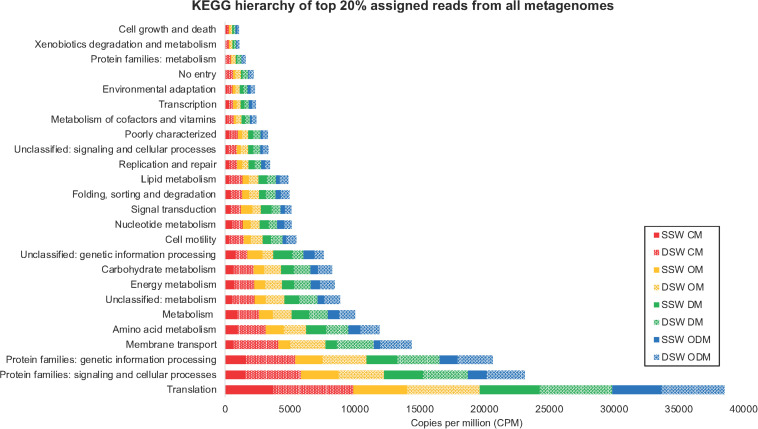
Marine biofilms are essential biological components that transform built structures into artificial reefs. Anthropogenic contaminants released into the marine environment, such as crude oil and chemical dispersant from an oil spill, may disrupt the diversity and function of these foundational biofilms. To investigate the response of marine biofilm microbiomes from distinct environments to contaminants and to address microbial functional response, biofilm metagenomes were analyzed from two short-term microcosms, one using surface seawater (SSW) and the other using deep seawater (DSW). Following exposure to crude oil, chemical dispersant, and dispersed oil, taxonomically distinct communities were observed between microcosms from different source water challenged with the same contaminants and higher Shannon diversity was observed in SSW metagenomes. , , , and phylotypes contributed to driving community differences between SSW and DSW. SSW metagenomes were dominated by Rhodobacteraceae, known biofilm-formers, and DSW metagenomes had the highest abundance of , associated with hydrocarbon degradation and biofilm formation. Association of source water metadata with treatment groups revealed that control biofilms (no contaminant) harbor the highest percentage of significant KEGG orthologs (KOs). While 70% functional similarity was observed among all metagenomes from both experiments, functional differences between SSW and DSW metagenomes were driven primarily by membrane transport KOs, while functional similarities were attributed to translation and signaling and cellular process KOs. Oil and dispersant metagenomes were 90% similar to each other in their respective experiments, which provides evidence of functional redundancy in these microbiomes. When interrogating microbial functional redundancy, it is crucial to consider how composition and function evolve in tandem when assessing functional responses to changing environmental conditions within marine biofilms. This study may have implications for future oil spill mitigation strategies at the surface and at depth and also provides information about the microbiome functional responses of biofilms on steel structures in the marine built environment.
海洋生物膜是将建筑结构转变为人工鱼礁的重要生物组成部分。释放到海洋环境中的人为污染物,如石油泄漏中的原油和化学分散剂,可能会破坏这些基础生物膜的多样性和功能。为了研究不同环境下海洋生物膜微生物群对污染物的反应,并探讨微生物的功能反应,我们从两个短期微观世界分析了生物膜宏基因组,一个使用表层海水(SSW),另一个使用深层海水(DSW)。在接触原油、化学分散剂和分散油后,在受到相同污染物挑战的不同源水的微观世界之间观察到分类学上不同的群落,并且在SSW宏基因组中观察到更高的香农多样性。 、 、 和 系统发育型有助于推动SSW和DSW之间的群落差异。SSW宏基因组以红杆菌科为主,红杆菌科是已知的生物膜形成者,而DSW宏基因组中 丰度最高, 与碳氢化合物降解和生物膜形成有关。源水元数据与处理组的关联表明,对照生物膜(无污染物)含有最高比例的显著KEGG直系同源物(KOs)。虽然在两个实验的所有宏基因组中观察到70%的功能相似性,但SSW和DSW宏基因组之间的功能差异主要由膜转运KOs驱动,而功能相似性归因于翻译以及信号传导和细胞过程KOs。在各自的实验中,油和分散剂宏基因组彼此相似性为90%,这为这些微生物群中的功能冗余提供了证据。在研究微生物功能冗余时,在评估海洋生物膜内对不断变化的环境条件的功能反应时,考虑组成和功能如何协同进化至关重要。这项研究可能对未来表层和深层的溢油缓解策略有影响,也提供了有关海洋建筑环境中钢结构上生物膜的微生物群功能反应的信息。