• 文献检索
  • 文档翻译
  • 深度研究
  • 学术资讯
  • Suppr Zotero 插件Zotero 插件
  • 邀请有礼
  • 套餐&价格
  • 历史记录
应用&插件
Suppr Zotero 插件Zotero 插件浏览器插件Mac 客户端Windows 客户端微信小程序
定价
高级版会员购买积分包购买API积分包
服务
文献检索文档翻译深度研究API 文档MCP 服务
关于我们
关于 Suppr公司介绍联系我们用户协议隐私条款
关注我们

Suppr 超能文献

核心技术专利:CN118964589B侵权必究
粤ICP备2023148730 号-1Suppr @ 2026

文献检索

告别复杂PubMed语法,用中文像聊天一样搜索,搜遍4000万医学文献。AI智能推荐,让科研检索更轻松。

立即免费搜索

文件翻译

保留排版,准确专业,支持PDF/Word/PPT等文件格式,支持 12+语言互译。

免费翻译文档

深度研究

AI帮你快速写综述,25分钟生成高质量综述,智能提取关键信息,辅助科研写作。

立即免费体验

神经血管血脑屏障的异质细胞球体作为个性化纳米神经医学的平台。

Heterocellular spheroids of the neurovascular blood-brain barrier as a platform for personalized nanoneuromedicine.

作者信息

Kumarasamy Murali, Sosnik Alejandro

机构信息

Laboratory of Pharmaceutical Nanomaterials Science, Department of Materials Science and Engineering, Technion-Israel Institute of Technology, De-Jur Bldg. Office 607, Technion City, 3200003 Haifa, Israel.

出版信息

iScience. 2021 Feb 12;24(3):102183. doi: 10.1016/j.isci.2021.102183. eCollection 2021 Mar 19.

DOI:10.1016/j.isci.2021.102183
PMID:33718835
原文链接:https://pmc.ncbi.nlm.nih.gov/articles/PMC7921813/
Abstract

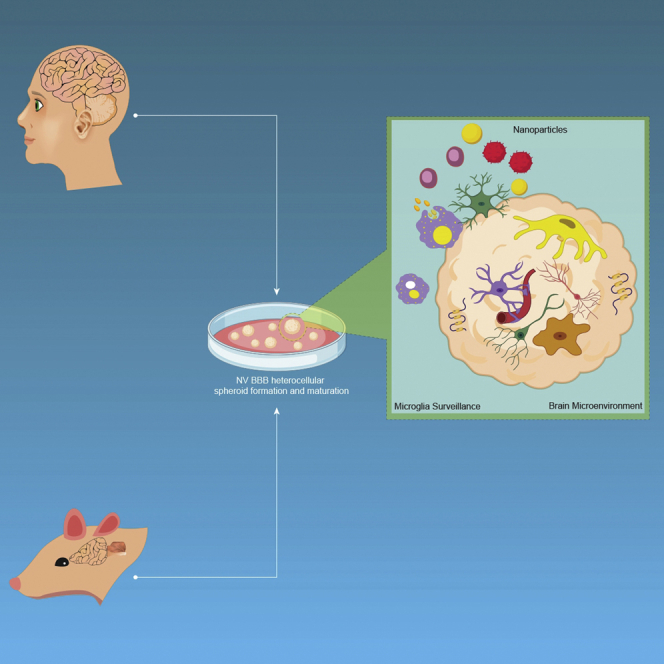
Nanoneuromedicine investigates nanotechnology to target the brain and treat neurological diseases. In this work, we biofabricated heterocellular spheroids comprising human brain microvascular endothelial cells, brain vascular pericytes and astrocytes combined with primary cortical neurons and microglia isolated from neonate rats. The structure and function are characterized by confocal laser scanning and light sheet fluorescence microscopy, electron microscopy, western blotting, and RNA sequencing. The spheroid bulk is formed by neural cells and microglia and the surface by endothelial cells and they upregulate key structural and functional proteins of the blood-brain barrier. These cellular constructs are utilized to preliminary screen the permeability of polymeric, metallic, and ceramic nanoparticles (NPs). Findings reveal that penetration and distribution patterns depend on the NP type and that microglia would play a key role in this pathway, highlighting the promise of this platform to investigate the interaction of different nanomaterials with the central nervous system in nanomedicine, nanosafety and nanotoxicology.

摘要

纳米神经医学研究利用纳米技术靶向大脑并治疗神经疾病。在这项工作中,我们生物制造了异细胞球体,其包含人脑血管内皮细胞、脑血管周细胞和星形胶质细胞,并结合了从新生大鼠分离的原代皮质神经元和小胶质细胞。通过共聚焦激光扫描和光片荧光显微镜、电子显微镜、蛋白质免疫印迹和RNA测序对其结构和功能进行了表征。球体主体由神经细胞和小胶质细胞形成,表面由内皮细胞形成,并且它们上调血脑屏障的关键结构和功能蛋白。这些细胞构建体用于初步筛选聚合物、金属和陶瓷纳米颗粒(NP)的渗透性。研究结果表明,穿透和分布模式取决于NP类型,并且小胶质细胞在该途径中起关键作用,突出了该平台在纳米医学、纳米安全性和纳米毒理学中研究不同纳米材料与中枢神经系统相互作用的前景。
https://cdn.ncbi.nlm.nih.gov/pmc/blobs/be6b/7921813/8be5ef428932/gr8.jpg
https://cdn.ncbi.nlm.nih.gov/pmc/blobs/be6b/7921813/1e4f4d186d12/fx1.jpg
https://cdn.ncbi.nlm.nih.gov/pmc/blobs/be6b/7921813/acd40d69b3fa/gr1.jpg
https://cdn.ncbi.nlm.nih.gov/pmc/blobs/be6b/7921813/65cf1175a51e/gr2.jpg
https://cdn.ncbi.nlm.nih.gov/pmc/blobs/be6b/7921813/2e669285eaac/gr3.jpg
https://cdn.ncbi.nlm.nih.gov/pmc/blobs/be6b/7921813/3fb715e554cc/gr4.jpg
https://cdn.ncbi.nlm.nih.gov/pmc/blobs/be6b/7921813/a8e148d7cafd/gr5.jpg
https://cdn.ncbi.nlm.nih.gov/pmc/blobs/be6b/7921813/ca6ca17d6757/gr6.jpg
https://cdn.ncbi.nlm.nih.gov/pmc/blobs/be6b/7921813/9924e8841c61/gr7.jpg
https://cdn.ncbi.nlm.nih.gov/pmc/blobs/be6b/7921813/8be5ef428932/gr8.jpg
https://cdn.ncbi.nlm.nih.gov/pmc/blobs/be6b/7921813/1e4f4d186d12/fx1.jpg
https://cdn.ncbi.nlm.nih.gov/pmc/blobs/be6b/7921813/acd40d69b3fa/gr1.jpg
https://cdn.ncbi.nlm.nih.gov/pmc/blobs/be6b/7921813/65cf1175a51e/gr2.jpg
https://cdn.ncbi.nlm.nih.gov/pmc/blobs/be6b/7921813/2e669285eaac/gr3.jpg
https://cdn.ncbi.nlm.nih.gov/pmc/blobs/be6b/7921813/3fb715e554cc/gr4.jpg
https://cdn.ncbi.nlm.nih.gov/pmc/blobs/be6b/7921813/a8e148d7cafd/gr5.jpg
https://cdn.ncbi.nlm.nih.gov/pmc/blobs/be6b/7921813/ca6ca17d6757/gr6.jpg
https://cdn.ncbi.nlm.nih.gov/pmc/blobs/be6b/7921813/9924e8841c61/gr7.jpg
https://cdn.ncbi.nlm.nih.gov/pmc/blobs/be6b/7921813/8be5ef428932/gr8.jpg

相似文献

1
Heterocellular spheroids of the neurovascular blood-brain barrier as a platform for personalized nanoneuromedicine.神经血管血脑屏障的异质细胞球体作为个性化纳米神经医学的平台。
iScience. 2021 Feb 12;24(3):102183. doi: 10.1016/j.isci.2021.102183. eCollection 2021 Mar 19.
2
Ultrasmall gold nanoparticles (2 nm) can penetrate and enter cell nuclei in an in vitro 3D brain spheroid model.超小金纳米颗粒(2纳米)能够在体外三维脑球体模型中穿透并进入细胞核。
Acta Biomater. 2020 Jul 15;111:349-362. doi: 10.1016/j.actbio.2020.04.023. Epub 2020 May 13.
3
The Nose-To-Brain Transport of Polymeric Nanoparticles Is Mediated by Immune Sentinels and Not by Olfactory Sensory Neurons.聚合物纳米颗粒的鼻-脑转运是由免疫哨兵介导的,而非嗅觉感觉神经元。
Adv Biosyst. 2019 Dec;3(12):e1900123. doi: 10.1002/adbi.201900123. Epub 2019 Sep 25.
4
Light sheet fluorescence microscopy versus confocal microscopy: in quest of a suitable tool to assess drug and nanomedicine penetration into multicellular tumor spheroids.光片荧光显微镜与共聚焦显微镜:寻找合适的工具评估药物和纳米药物渗透入多细胞肿瘤球体。
Eur J Pharm Biopharm. 2019 Sep;142:195-203. doi: 10.1016/j.ejpb.2019.06.019. Epub 2019 Jun 20.
5
Distribution of SiO nanoparticles in 3D liver microtissues.SiO 纳米颗粒在 3D 肝微组织中的分布。
Int J Nanomedicine. 2019 Feb 22;14:1411-1431. doi: 10.2147/IJN.S189888. eCollection 2019.
6
Transport of ultrasmall gold nanoparticles (2 nm) across the blood-brain barrier in a six-cell brain spheroid model.六细胞脑球体模型中 2nm 超小金纳米颗粒的血脑屏障转运。
Sci Rep. 2020 Oct 22;10(1):18033. doi: 10.1038/s41598-020-75125-2.
7
Assembly of Human Stem Cell-Derived Cortical Spheroids and Vascular Spheroids to Model 3-D Brain-like Tissues.人干细胞来源的皮质球体和血管球体的组装,以模拟 3D 类脑组织。
Sci Rep. 2019 Apr 12;9(1):5977. doi: 10.1038/s41598-019-42439-9.
8
Nanoparticles Penetrate into the Multicellular Spheroid-on-Chip: Effect of Surface Charge, Protein Corona, and Exterior Flow.纳米颗粒穿透多细胞球芯片:表面电荷、蛋白冠和外部流动的影响。
Mol Pharm. 2017 Dec 4;14(12):4618-4627. doi: 10.1021/acs.molpharmaceut.7b00726. Epub 2017 Nov 13.
9
Investigation of heterocellular features of the mouse retinal neurovascular unit by 3D electron microscopy.利用 3D 电子显微镜研究小鼠视网膜神经血管单元的异细胞特征。
J Anat. 2023 Aug;243(2):245-257. doi: 10.1111/joa.13721. Epub 2022 Jul 16.
10
Blood-brain-barrier spheroids as an in vitro screening platform for brain-penetrating agents.血脑屏障球体作为一种用于穿透血脑屏障药物的体外筛选平台。
Nat Commun. 2017 Jun 6;8:15623. doi: 10.1038/ncomms15623.

引用本文的文献

1
Barrier genes are associated with preterm birth.屏障基因与早产有关。
Front Med (Lausanne). 2025 Jun 23;12:1580877. doi: 10.3389/fmed.2025.1580877. eCollection 2025.
2
Multiscale Organization of Neural Networks in a 3D Bioprinted Matrix.3D生物打印基质中神经网络的多尺度组织
Adv Sci (Weinh). 2025 Aug;12(30):e04455. doi: 10.1002/advs.202504455. Epub 2025 May 28.
3
Nanotechnology to Overcome Blood-Brain Barrier Permeability and Damage in Neurodegenerative Diseases.纳米技术克服神经退行性疾病中的血脑屏障通透性及损伤

本文引用的文献

1
The Right Stuff: On the Future of Nanotoxicology.正确的特质:论纳米毒理学的未来
Front Toxicol. 2019 Nov 26;1:1. doi: 10.3389/ftox.2019.00001. eCollection 2019.
2
Olfactory transmucosal SARS-CoV-2 invasion as a port of central nervous system entry in individuals with COVID-19.COVID-19 患者中嗅黏膜 SARS-CoV-2 入侵作为中枢神经系统进入的途径。
Nat Neurosci. 2021 Feb;24(2):168-175. doi: 10.1038/s41593-020-00758-5. Epub 2020 Nov 30.
3
Mixed Amphiphilic Polymeric Nanoparticles of Chitosan, Poly(vinyl alcohol) and Poly(methyl methacrylate) for Intranasal Drug Delivery: A Preliminary In Vivo Study.
Pharmaceutics. 2025 Feb 20;17(3):281. doi: 10.3390/pharmaceutics17030281.
4
Generation of Advanced Blood-Brain Barrier Spheroids Using Human-Induced Pluripotent Stem Cell-Derived Brain Capillary Endothelial-Like Cells.利用人诱导多能干细胞衍生的脑微血管内皮样细胞生成先进的血脑屏障类器官
Adv Biol (Weinh). 2025 Apr;9(4):e2400442. doi: 10.1002/adbi.202400442. Epub 2025 Feb 6.
5
Blood-Spinal Cord Barrier: Its Role in Spinal Disorders and Emerging Therapeutic Strategies.血脊髓屏障:其在脊髓疾病中的作用及新兴治疗策略
NeuroSci. 2021 Dec 21;3(1):1-27. doi: 10.3390/neurosci3010001. eCollection 2022 Mar.
6
Blood-Brain Barrier-Targeting Nanoparticles: Biomaterial Properties and Biomedical Applications in Translational Neuroscience.血脑屏障靶向纳米颗粒:生物材料特性及其在转化神经科学中的生物医学应用
Pharmaceuticals (Basel). 2024 May 10;17(5):612. doi: 10.3390/ph17050612.
7
Graphene Oxide Nanoparticles and Organoids: A Prospective Advanced Model for Pancreatic Cancer Research.氧化石墨烯纳米粒子和类器官:胰腺癌研究的一种有前景的先进模型。
Int J Mol Sci. 2024 Jan 15;25(2):1066. doi: 10.3390/ijms25021066.
8
Differential transcriptome response of blood brain barrier spheroids to neuroinvasive and .血脑屏障球体对神经侵袭性 和 差异转录组反应
Front Cell Infect Microbiol. 2023 Dec 19;13:1326578. doi: 10.3389/fcimb.2023.1326578. eCollection 2023.
9
Micro/nanosystems for controllable drug delivery to the brain.用于可控药物输送至大脑的微纳系统。
Innovation (Camb). 2023 Nov 27;5(1):100548. doi: 10.1016/j.xinn.2023.100548. eCollection 2024 Jan 8.
10
Multifunctional Nanocarriers for Alzheimer's Disease: Befriending the Barriers.多功能纳米载体治疗阿尔茨海默病:突破障碍。
Mol Neurobiol. 2024 May;61(5):3042-3089. doi: 10.1007/s12035-023-03730-z. Epub 2023 Nov 15.
壳聚糖、聚乙烯醇和聚甲基丙烯酸甲酯混合两亲性聚合物纳米粒经鼻给药的体内初步研究。
Molecules. 2020 Sep 30;25(19):4496. doi: 10.3390/molecules25194496.
4
Somatic cell-derived organoids as prototypes of human epithelial tissues and diseases.体细胞来源的类器官作为人类上皮组织和疾病的模型
Nat Mater. 2021 Feb;20(2):156-169. doi: 10.1038/s41563-020-0754-0. Epub 2020 Aug 17.
5
The Nose-To-Brain Transport of Polymeric Nanoparticles Is Mediated by Immune Sentinels and Not by Olfactory Sensory Neurons.聚合物纳米颗粒的鼻-脑转运是由免疫哨兵介导的,而非嗅觉感觉神经元。
Adv Biosyst. 2019 Dec;3(12):e1900123. doi: 10.1002/adbi.201900123. Epub 2019 Sep 25.
6
Infectivity of human coronavirus in the brain.人类冠状病毒在大脑中的感染性。
EBioMedicine. 2020 Jun;56:102799. doi: 10.1016/j.ebiom.2020.102799. Epub 2020 May 28.
7
Size, shape, and flexibility influence nanoparticle transport across brain endothelium under flow.尺寸、形状和柔韧性会影响纳米颗粒在流动状态下穿过脑内皮的传输。
Bioeng Transl Med. 2019 Dec 26;5(2):e10153. doi: 10.1002/btm2.10153. eCollection 2020 May.
8
Modeling and Targeting Alzheimer's Disease With Organoids.利用类器官对阿尔茨海默病进行建模与靶向研究。
Front Pharmacol. 2020 Mar 31;11:396. doi: 10.3389/fphar.2020.00396. eCollection 2020.
9
In vitro modeling of the neurovascular unit: advances in the field.体外神经血管单元模型:该领域的进展。
Fluids Barriers CNS. 2020 Mar 16;17(1):22. doi: 10.1186/s12987-020-00183-7.
10
Immune cell regulation of glia during CNS injury and disease.中枢神经系统损伤和疾病期间免疫细胞对神经胶质的调控。
Nat Rev Neurosci. 2020 Mar;21(3):139-152. doi: 10.1038/s41583-020-0263-9. Epub 2020 Feb 10.