Omar Othman A M, Elbarkouky Reda A, Ahmed Hamdy M
Physics and Engineering Mathematics Department, Faculty of Engineering, Ain Shams University, Cairo 11517, Egypt.
Higher Institute of Engineering, El-Shorouk Academy, P.O. 3 El-Shorouk City, Cairo, Egypt.
Results Phys. 2021 Apr;23:104018. doi: 10.1016/j.rinp.2021.104018. Epub 2021 Mar 12.
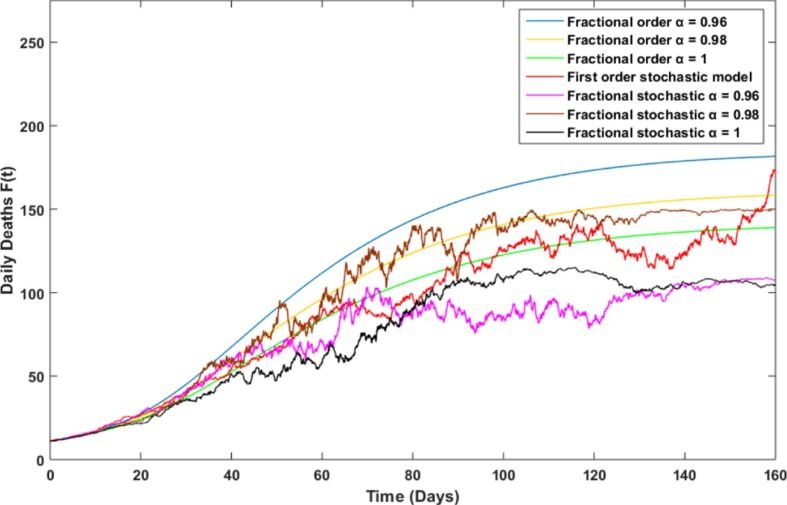
In this paper, COVID-19 dynamics are modelled with three mathematical dynamic models, fractional order modified SEIRF model, stochastic modified SEIRF model, and fractional stochastic modified SEIRF model, to characterize and predict virus behavior. By using Euler method and Euler-Murayama method, the numerical solutions for the considered models are obtained. The considered models are applied to the case study of Egypt to forecast COVID-19 behavior for the second virus wave which is assumed to be started on 15 November 2020. Finally, comparisons between actual and predicted daily infections are presented.
在本文中,利用三个数学动态模型,即分数阶修正SEIRF模型、随机修正SEIRF模型和分数阶随机修正SEIRF模型,对新冠病毒病(COVID-19)动态进行建模,以表征和预测病毒行为。通过使用欧拉方法和欧拉-丸山方法,获得了所考虑模型的数值解。将所考虑的模型应用于埃及的案例研究,以预测假定于2020年11月15日开始的第二波病毒疫情期间的新冠病毒病行为。最后,给出了实际每日感染病例数与预测值之间的比较。