Department of Neurobiology, Care Sciences and Society, Karolinska Institutet, Huddinge, Sweden.
Karolinska University Hospital, Stockholm, Sweden.
Health Expect. 2021 Jun;24(3):905-916. doi: 10.1111/hex.13233. Epub 2021 Mar 17.
Despite intentions to increase user participation in the development of health services, the concept of participation and how it unfolds within studies with a participatory design has rarely been addressed.
The aim of this study was to describe how user participation manifests itself within a co-design process involving patients, significant others and health-care professionals, including potential enablers or barriers.
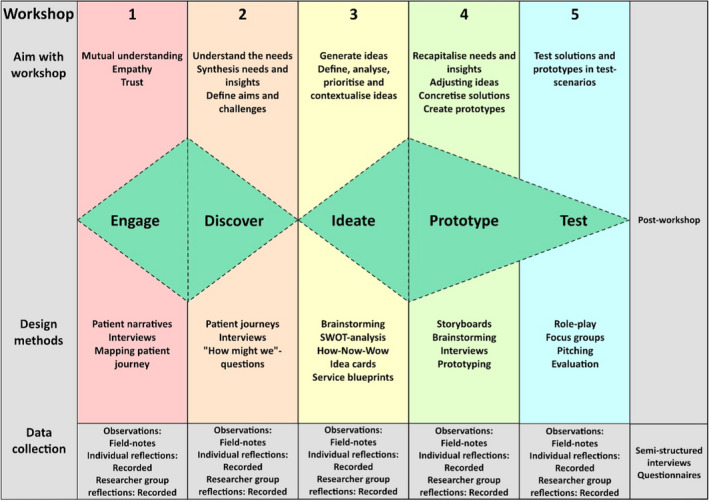
This study was conducted in the context of a co-design process of a new person-centred transition from a hospital to continued rehabilitation in the home involving three patients with stroke, one significant other and 11 professionals. Data were collected by observations during the workshops, semi-structured interviews and questionnaires.
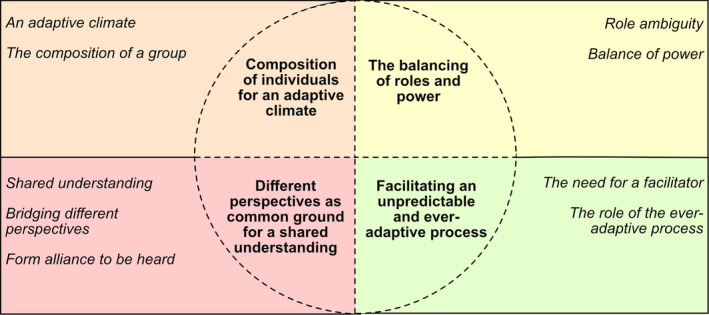
Four categories: 'Composition of individuals for an adaptive climate'; 'The balancing of roles and power'; 'Different perspectives as common ground for a shared understanding'; and 'Facilitating an unpredictable and ever-adaptive process', with all together nine subcategories, resulted from the analysis. Participation varied between individuals, groups and steps within the process, and on the topic of discussions and the motivation to contribute.
DISCUSSION/CONCLUSION: Participation is not something that is realized by only applying participatory design methodology. Participation manifests itself through the interaction of the participants and their skills to handle different perspectives, roles and assignments. Participation is enabled by individual, group and facilitating aspects. Co-design processes should allow for varying levels of participation among the participants and throughout the process.
Patients, significant others and health-care professionals participated as co-designers of a care transition model between hospital and home.
尽管有意图增加用户在卫生服务发展中的参与度,但参与的概念以及它在具有参与式设计的研究中是如何展开的,很少得到解决。
本研究旨在描述用户参与如何在涉及患者、重要他人和医疗保健专业人员的共同设计过程中表现出来,包括潜在的促成因素或障碍。
本研究是在涉及三个中风患者、一个重要他人和 11 名专业人员的新的以患者为中心的从医院到家庭持续康复的共同设计过程的背景下进行的。数据通过研讨会期间的观察、半结构化访谈和问卷调查收集。
从分析中得出了四个类别:“为适应气候组成个体”、“平衡角色和权力”、“不同观点作为共同理解的基础”和“促进不可预测和不断适应的过程”,共九个子类别。参与度在个体、群体和过程中的步骤之间有所不同,也在讨论的主题和贡献的动机上有所不同。
讨论/结论:参与不是通过仅仅应用参与式设计方法就能实现的。参与是通过参与者的互动以及他们处理不同观点、角色和任务的能力表现出来的。参与是由个体、群体和促进因素促成的。共同设计过程应该允许参与者在不同的层面上参与,并贯穿整个过程。
患者、重要他人和医疗保健专业人员作为医院和家庭之间护理过渡模式的共同设计者参与其中。