Andersén Heidi, Kankaanranta Hannu, Tuomisto Leena E, Piirilä Päivi, Sovijärvi Anssi, Langhammer Arnulf, Backman Helena, Lundbäck Bo, Rönmark Eva, Lehtimäki Lauri, Ilmarinen Pinja
Karolinska University Hospital, Thoracic Oncology Unit, Tema Cancer, Stockholm, Sweden.
Faculty of Medicine and Health Technology, Tampere University, Tampere, Finland.
Prev Med Rep. 2021 Feb 23;22:101338. doi: 10.1016/j.pmedr.2021.101338. eCollection 2021 Jun.
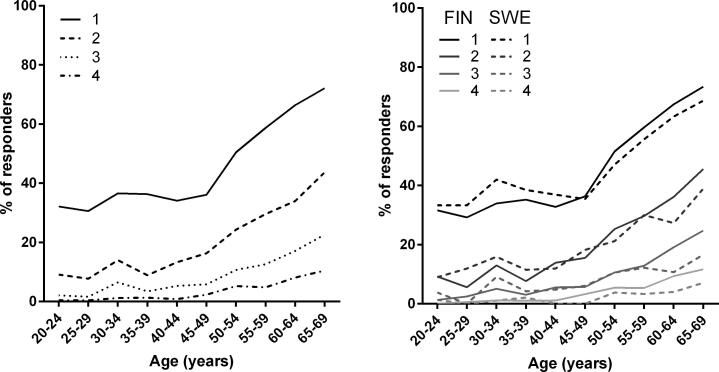
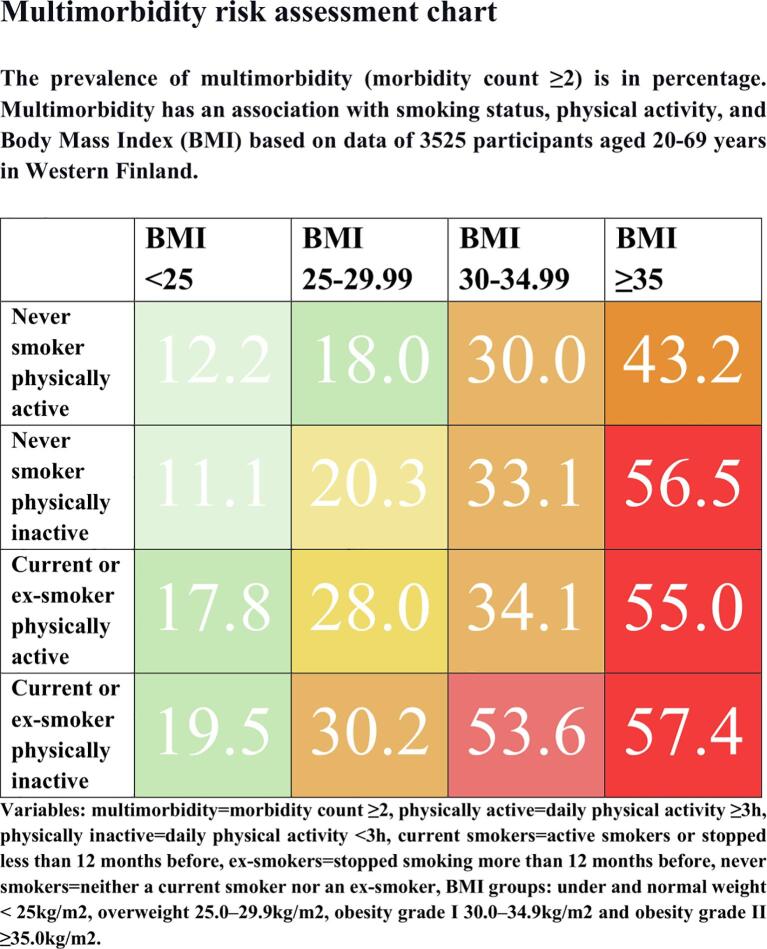
Multimorbidity is an emerging public health priority. This study aims to assess the role of lifestyle and socioeconomic status in the prevalence of multimorbidity and chronic diseases by using two language groups that are part of the same genetic subgroup but differ by daily habits. We conducted a cross-sectional survey in 2016 with randomly selected population sample with 4173 responders (52.3%) aged 20-69 years in Western Finland. We included 3864 Finnish participants with Swedish (28.1%) or Finnish (71.9%) as a native language. We used a questionnaire to assess participants' chronic diseases and lifestyle. We determined multimorbidity as a disease count ≥ 2. Finnish speakers were more likely to have a diagnosis of COPD, heart failure, diabetes, reflux disease, chronic kidney failure, and painful conditions than Swedish speakers. The prevalence of multimorbidity was higher for Finnish speakers in the age group of 60-69 years (41.0% vs. 32.0%, p = 0.018) than Swedish speakers. A higher proportion of Finnish speakers smoked, were obese, inactive, and had lower socioeconomic status compared to Swedish speakers. All these factors, in addition to age and female sex, were significant risk factors for multimorbidity. Prevalence of multimorbidity was different in two language groups living in the same area and was associated with differences in lifestyle factors such as smoking, physical inactivity and obesity.
多病共存是一个新出现的公共卫生重点问题。本研究旨在通过使用属于同一基因亚组但日常习惯不同的两个语言群体,评估生活方式和社会经济地位在多病共存及慢性病患病率中的作用。2016年,我们在芬兰西部对随机抽取的4173名年龄在20至69岁之间的人群样本进行了横断面调查。我们纳入了3864名以瑞典语(28.1%)或芬兰语(71.9%)为母语的芬兰参与者。我们使用问卷来评估参与者的慢性病和生活方式。我们将多病共存定义为疾病数量≥2种。与说瑞典语的人相比,说芬兰语的人更有可能被诊断患有慢性阻塞性肺疾病、心力衰竭、糖尿病、反流性疾病、慢性肾衰竭和疼痛性疾病。在60至69岁年龄组中,说芬兰语的人的多病共存患病率(41.0%对32.0%,p = 0.018)高于说瑞典语的人。与说瑞典语的人相比,说芬兰语的人吸烟、肥胖、不活动的比例更高,且社会经济地位更低。除年龄和女性性别外,所有这些因素都是多病共存的重要危险因素。生活在同一地区的两个语言群体的多病共存患病率不同,且与吸烟、身体不活动和肥胖等生活方式因素的差异有关。