ETH Laboratory for Functional Immune Repertoire Analysis, Institute of Pharmaceutical Sciences, D-CHAB, ETH Zürich, Zürich, Switzerland.
Eur J Immunol. 2021 Jun;51(6):1334-1347. doi: 10.1002/eji.202048976. Epub 2021 Apr 1.
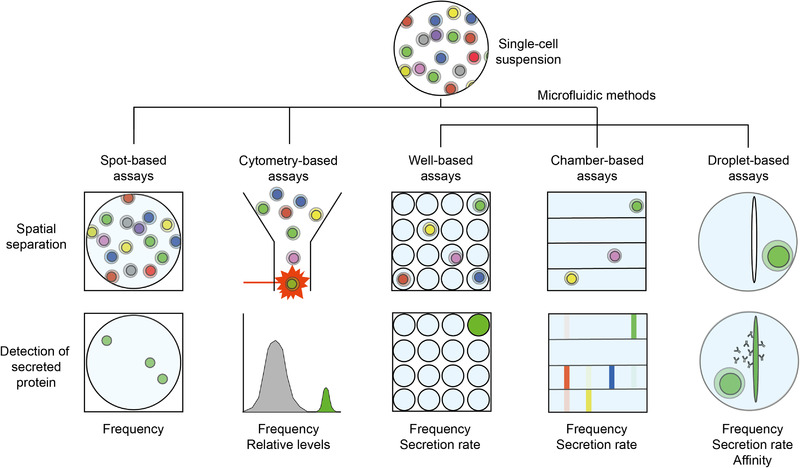
The dynamics, nature, strength, and ultimately protective capabilities of an active immune response are determined by the extracellular constitution and concentration of various soluble factors. Generated effector cells secrete such mediators, including antibodies, chemo- and cytokines to achieve functionality. These secreted factors organize the individual immune cells into functional tissues, initiate, orchestrate, and regulate the immune response. Therefore, a single-cell resolved analysis of protein secretion is a valuable tool for studying the heterogeneity and functionality of immune cells. This review aims to provide a comparative overview of various methods to characterize immune reactions by measuring single-cell protein secretion. Spot-based and cytometry-based assays, such as ELISpot and flow cytometry, respectively, are well-established methods applied in basic research and clinical settings. Emerging novel technologies, such as microfluidic platforms, offer new ways to measure and exploit protein secretion in immune reactions. Further technological advances will allow the deciphering of protein secretion in immunological responses with unprecedented detail, linking secretion to functionality. Here, we summarize the development and recent advances of tools that allow the analysis of protein secretion at the single-cell level, and discuss and contrast their applications within immunology.
各种可溶性因子的细胞外构成和浓度决定了主动免疫反应的动态性、性质、强度和最终保护能力。产生的效应细胞会分泌包括抗体、趋化因子和细胞因子在内的此类介质来实现其功能。这些分泌因子将单个免疫细胞组织成具有功能的组织,启动、协调和调节免疫反应。因此,单细胞水平上的蛋白分泌分析是研究免疫细胞异质性和功能的有力工具。本综述旨在比较各种通过测量单细胞蛋白分泌来描述免疫反应的方法。基于斑点和基于细胞计数的检测方法,如 ELISpot 和流式细胞术,分别是应用于基础研究和临床环境中的成熟方法。新兴的新技术,如微流控平台,为测量和利用免疫反应中的蛋白分泌提供了新的途径。进一步的技术进步将使人们能够以前所未有的细节解析免疫反应中的蛋白分泌,并将其与功能联系起来。在这里,我们总结了允许在单细胞水平上分析蛋白分泌的工具的发展和最新进展,并讨论和对比了它们在免疫学中的应用。