Department of Internal Medicine, Seoul National University College of Medicine, Seoul Metropolitan Government Seoul National University Boramae Medical Center, Seoul, Republic of Korea.
Health Care Center, Seoul Metropolitan Government Seoul National University Boramae Medical Center, Seoul, Republic of Korea.
PLoS One. 2021 Mar 19;16(3):e0248856. doi: 10.1371/journal.pone.0248856. eCollection 2021.
Metabolic syndrome (MetS) increases the risk of diabetes mellitus (DM), cardiovascular disease (CVD), cancer, and mortality. Sarcopenia has been reported as a risk factor for MetS, non-alcoholic fatty liver disease, and CVD. To date, the association between sarcopenia and MetS has been investigated. However, there have been few studies on the dose-response relationship between sarcopenia and MetS. We investigated the association between sarcopenia and the prevalence of MetS. We also aimed to analyze the dose-response relationship between skeletal muscle mass and the prevalence of MetS.
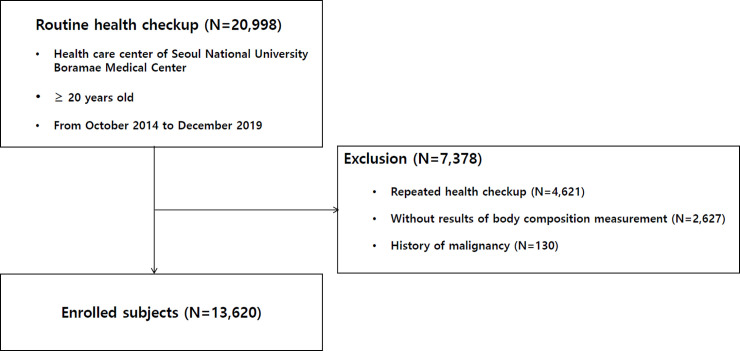
We enrolled 13,620 participants from October 2014 to December 2019. Skeletal muscle mass was measured using bioelectrical impedance analysis (BIA). Appendicular skeletal muscle mass (ASM) was divided by body weight (kg) and was expressed as a percentage (ASM x 100/Weight, ASM%). The quartiles of ASM% were calculated for each gender, with Q1 and Q4 being the lowest and highest quartiles of ASM%, respectively. The quartiles of ASM% were calculated for each gender, with Q1 and Q4 being the lowest and highest quartiles of ASM%, respectively. Linear regression and logistic regression analyses were used to compare the clinical parameters according to ASM%, adjusted for age, sex, obesity, hypertension (HT), DM, dyslipidemia (DL), smoking, alcohol intake, and C-reactive protein (CRP). Multiple logistic regression analysis was performed to determine the risk of MetS in each group.
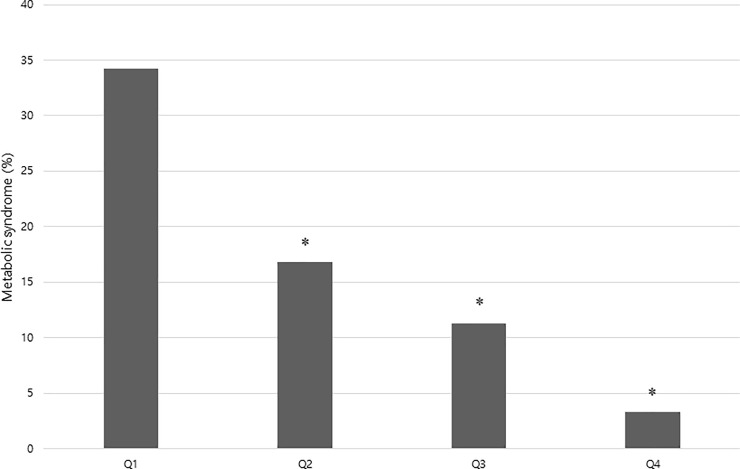
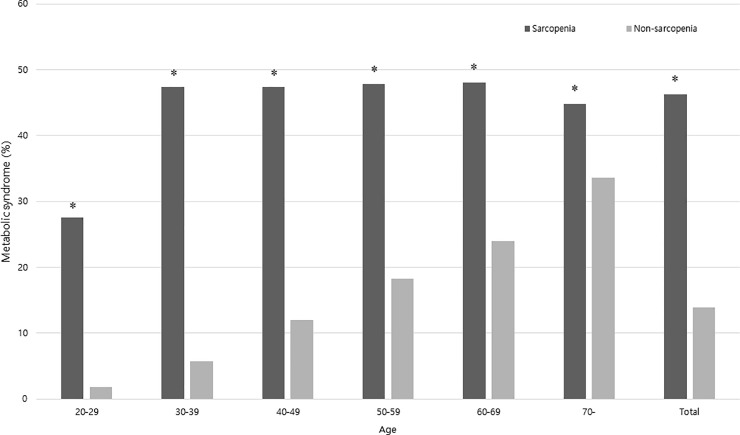
A dose-response relationship was identified between ASM% and MetS. Sarcopenia was associated with an increased prevalence of MetS. After adjustment for age, sex, obesity, HT, DM, DL, smoking, alcohol intake, and CRP, sarcopenia remained significantly associated with MetS. For each 1 quartile increment in ASM%, the risk of MetS decreased by 56% (P< 0.001). After adjusting for age, sex, obesity, HT, DM, DL, smoking, alcohol intake, and CRP, the risk of MetS decreased by 25% per 1Q increment in ASM% (P < 0.001).
Sarcopenia by BIA is independently associated with the risk of MetS and has a dose-response relationship.
代谢综合征(MetS)会增加糖尿病(DM)、心血管疾病(CVD)、癌症和死亡率的风险。肌肉减少症已被报道为 MetS、非酒精性脂肪性肝病和 CVD 的危险因素。迄今为止,已经有研究调查了肌肉减少症与 MetS 之间的关系。然而,关于肌肉减少症与 MetS 之间的剂量-反应关系的研究较少。我们调查了肌肉减少症与 MetS 患病率之间的关系。我们还旨在分析骨骼肌质量与 MetS 患病率之间的剂量-反应关系。
我们于 2014 年 10 月至 2019 年 12 月期间纳入了 13620 名参与者。使用生物电阻抗分析(BIA)测量骨骼肌质量。四肢骨骼肌质量(ASM)除以体重(kg),并表示为百分比(ASM x 100/体重,ASM%)。根据性别计算 ASM%的四分位数,Q1 和 Q4 分别为 ASM%的最低和最高四分位数。根据性别计算 ASM%的四分位数,Q1 和 Q4 分别为 ASM%的最低和最高四分位数。使用线性回归和逻辑回归分析比较了根据 ASM%调整年龄、性别、肥胖、高血压(HT)、糖尿病(DM)、血脂异常(DL)、吸烟、饮酒和 C 反应蛋白(CRP)后的临床参数。进行多因素逻辑回归分析,以确定每组 MetS 的风险。
ASM%与 MetS 之间存在剂量-反应关系。肌肉减少症与 MetS 患病率增加有关。在调整年龄、性别、肥胖、HT、DM、DL、吸烟、饮酒和 CRP 后,肌肉减少症与 MetS 仍然显著相关。每增加 1 个四分位距,MetS 的风险降低 56%(P<0.001)。在调整年龄、性别、肥胖、HT、DM、DL、吸烟、饮酒和 CRP 后,ASM%每增加 1Q,MetS 的风险降低 25%(P<0.001)。
通过 BIA 评估的肌肉减少症与 MetS 的风险独立相关,且具有剂量-反应关系。