Guangdong Eye Institute, Department of Ophthalmology, Guangdong Provincial People's Hospital, Guangdong Academy of Medical Sciences.
Shantou University Medical College.
J Atheroscler Thromb. 2022 May 1;29(5):579-596. doi: 10.5551/jat.62059. Epub 2021 Mar 19.
To develop and validate a nomogram using retinal vasculature features and clinical variables to predict coronary artery disease (CAD) in patients with suspected angina.
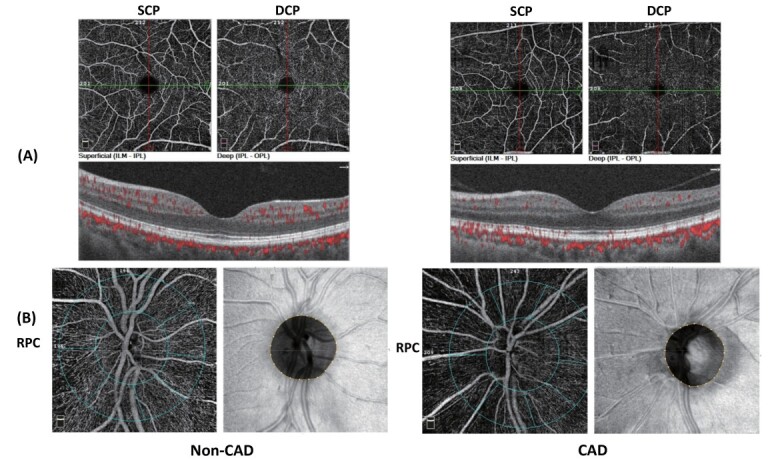
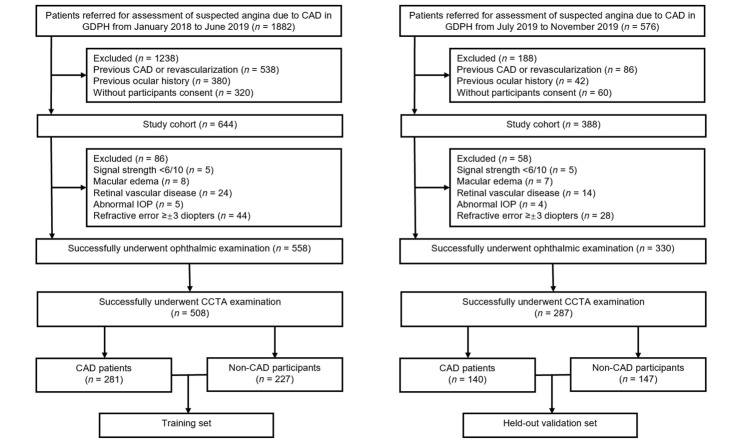
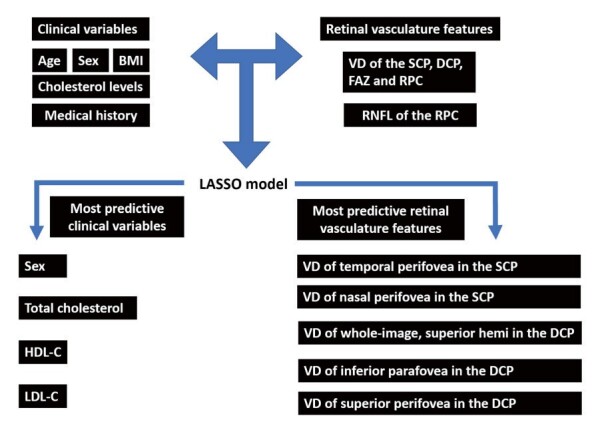
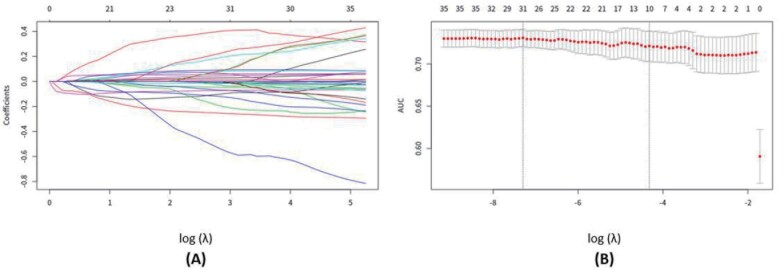
The prediction model consisting of 795 participants was developed in a training set of 508 participants with suspected angina due to CAD, and data were collected from January 2018 to June 2019. The held-out validation was conducted with 287 consecutive patients from July 2019 to November 2019. All patients with suspected CAD received optical coherence tomography angiography (OCTA) examination before undergoing coronary CT angiography. LASSO regression model was used for data reduction and feature selection. Multivariable logistic regression analysis was used to develop the retinal vasculature model for predicting the probability of the presence of CAD.
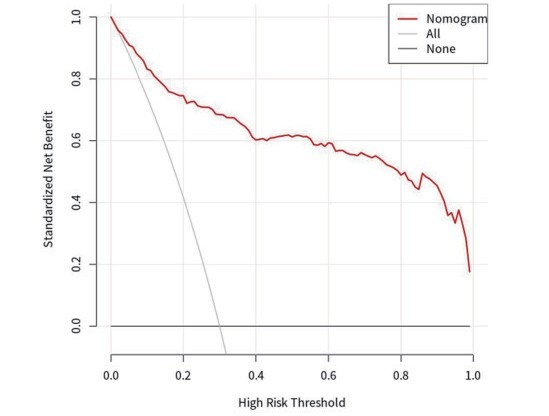
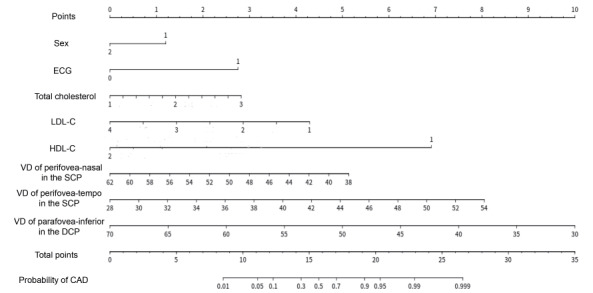
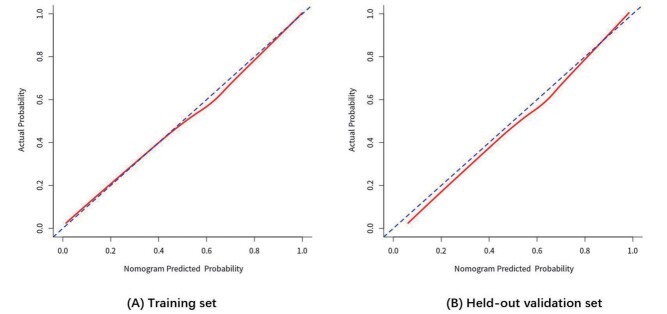
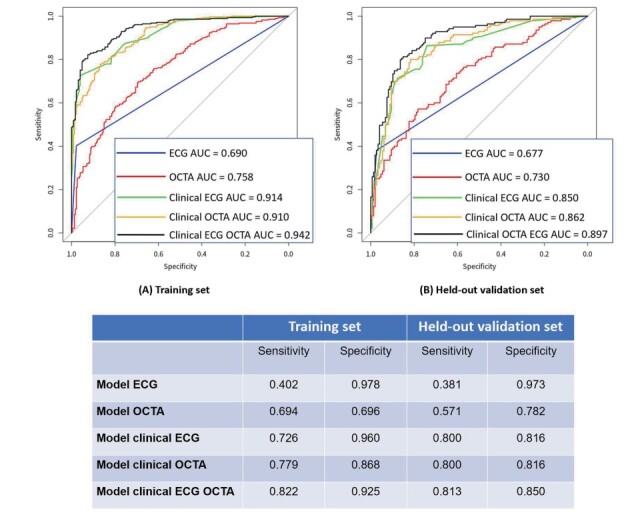
Three potential OCTA parameters including vessel density of the nasal and temporal perifovea in the superficial capillary plexus and vessel density of the inferior parafovea in the deep capillary plexus were further selected as independent retinal vasculature predictors. Model clinical electrocardiogram (ECG) OCTA (clinical variables+ECG+OCTA) was presented as the individual prediction nomogram, with good discrimination (AUC of 0.942 [95% CI, 0.923-0.961] and 0.897 [95% CI, 0.861-0.933] in the training and held-out validation sets, respectively) and good calibration. Decision curve analysis indicated the clinical applicability of this retinal vasculature nomogram.
The presented retinal vasculature nomogram based on individual probability can accurately identify the presence of CAD, which could improve patient selection and diagnostic yield of aggressive testing before determining a diagnosis.
利用视网膜血管特征和临床变量开发并验证一个列线图,以预测疑似心绞痛患者的冠状动脉疾病(CAD)。
该预测模型由 795 名参与者组成,其中 508 名参与者因 CAD 导致疑似心绞痛,数据收集于 2018 年 1 月至 2019 年 6 月。2019 年 7 月至 11 月,连续 287 名疑似 CAD 的患者进行了保留验证。所有疑似 CAD 的患者均在接受冠状动脉 CT 血管造影前接受了光学相干断层扫描血管造影(OCTA)检查。LASSO 回归模型用于数据缩减和特征选择。多变量逻辑回归分析用于开发预测 CAD 存在概率的视网膜血管模型。
选择了三个潜在的 OCTA 参数,包括浅层毛细血管丛鼻侧和颞侧的血管密度以及深层毛细血管丛下旁中心凹的血管密度,作为独立的视网膜血管预测因子。模型临床心电图(ECG)OCTA(临床变量+ECG+OCTA)被呈现为个体预测列线图,具有良好的判别能力(在训练集和保留验证集中的 AUC 分别为 0.942[95%CI,0.923-0.961]和 0.897[95%CI,0.861-0.933])和良好的校准度。决策曲线分析表明了该视网膜血管列线图的临床适用性。
该列线图基于个体概率,可以准确识别 CAD 的存在,这可以改善诊断前确定诊断时的患者选择和积极检测的诊断收益。