Department of Digital Health Research, Division of Medicine, Oslo University Hospital, Pb 4950 Nydalen, N-0424, Oslo, Norway.
Faculty of Health and Social Sciences, University of South-Eastern Norway, Drammen, Norway.
BMC Nephrol. 2021 Mar 22;22(1):105. doi: 10.1186/s12882-021-02284-3.
Renal transplant recipients have to see a nephrologist for regular follow-up for the rest of their lives. To reduce the burden for the patients, video consultation can be an alternative to traditional in-person hospital consultations. The aim of the current study was, from the perspectives of patients and health care providers, to investigate the perceived benefits and challenges of using video consultations in outpatient renal transplant recipient follow-up.
Patients (i.e., renal transplant recipients; n = 18) alternated between regular in-person follow-up consultations and video consultations. Patients and health care providers were then invited to participate in semi-structured interviews. The interviews were analyzed using thematic analysis.
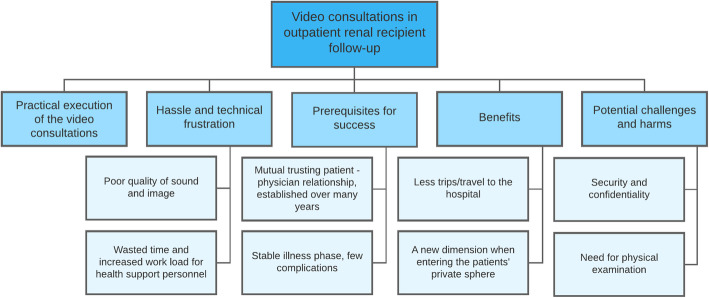
Patients interviewed (n = 15) were median 53 years old (range 37-64) and 53% female. The video consultation solution used in the study turned out to have major technical deficiencies. Despite the technical challenges, however, the majority of the patients reported appreciating being able to alternate between video and in-person hospital consultations. Main benefits reported included not needing to travel to the hospital and thereby saving time, less focus on being chronically ill and potential economic benefits for patients and society. The health care providers (n = 3) also valued the benefits provided by the use of video consultations, but described the reoccurring technical challenges as disruptive. The fact that patients were in a stable phase of their health condition and already had an established, trusting relationship with their nephrologist, acted as facilitators for success. Possible challenges and harms described included concerns related to security, confidentiality and interruptions, as well as the potential need for physical examinations.
Benefits from using video consultations as an alternative to in-person consultations may outweigh potential technological challenges for patients as well as health care providers. A long-lasting mutually trusting relationship between patient and provider may be an important prerequisite for the experienced benefits of using video consultation. Findings also indicate that starting such care delivery changes in a small-scale, with a few selected patients in a stable phase of their condition, may be an important factor for success.
肾移植受者需要在余生中定期看肾病医生进行随访。为了减轻患者的负担,视频咨询可以作为传统门诊咨询的替代方案。本研究旨在从患者和医疗保健提供者的角度,调查在门诊肾移植受者随访中使用视频咨询的感知益处和挑战。
患者(即肾移植受者;n=18)在定期门诊随访和视频咨询之间交替进行。然后邀请患者和医疗保健提供者参加半结构化访谈。使用主题分析对访谈进行分析。
接受采访的患者(n=15)的年龄中位数为 53 岁(范围 37-64 岁),其中 53%为女性。研究中使用的视频咨询解决方案存在重大技术缺陷。然而,尽管存在技术挑战,但大多数患者报告说,他们很欣赏能够在视频和门诊医院咨询之间交替进行。报告的主要益处包括无需前往医院,从而节省时间、减少对慢性疾病的关注以及对患者和社会的潜在经济益处。医疗保健提供者(n=3)也重视使用视频咨询带来的好处,但描述了反复出现的技术挑战会带来干扰。患者处于健康状况稳定阶段,并且已经与他们的肾病医生建立了稳定、信任的关系,这是成功的促进因素。描述的可能挑战和危害包括与安全性、保密性和中断相关的担忧,以及对身体检查的潜在需求。
对于患者和医疗保健提供者来说,使用视频咨询作为门诊咨询的替代方案的益处可能超过潜在的技术挑战。患者和提供者之间持久的相互信任关系可能是使用视频咨询体验益处的重要前提。研究结果还表明,从小规模开始,选择一些处于稳定状态的患者进行这种护理交付的改变,可能是成功的重要因素。