Health Services Management Centre, Park House, University of Birmingham, Birmingham, B15 2RT, UK.
Sociology and Social Policy Department, University of Leeds, Leeds, LS2 9JT, UK.
Syst Rev. 2021 Mar 22;10(1):82. doi: 10.1186/s13643-021-01630-8.
Inter-organisational collaboration is increasingly prominent within contemporary healthcare systems. A range of collaboration types such as alliances, networks, and mergers have been proposed as a means to turnaround organisations, by reducing duplication of effort, enabling resource sharing, and promoting innovations. However, in practice, due to the complexity of the process, such efforts are often rife with difficulty. Notable contributions have sought to make sense of this area; however, further understanding is needed in order to gain a better understanding of why some inter-organisational collaborations work when others do not, to be able to more effectively implement collaborations in the future.
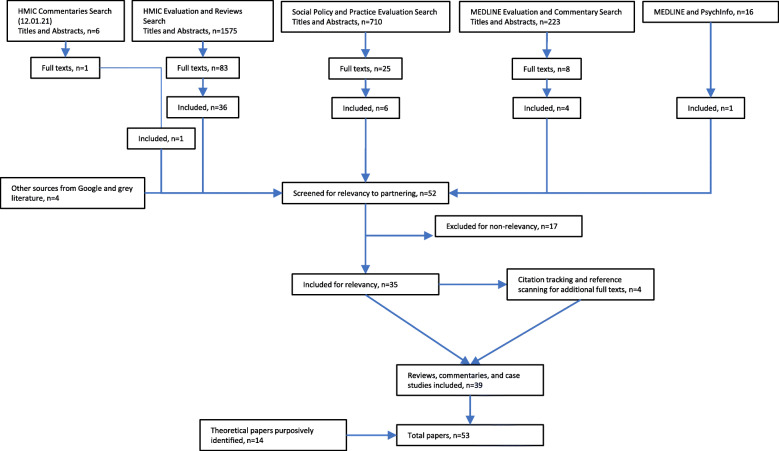
Realist review methodology was used with the intention of formulating context-mechanism-outcome configurations (CMOCs) to explain how inter-organisational collaborations work and why, combining systematic and purposive literature search techniques. The systematic review encompassed searches for reviews, commentaries, opinion pieces, and case studies on HMIC, MEDLINE, PsycINFO, and Social Policy and Practice databases, and further searches were conducted using Google Scholar. Data were extracted from included studies according to relevance to the realist review.
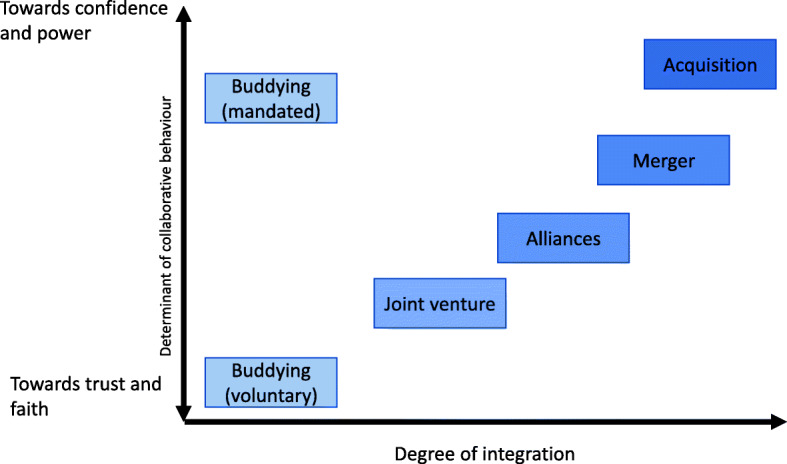
Fifty-three papers were included, informing the development of programme theories of how, why, and when inter-organisational collaborations in healthcare work. Formulation of our programme theories incorporated the concepts of partnership synergy and collaborative inertia and found that it was essential to consider mechanisms underlying partnership functioning, such as building trust and faith in the collaboration to maximise synergy and thus collaborative performance. More integrative or mandated collaboration may lean more heavily on contract to drive collaborative behaviour.
As the first realist review of inter-organisational collaborations in healthcare as an intervention for improvement, this review provides actionable evidence for policymakers and implementers, enhancing understanding of mechanisms underlying the functioning and performing of inter-organisational collaborations, as well as how to configure the context to aid success. Next steps in this research will test the results against further case studies and primary data to produce a further refined theory.
PROSPERO CRD42019149009.
在当代医疗保健系统中,组织间的协作越来越突出。各种合作类型,如联盟、网络和合并,被提议作为一种手段来扭转组织的局面,通过减少重复工作、实现资源共享和促进创新。然而,在实践中,由于过程的复杂性,这些努力往往充满了困难。一些有影响力的研究试图理解这一领域;然而,为了更好地理解为什么有些组织间的合作有效,而有些则无效,以便将来更有效地实施合作,还需要进一步的理解。
采用现实主义审查方法,旨在制定情境-机制-结果配置(CMOC),以解释组织间合作是如何以及为什么起作用的,结合系统和有针对性的文献搜索技术。系统审查涵盖了对 HMIC、MEDLINE、PsycINFO 和社会政策与实践数据库中的评论、评论、观点文章和案例研究的搜索,并使用 Google Scholar 进行了进一步搜索。根据与现实主义审查的相关性,从纳入的研究中提取数据。
纳入了 53 篇论文,为制定关于医疗保健中组织间合作如何、为何以及何时起作用的方案理论提供了信息。我们的方案理论的制定纳入了伙伴关系协同和合作惯性的概念,并发现考虑伙伴关系运作背后的机制至关重要,例如建立对合作的信任和信心,以最大限度地发挥协同作用,从而提高合作绩效。更具整合性或强制性的合作可能更依赖于合同来推动合作行为。
作为对医疗保健中组织间合作作为改进干预措施的首次现实主义审查,本审查为政策制定者和实施者提供了可操作的证据,增强了对组织间合作运作和表现背后机制的理解,以及如何配置情境以促进成功。这项研究的下一步将通过进一步的案例研究和原始数据来检验结果,以产生进一步完善的理论。
PROSPERO CRD42019149009。