Aghdam Shiva Abdollahi, Brown Amanda May Vivian
Department of Biological Sciences, Texas Tech University, 2901 Main St, Lubbock, TX 79409 USA.
Environ Microbiome. 2021 Mar 18;16:6. doi: 10.1186/s40793-021-00375-0. eCollection 2021.
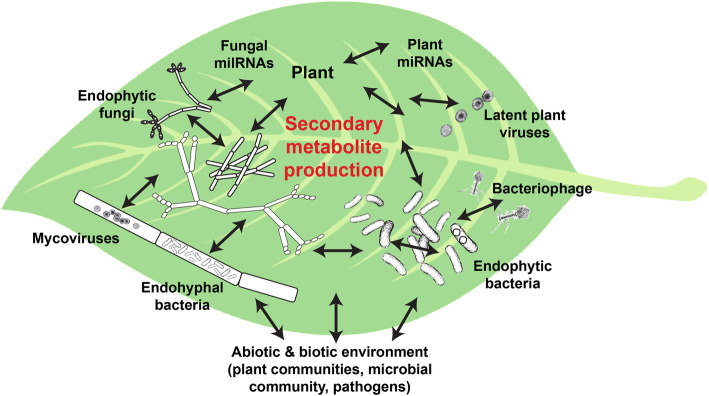
Plant microbiomes are not only diverse, but also appear to host a vast pool of secondary metabolites holding great promise for bioactive natural products and drug discovery. Yet, most microbes within plants appear to be uncultivable, and for those that can be cultivated, their metabolic potential lies largely hidden through regulatory silencing of biosynthetic genes. The recent explosion of powerful interdisciplinary approaches, including multi-omics methods to address multi-trophic interactions and artificial intelligence-based computational approaches to infer distribution of function, together present a paradigm shift in high-throughput approaches to natural product discovery from plant-associated microbes. Arguably, the key to characterizing and harnessing this biochemical capacity depends on a novel, systematic approach to characterize the triggers that turn on secondary metabolite biosynthesis through molecular or genetic signals from the host plant, members of the rich 'in planta' community, or from the environment. This review explores breakthrough approaches for natural product discovery from plant microbiomes, emphasizing the promise of deep learning as a tool for endophyte bioprospecting, endophyte biochemical novelty prediction, and endophyte regulatory control. It concludes with a proposed pipeline to harness global databases (genomic, metabolomic, regulomic, and chemical) to uncover and unsilence desirable natural products.
The online version contains supplementary material available at 10.1186/s40793-021-00375-0.
植物微生物群落不仅种类多样,而且似乎蕴藏着大量次生代谢产物,有望成为生物活性天然产物和药物发现的宝库。然而,植物体内的大多数微生物似乎无法培养,而对于那些能够培养的微生物,其代谢潜力在很大程度上通过生物合成基因的调控沉默而被隐藏。最近,强大的跨学科方法激增,包括用于解决多营养相互作用的多组学方法以及基于人工智能的计算方法来推断功能分布,共同呈现了从植物相关微生物中发现天然产物的高通量方法的范式转变。可以说,表征和利用这种生化能力的关键取决于一种新颖的系统方法,该方法通过来自宿主植物、丰富的“植物内”群落成员或环境的分子或遗传信号来表征开启次生代谢产物生物合成的触发因素。本综述探讨了从植物微生物群落中发现天然产物的突破性方法,强调深度学习作为一种用于内生菌生物勘探、内生菌生化新颖性预测和内生菌调控控制的工具的前景。最后提出了一个利用全球数据库(基因组、代谢组、调控组和化学数据库)来发现和激活所需天然产物的流程。
在线版本包含可在10.1186/s40793-021-00375-0获取的补充材料。