Remtulla Ridhaa, Hagana Arwa, Houbby Nour, Ruparell Kajal, Aojula Nivaran, Menon Anannya, Thavarajasingam Santhosh G, Meyer Edgar
College of Medical and Dental Sciences, University of Birmingham, Birmingham, UK.
Imperial College London, School of Medicine, London, UK.
BMC Health Serv Res. 2021 Mar 24;21(1):269. doi: 10.1186/s12913-021-06232-7.
Psychological safety is the concept by which individuals feel comfortable expressing themselves in a work environment, without fear of embarrassment or criticism from others. Psychological safety in healthcare is associated with improved patient safety outcomes, enhanced physician engagement and fostering a creative learning environment. Therefore, it is important to establish the key levers which can act as facilitators or barriers to establishing psychological safety. Existing literature on psychological safety in healthcare teams has focused on secondary care, primarily from an individual profession perspective. In light of the increased focus on multidisciplinary work in primary care and the need for team-based studies, given that psychological safety is a team-based construct, this study sought to investigate the facilitators and barriers to psychological safety in primary care multidisciplinary teams.
A mono-method qualitative research design was chosen for this study. Healthcare professionals from four primary care teams (n = 20) were recruited using snowball sampling. Data collection was through semi-structured interviews. Thematic analysis was used to generate findings.
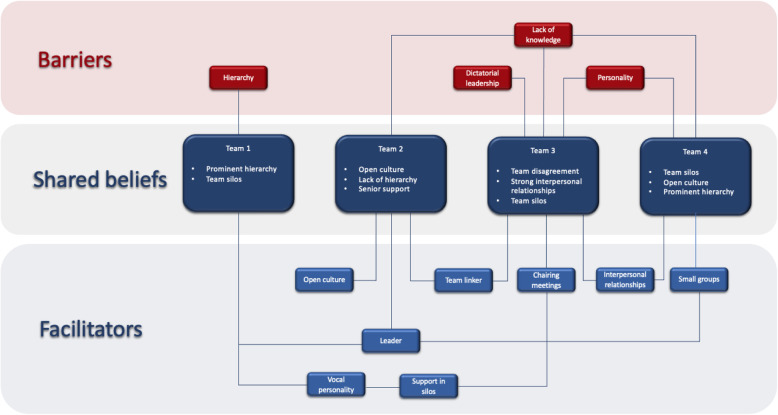
Three meta themes surfaced: shared beliefs, facilitators and barriers to psychological safety. The shared beliefs offered insights into the teams' background functioning, providing important context to the facilitators and barriers of psychological safety specific to each team. Four barriers to psychological safety were identified: hierarchy, perceived lack of knowledge, personality and authoritarian leadership. Eight facilitators surfaced: leader and leader inclusiveness, open culture, vocal personality, support in silos, boundary spanner, chairing meetings, strong interpersonal relationships and small groups.
This study emphasises that factors influencing psychological safety can be individualistic, team-based or organisational. Although previous literature has largely focused on the role of leaders in promoting psychological safety, safe environments can be created by all team members. Members can facilitate psychological safety in instances where positive leadership behaviours are lacking - for example, strengthening interpersonal relationships, finding support in silos or rotating the chairperson in team meetings. It is anticipated that these findings will encourage practices to reflect on their team dynamics and adopt strategies to ensure every member's voice is heard.
心理安全是指个体在工作环境中能够自在地表达自己,而不必担心被他人尴尬或批评的一种概念。医疗保健领域的心理安全与改善患者安全结果、提高医生参与度以及营造富有创造力的学习环境相关。因此,确定能够促进或阻碍心理安全建立的关键因素非常重要。现有的关于医疗团队心理安全的文献主要集中在二级医疗,且主要是从个体专业的角度。鉴于对初级医疗中多学科工作的关注度增加以及基于团队研究的必要性,考虑到心理安全是一个基于团队的概念,本研究旨在调查初级医疗多学科团队中促进心理安全的因素和阻碍因素。
本研究选择了单一方法的定性研究设计。通过滚雪球抽样招募了来自四个初级医疗团队的医疗专业人员(n = 20)。数据收集通过半结构化访谈进行。采用主题分析法得出研究结果。
出现了三个元主题:共同信念、心理安全的促进因素和阻碍因素。共同信念揭示了团队的背景运作情况,为每个团队特有的心理安全促进因素和阻碍因素提供了重要背景。确定了心理安全的四个阻碍因素:等级制度、感知到的知识不足、个性和专制领导。出现了八个促进因素:领导者及领导者的包容性、开放的文化、外向的个性、部门内的支持、跨界协调者、主持会议、牢固的人际关系和小团队规模。
本研究强调,影响心理安全的因素可以是个人层面、团队层面或组织层面的。尽管先前的文献主要关注领导者在促进心理安全方面的作用,但所有团队成员都可以创造安全的环境。在缺乏积极领导行为的情况下,成员可以促进心理安全——例如,加强人际关系、在部门内寻求支持或在团队会议中轮流担任主席。预计这些研究结果将促使医疗机构反思其团队动态,并采取策略确保每个成员的声音都能被听到。