Zhou Jiasheng, He Da, Shang Xiaoyu, Guo Zhendong, Chen Sung-Liang, Luo Jiajia
University of Michigan-Shanghai Jiao Tong University Joint Institute, Shanghai Jiao Tong University, Shanghai 200240, China.
Biomedical Engineering Department, Peking University, Beijing 100191, China.
Photoacoustics. 2021 Feb 2;22:100242. doi: 10.1016/j.pacs.2021.100242. eCollection 2021 Jun.
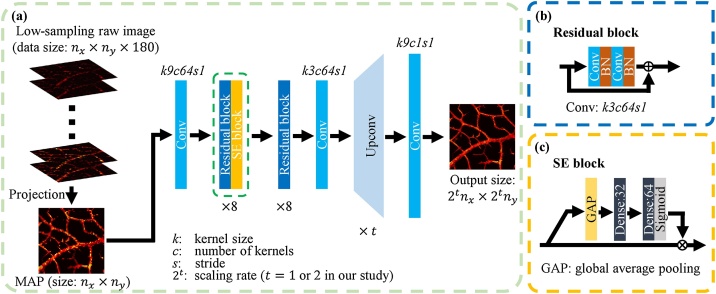
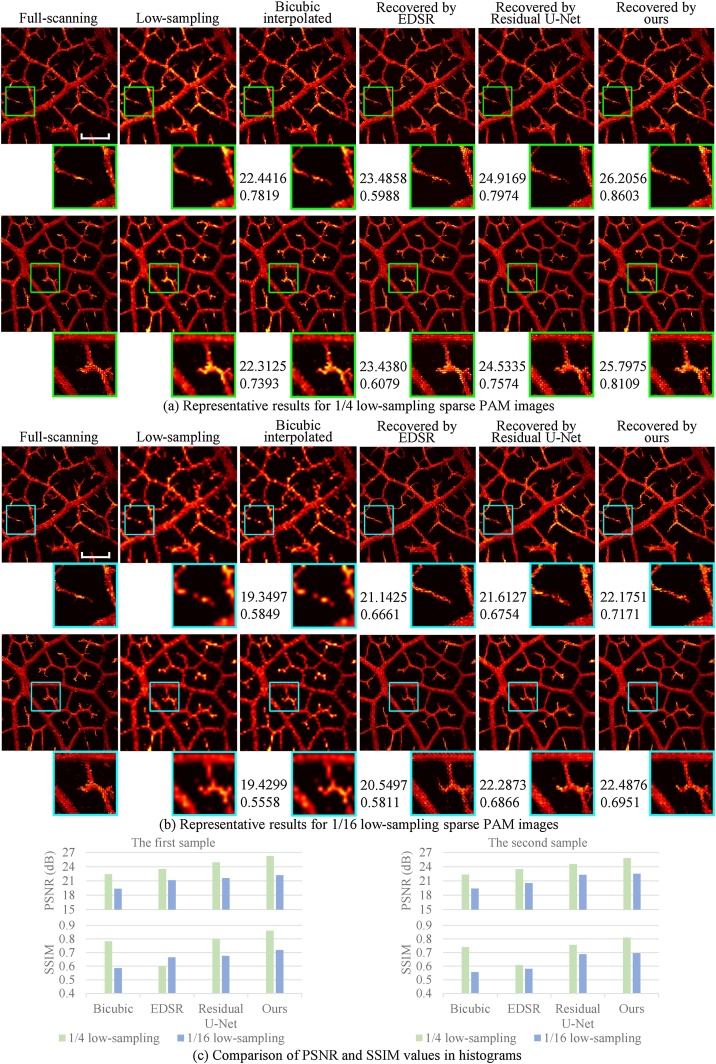
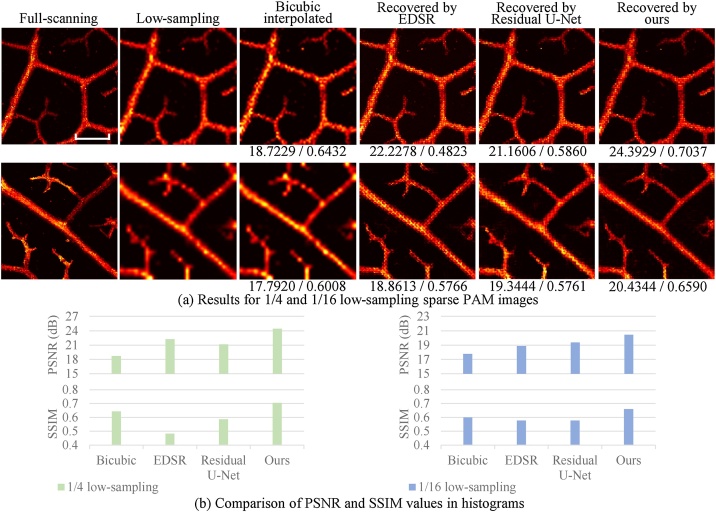
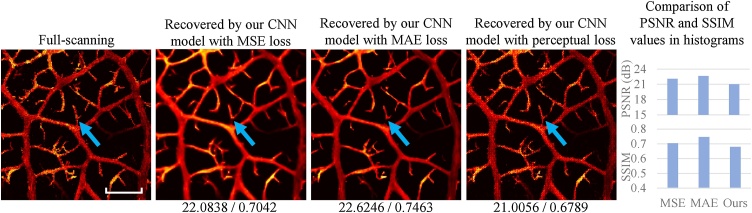
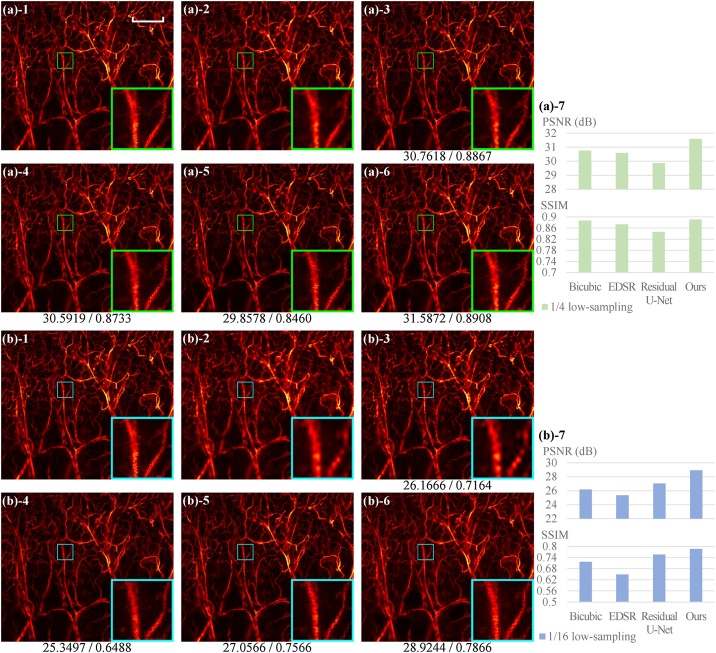
The point-by-point scanning mechanism of photoacoustic microscopy (PAM) results in low-speed imaging, limiting the application of PAM. In this work, we propose a method to improve the quality of sparse PAM images using convolutional neural networks (CNNs), thereby speeding up image acquisition while maintaining good image quality. The CNN model utilizes attention modules, residual blocks, and perceptual losses to reconstruct the sparse PAM image, which is a mapping from a 1/4 or 1/16 low-sampling sparse PAM image to a latent fully-sampled one. The model is trained and validated mainly on PAM images of leaf veins, showing effective improvements quantitatively and qualitatively. Our model is also tested using PAM images of blood vessels of mouse ears and eyes. The results suggest that the model can enhance the quality of the sparse PAM image of blood vessels in several aspects, which facilitates fast PAM and its clinical applications.
光声显微镜(PAM)的逐点扫描机制导致成像速度较慢,限制了PAM的应用。在这项工作中,我们提出了一种使用卷积神经网络(CNN)来提高稀疏PAM图像质量的方法,从而在保持良好图像质量的同时加快图像采集速度。CNN模型利用注意力模块、残差块和感知损失来重建稀疏PAM图像,该图像是从1/4或1/16低采样率的稀疏PAM图像到潜在的全采样图像的映射。该模型主要在叶脉的PAM图像上进行训练和验证,在定量和定性方面都显示出有效的改进。我们的模型还使用小鼠耳朵和眼睛血管的PAM图像进行了测试。结果表明,该模型可以在多个方面提高血管稀疏PAM图像的质量,这有利于快速PAM及其临床应用。