Clausen Alexander Guldmann, Vad Oliver Bundgaard, Andersen Julie Husted, Olesen Morten Salling
Department of Biomedical Sciences, Faculty of Health and Medical Sciences, University of Copenhagen, Copenhagen, Denmark.
Laboratory for Molecular Cardiology, Department of Cardiology, The Heart Centre, Rigshospitalet, University Hospital of Copenhagen, Copenhagen, Denmark.
Front Cardiovasc Med. 2021 Mar 9;8:650667. doi: 10.3389/fcvm.2021.650667. eCollection 2021.
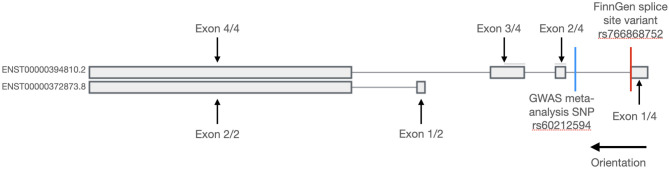
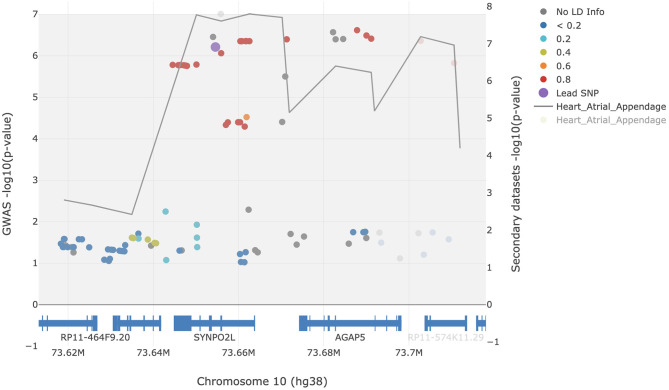
Multiple genome-wide association studies (GWAS) have identified numerous loci associated with atrial fibrillation (AF). However, the genes driving these associations and how they contribute to the AF pathogenesis remains poorly understood. To identify genes likely to be driving the observed association, we searched the FinnGen study consisting of 12,859 AF cases and 73,341 controls for rare genetic variants predicted to cause loss-of-function. A specific splice site variant was found in the gene, located in an AF associated locus on chromosome 10. This variant was associated with an increased risk of AF with a relatively high odds ratio of 3.5 ( = 9.9 × 10). is an important gene involved in the structural development and function of the cardiac myocyte and our findings thus support the recent suggestions that AF can present as atrial cardiomyopathy.
多项全基因组关联研究(GWAS)已确定了许多与心房颤动(AF)相关的基因座。然而,驱动这些关联的基因及其如何导致AF发病机制仍知之甚少。为了确定可能驱动观察到的关联的基因,我们在由12859例AF病例和73341例对照组成的芬兰基因研究中搜索了预测会导致功能丧失的罕见遗传变异。在位于10号染色体上AF相关基因座的基因中发现了一个特定的剪接位点变异。该变异与AF风险增加相关,相对较高的优势比为3.5(P = 9.9 × 10⁻⁶)。该基因是参与心肌细胞结构发育和功能的重要基因,因此我们的研究结果支持了最近关于AF可表现为心房心肌病的观点。