School of Psychological Science, University of Bristol, Bristol, UK.
Ageing Epidemiology Research Unit, School of Public Health, Imperial College London, London, UK.
Psychol Med. 2023 Jan;53(1):149-159. doi: 10.1017/S0033291721001306. Epub 2021 Mar 26.
The effective implementation of government policies and measures for controlling the coronavirus disease 2019 (COVID-19) pandemic requires compliance from the public. This study aimed to examine cross-sectional and longitudinal associations of trust in government regarding COVID-19 control with the adoption of recommended health behaviours and prosocial behaviours, and potential determinants of trust in government during the pandemic.
This study analysed data from the PsyCorona Survey, an international project on COVID-19 that included 23 733 participants from 23 countries (representative in age and gender distributions by country) at baseline survey and 7785 participants who also completed follow-up surveys. Specification curve analysis was used to examine concurrent associations between trust in government and self-reported behaviours. We further used structural equation model to explore potential determinants of trust in government. Multilevel linear regressions were used to examine associations between baseline trust and longitudinal behavioural changes.
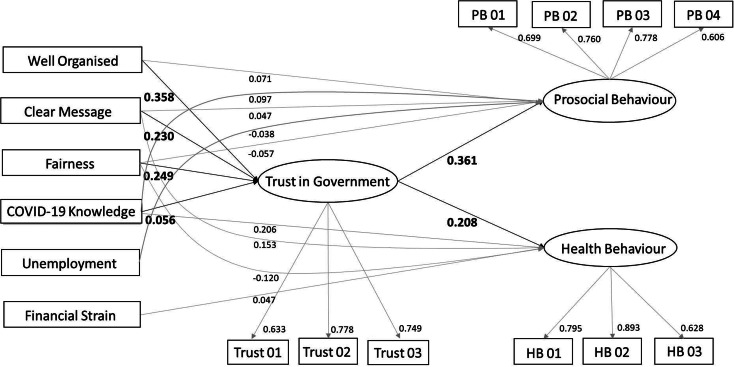
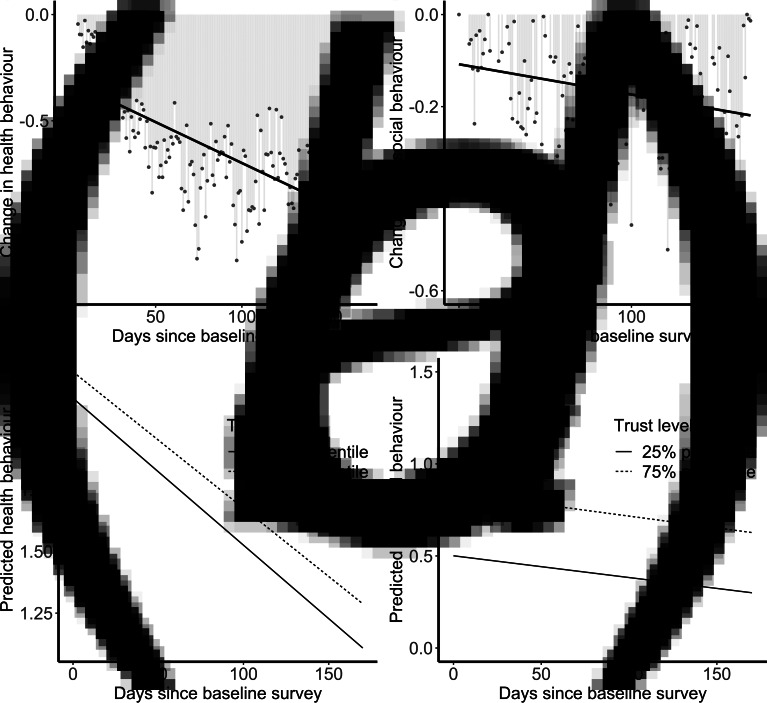
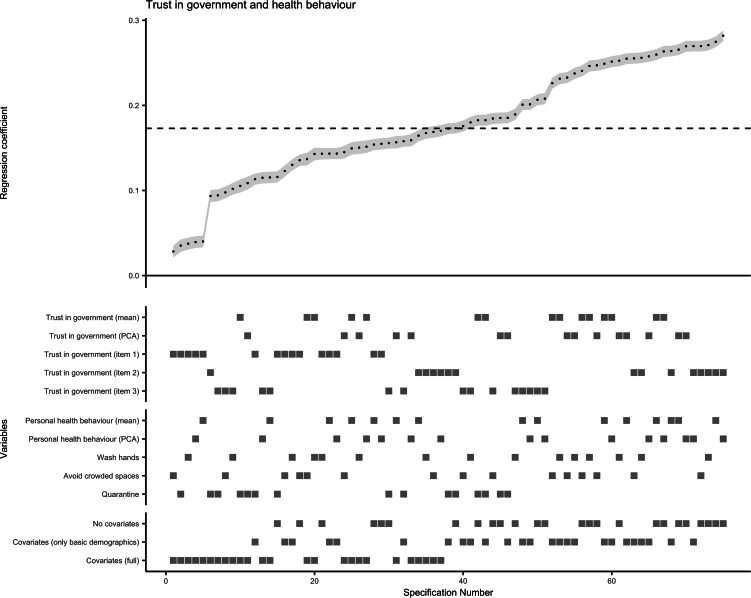
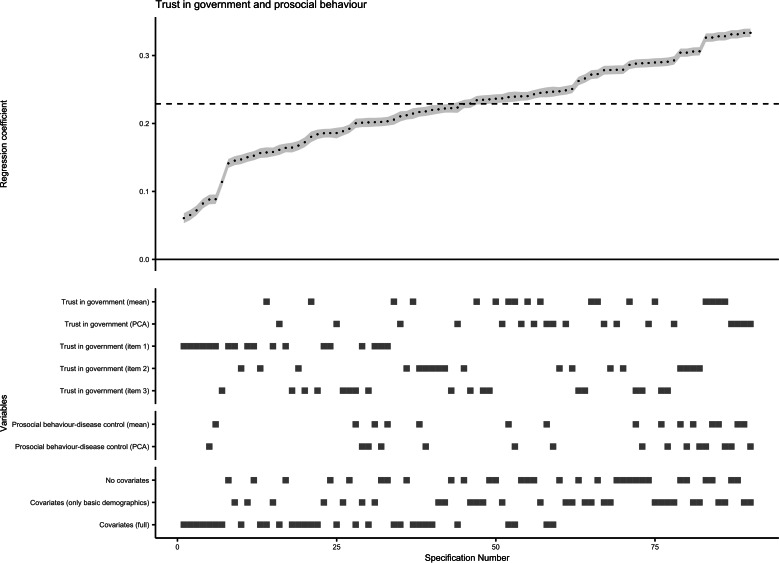
Higher trust in government regarding COVID-19 control was significantly associated with higher adoption of health behaviours (handwashing, avoiding crowded space, self-quarantine) and prosocial behaviours in specification curve analyses (median standardised = 0.173 and 0.229, < 0.001). Government perceived as well organised, disseminating clear messages and knowledge on COVID-19, and perceived fairness were positively associated with trust in government (standardised = 0.358, 0.230, 0.056, and 0.249, < 0.01). Higher trust at baseline survey was significantly associated with lower rate of decline in health behaviours over time ( for interaction = 0.001).
These results highlighted the importance of trust in government in the control of COVID-19.
有效实施政府控制 2019 年冠状病毒病(COVID-19)大流行的政策和措施需要公众遵守。本研究旨在调查对 COVID-19 控制的政府信任与采用推荐的健康行为和亲社会行为之间的横断面和纵向关联,以及大流行期间政府信任的潜在决定因素。
本研究分析了 PsyCorona 调查的数据,该调查是一项关于 COVID-19 的国际项目,包括来自 23 个国家的 23733 名参与者(按国家的年龄和性别分布具有代表性),他们在基线调查时完成了调查,还有 7785 名参与者也完成了后续调查。规范曲线分析用于检验政府信任与自我报告行为之间的同期关联。我们进一步使用结构方程模型来探索政府信任的潜在决定因素。多层次线性回归用于检验基线信任与纵向行为变化之间的关联。
在规范曲线分析中,对 COVID-19 控制的政府信任度越高,与更高的健康行为(洗手、避免拥挤场所、自我隔离)和亲社会行为的采用显著相关(中位数标准化 = 0.173 和 0.229,<0.001)。组织有序、清晰传达 COVID-19 信息和知识以及公平性被感知到的政府与政府信任呈正相关(标准化 = 0.358、0.230、0.056 和 0.249,<0.01)。基线调查中较高的信任度与健康行为随时间下降的速度较慢显著相关(交互作用=0.001)。
这些结果强调了政府信任在 COVID-19 控制中的重要性。