Department of Otolaryngology - Head & Neck Surgery, Virginia Commonwealth University School of Medicine, Richmond, VA, USA; Department of Physiology and Biophysics, Virginia Commonwealth University School of Medicine, Richmond, VA, USA.
Department of Otolaryngology - Head & Neck Surgery, Virginia Commonwealth University School of Medicine, Richmond, VA, USA; Department of Physiology and Biophysics, Virginia Commonwealth University School of Medicine, Richmond, VA, USA.
Am J Otolaryngol. 2021 Jul-Aug;42(4):103001. doi: 10.1016/j.amjoto.2021.103001. Epub 2021 Mar 22.
The association between COVID-19 and chemosensory loss has garnered substantial attention, however to date little is known about the real-life consequences of impairment in this unique patient population. The aim of this study is to evaluate the quality of life (QOL) and personal safety deficits experienced by patients with COVID-19 infection.
Prospective, longitudinal questionnaires.
National survey.
A longitudinal web-based nationwide survey of adults with COVID-19 and/or a sudden change in smell and taste was launched April 10, 2020. Previously published questions on chemosensory-related QOL and safety events were asked at the 6-month follow-up survey.
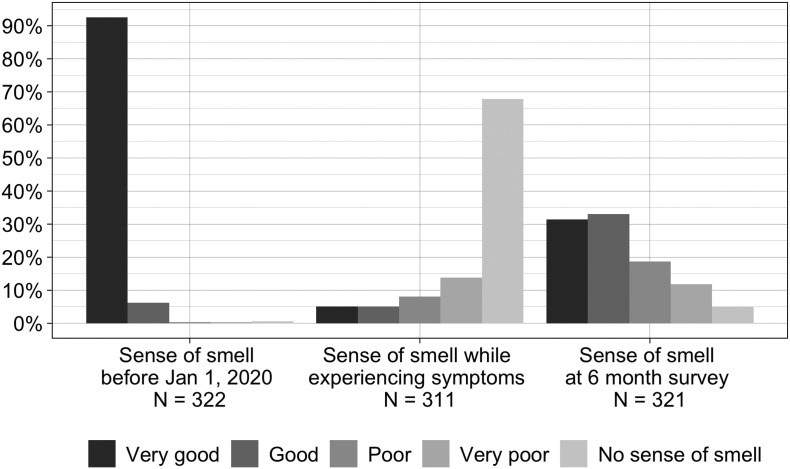
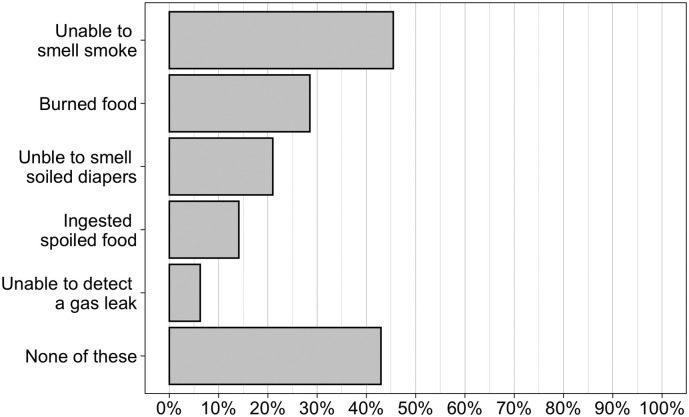
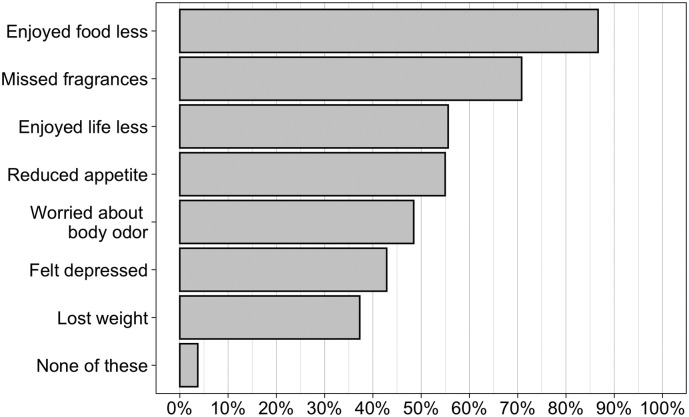
As of February 10, 2021, 480 eligible respondents took the 6-month questionnaire, of whom 322 were COVID-19 positive. Impact on QOL was substantial with 96% of subjects reporting at least one of the defined deficits, and over 75% reporting at least 3 of these. "Reduced enjoyment of food" was the most common complaint (87%), while 43% of subjects self-reported depression. The prevalence of safety-related issues was common in this population, with over 57% reporting at least one, and 36% reporting 2 or more events. Of the events asked, the inability to smell smoke that others could perceive was the most common at 45%.
COVID-19 associated chemosensory losses have a real and substantial impact on both quality of life and safety, beyond mere inconvenience. The high prevalence of these issues despite a relatively short period of olfactory deficit should alert clinicians to the serious risks to an already vulnerable patient population.
新冠病毒(COVID-19)与嗅觉丧失之间的关联已引起广泛关注,但迄今为止,人们对这一独特患者群体中嗅觉丧失的实际后果知之甚少。本研究旨在评估 COVID-19 感染患者的生活质量(QOL)和个人安全缺陷。
前瞻性、纵向问卷调查。
全国性调查。
2020 年 4 月 10 日,针对 COVID-19 患者和/或嗅觉和味觉突然改变的成年人发起了一项纵向网络全国性调查。在 6 个月的随访调查中,询问了先前发表的关于与嗅觉相关的 QOL 和安全事件的问题。
截至 2021 年 2 月 10 日,480 名符合条件的受访者完成了 6 个月的问卷,其中 322 名 COVID-19 检测呈阳性。对 QOL 的影响是巨大的,96%的受试者报告至少有一种定义的缺陷,超过 75%的受试者报告至少有 3 种缺陷。“降低对食物的享受”是最常见的抱怨(87%),而 43%的受试者自我报告有抑郁症状。该人群中安全相关问题的发生率较高,超过 57%的受试者报告至少有 1 次,36%的受试者报告有 2 次或更多次事件。在所询问的事件中,无法闻到他人能察觉到的烟雾的情况最为常见,占 45%。
COVID-19 相关的嗅觉丧失对生活质量和安全都有真实而重大的影响,而不仅仅是不便。尽管嗅觉丧失的时间相对较短,但这些问题的高发生率应该提醒临床医生注意这些问题对已经脆弱的患者群体的严重风险。