Kim Taeyoon, Hu Suman, Kim Jaewook, Kwak Joon Young, Park Jongkil, Lee Suyoun, Kim Inho, Park Jong-Keuk, Jeong YeonJoo
Center for Neuromorphic Engineering, Korea Institutes of Science and Technology, Seoul, South Korea.
Front Comput Neurosci. 2021 Mar 11;15:646125. doi: 10.3389/fncom.2021.646125. eCollection 2021.
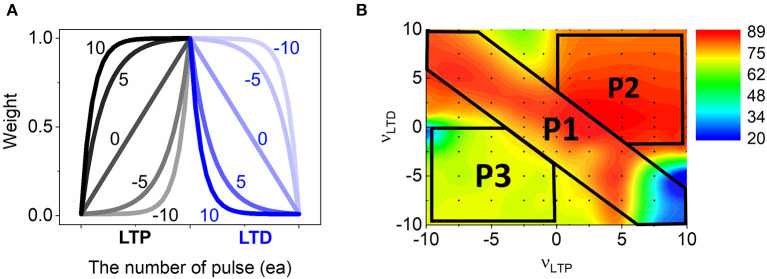
Among many artificial neural networks, the research on Spike Neural Network (SNN), which mimics the energy-efficient signal system in the brain, is drawing much attention. Memristor is a promising candidate as a synaptic component for hardware implementation of SNN, but several non-ideal device properties are making it challengeable. In this work, we conducted an SNN simulation by adding a device model with a non-linear weight update to test the impact on SNN performance. We found that SNN has a strong tolerance for the device non-linearity and the network can keep the accuracy high if a device meets one of the two conditions: 1. symmetric LTP and LTD curves and 2. positive non-linearity factors for both LTP and LTD. The reason was analyzed in terms of the balance between network parameters as well as the variability of weight. The results are considered to be a piece of useful prior information for the future implementation of emerging device-based neuromorphic hardware.
在众多人工神经网络中,对模仿大脑中节能信号系统的脉冲神经网络(SNN)的研究备受关注。忆阻器作为用于SNN硬件实现的突触组件是一个有前景的候选者,但一些非理想的器件特性使其具有挑战性。在这项工作中,我们通过添加一个具有非线性权重更新的器件模型进行了SNN模拟,以测试其对SNN性能的影响。我们发现SNN对器件非线性具有很强的耐受性,并且如果器件满足以下两个条件之一,网络就能保持高精度:1. 对称的长时程增强(LTP)和长时程抑制(LTD)曲线;2. LTP和LTD的正非线性因子。从网络参数之间的平衡以及权重的可变性方面分析了原因。这些结果被认为是未来基于新兴器件的神经形态硬件实现的有用先验信息。