Institute for Sport and Sport Science, TU Dortmund University, Dortmund, Germany.
Institute for Cardiovascular Research and Sport Medicine, German Sport University Cologne, Cologne, Germany.
Eur J Appl Physiol. 2021 Jul;121(7):1803-1814. doi: 10.1007/s00421-021-04668-7. Epub 2021 Mar 31.
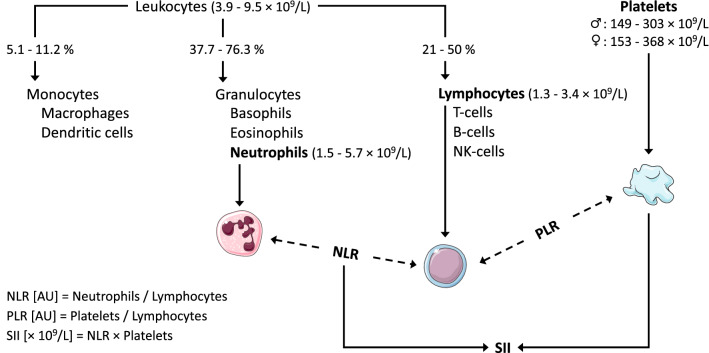
Over the last decades the cellular immune inflammation markers neutrophil-to-lymphocyte ratio (NLR), platelet-to-lymphocyte ratio (PLR) and systemic immune-inflammation index (SII = NLR × platelets) have emerged in clinical context as markers of disease-related inflammation and are now widely appreciated due to their integrative character. Transferring these clinically established inflammation markers into exercise physiology seems highly beneficial, especially due to the low temporal, financial and infrastructural resources needed for assessment and calculation. Therefore, the aim of this review is to summarize evidence on the value of the integrative inflammation markers NLR, PLR and SII for depiction of exercise-induced inflammation and highlight potential applications in exercise settings. Despite sparse evidence, multiple investigations revealed responsiveness of the markers to acute and chronic exercise, thereby opening promising avenues in the field of exercise physiology. In performance settings, they might help to infer information for exercise programming by reflecting exercise strain and recovery status or periods of overtraining and increased infection risk. In health settings, application involves the depiction of anti-inflammatory effects of chronic exercise in patients exhibiting chronic inflammation. Further research should, therefore, focus on establishing reference values for these integrative markers in athletes at rest, assess the kinetics and reliability in response to different exercise modalities and implement the markers into clinical exercise trials to depict anti-inflammatory effects of chronic exercise in different patient collectives.
在过去几十年中,细胞免疫炎症标志物中性粒细胞与淋巴细胞比值(NLR)、血小板与淋巴细胞比值(PLR)和全身免疫炎症指数(SII= NLR×血小板)在临床背景下作为疾病相关炎症的标志物出现,并因其综合特征而得到广泛认可。将这些临床确立的炎症标志物应用于运动生理学似乎具有高度的益处,尤其是因为评估和计算所需的时间、财务和基础设施资源较少。因此,本综述的目的是总结整合炎症标志物 NLR、PLR 和 SII 用于描述运动引起的炎症的价值证据,并强调其在运动环境中的潜在应用。尽管证据有限,但多项研究显示这些标志物对急性和慢性运动具有反应性,从而为运动生理学领域开辟了有前途的途径。在运动表现环境中,它们可以通过反映运动的应激和恢复状态或过度训练和感染风险增加的时期,帮助推断运动方案的信息。在健康环境中,应用涉及描述慢性运动对表现出慢性炎症的患者的抗炎作用。因此,进一步的研究应集中在建立这些整合标志物在静息状态下运动员的参考值,评估不同运动方式的反应动力学和可靠性,并将标志物纳入临床运动试验,以描绘不同患者群体中慢性运动的抗炎作用。