Department of Microbiology & Immunology, Montana State University, Bozeman, MT, USA.
Laboratory of Microbiology, Wageningen University, Wageningen, The Netherlands.
Gut Microbes. 2021 Jan-Dec;13(1):1-15. doi: 10.1080/19490976.2021.1897217.
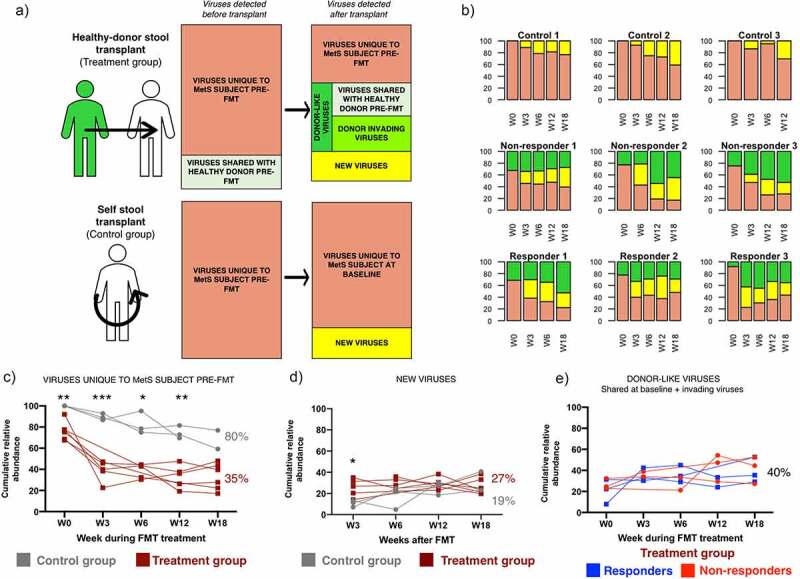
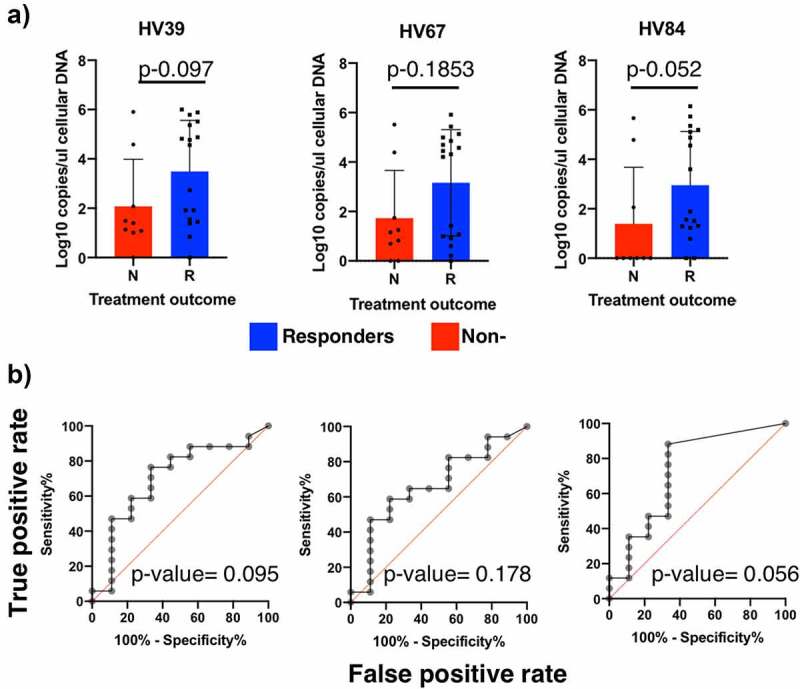
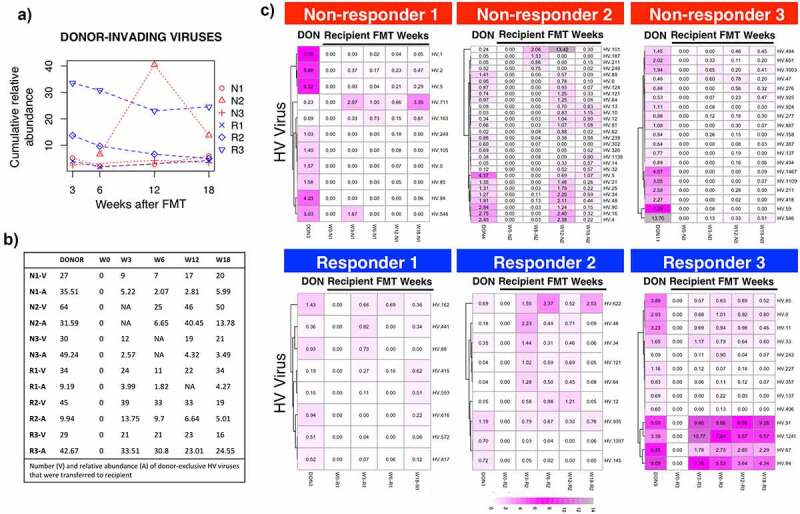
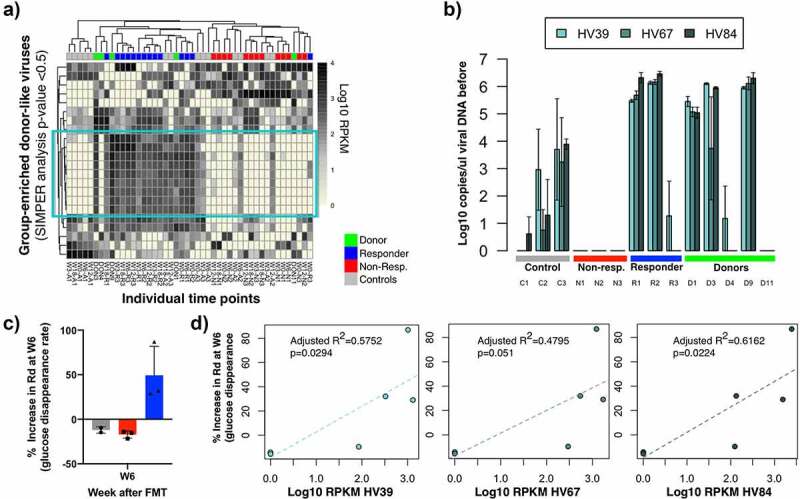
Metabolic Syndrome (MetS) is a growing public health concern worldwide. Individuals with MetS have an increased risk for cardiovascular (CV) disease and type 2 diabetes (T2D). These diseases - in part preventable with the treatment of MetS - increase the chances of premature death and pose a great economic burden to health systems. A healthy gut microbiota is associated with a reduction in MetS, T2D, and CV disease. Treatment of MetS with fecal microbiota transplantation (FMT) can be effective, however, its success rate is intermediate and difficult to predict. Because bacteriophages significantly affect the microbiota membership and function, the aim of this pilot study was to explore the dynamics of the gut bacteriophage community after FMT in MetS subjects. We performed a longitudinal study of stool bacteriophages from healthy donors and MetS subjects before and after FMT treatment. Subjects were assigned to either a control group (self-stool transplant, n = 3) or a treatment group (healthy-donor-stool transplant; n-recipients = 6, n-donors = 5). Stool samples were collected over an 18-week period and bacteriophage-like particles were purified and sequenced. We found that FMT from healthy donors significantly alters the gut bacteriophage community. Subjects with better clinical outcome clustered closer to the heathy donor group, suggesting that throughout the treatment, their bacteriophage community was more similar to healthy donors. Finally, we identified bacteriophage groups that could explain these differences and we examined their prevalence in individuals from a larger cohort of MetS FMT trial.Trial information- http://www.trialregister.nl/trialreg/admin/rctview.asp?TC=2705; NTR 2705.
代谢综合征(MetS)是全球日益严重的公共卫生问题。患有 MetS 的个体患心血管疾病(CV)和 2 型糖尿病(T2D)的风险增加。这些疾病 - 部分可以通过治疗 MetS 来预防 - 增加了过早死亡的机会,并对卫生系统造成了巨大的经济负担。健康的肠道微生物群与 MetS、T2D 和 CV 疾病的减少有关。粪便微生物群移植(FMT)治疗 MetS 可能是有效的,但其成功率为中等,难以预测。由于噬菌体对微生物群成员和功能有重大影响,本初步研究的目的是探索 FMT 后 MetS 患者肠道噬菌体群落的动态变化。我们对健康供体和 FMT 治疗前后 MetS 患者的粪便噬菌体进行了纵向研究。将受试者分为对照组(自身粪便移植,n=3)或治疗组(健康供体粪便移植;n-受体=6,n-供体=5)。在 18 周的时间内收集粪便样本,并纯化和测序噬菌体样颗粒。我们发现,来自健康供体的 FMT 显著改变了肠道噬菌体群落。临床结局更好的受试者聚类更接近健康供体组,这表明在整个治疗过程中,他们的噬菌体群落与健康供体更相似。最后,我们确定了可以解释这些差异的噬菌体群,并检查了它们在来自更大 MetS FMT 试验队列的个体中的患病率。试验信息- http://www.trialregister.nl/trialreg/admin/rctview.asp?TC=2705; NTR 2705。