Dragan Ana-Maria, Truta Florina Maria, Tertis Mihaela, Florea Anca, Schram Jonas, Cernat Andreea, Feier Bogdan, De Wael Karolien, Cristea Cecilia, Oprean Radu
Department of Analytical Chemistry and Instrumental Analysis, "Iuliu Haţieganu" University of Medicine and Pharmacy, Cluj-Napoca, Romania.
Axes Research Group, University of Antwerp, Antwerp, Belgium.
Front Chem. 2021 Mar 16;9:641147. doi: 10.3389/fchem.2021.641147. eCollection 2021.
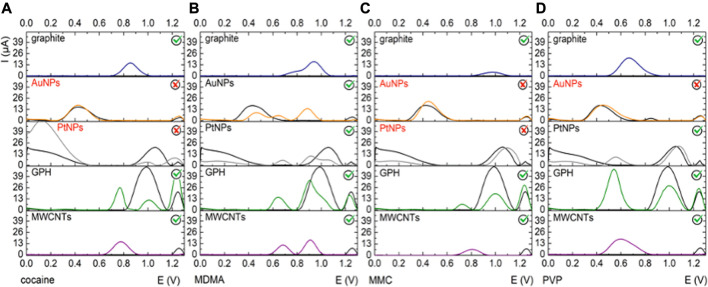
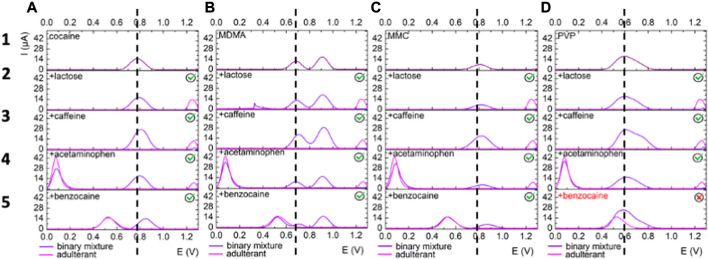
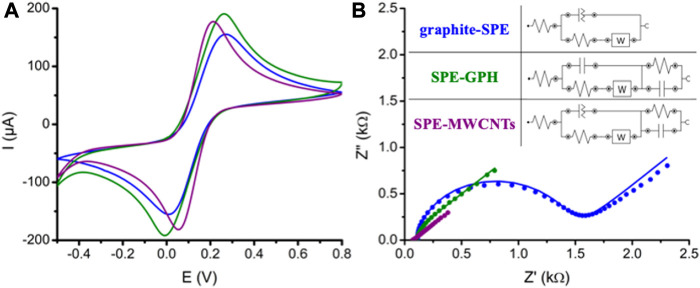
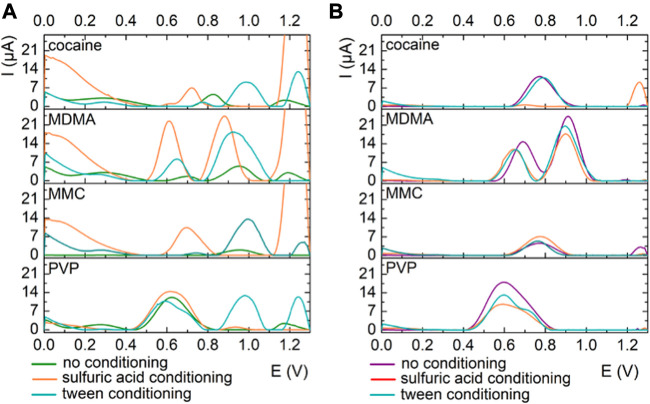
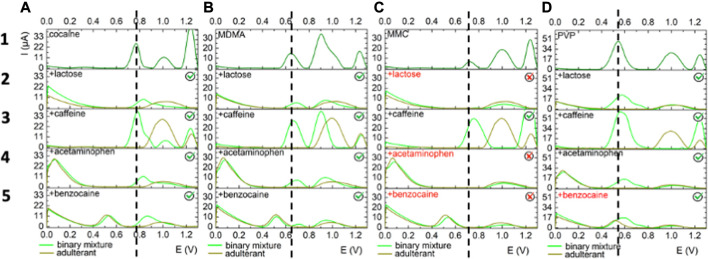
Illicit drugs use and abuse remains an increasing challenge for worldwide authorities and, therefore, it is important to have accurate methods to detect them in seized samples, biological fluids and wastewaters. They are recently classified as the latest group of emerging pollutants as their consumption increased tremendously in recent years. Nanomaterials have gained much attention over the last decade in the development of sensors for a myriad of applications. The applicability of these nanomaterials, functionalized or not, significantly increases and it is therefore highly suitable for use in the detection of illicit drugs. We have assessed the suitability of various nanoplatforms, such as graphene (GPH), multi-walled carbon nanotubes (MWCNTs), gold nanoparticles (AuNPs) and platinum nanoparticles (PtNPs) for the electrochemical detection of illicit drugs. GPH and MWCNTs were chosen as the most suitable platforms and cocaine, 3,4-methylendioxymethamfetamine (MDMA), 3-methylmethcathinone (MMC) and α-pyrrolidinovalerophenone (PVP) were tested. Due to the hydrophobicity of the nanomaterials-based platforms which led to low signals, two strategies were followed namely, pretreatment of the electrodes in sulfuric acid by cyclic voltammetry and addition of Tween 20 to the detection buffer. Both strategies led to an increase in the oxidation signal of illicit drugs. Binary mixtures of illicit drugs with common adulterants found in street samples were also investigated. The proposed strategies allowed the sensitive detection of illicit drugs in the presence of most adulterants. The suitability of the proposed sensors for the detection of illicit drugs in spiked wastewaters was finally assessed.
非法药物的使用和滥用对全球各国当局来说仍是一个日益严峻的挑战,因此,拥有准确的方法来检测查获样本、生物体液和废水中的非法药物非常重要。近年来,由于非法药物的消费量大幅增加,它们最近被归类为最新一类新兴污染物。在过去十年中,纳米材料在众多应用传感器的开发中备受关注。这些纳米材料无论是否功能化,其适用性都显著提高,因此非常适合用于非法药物的检测。我们评估了各种纳米平台,如石墨烯(GPH)、多壁碳纳米管(MWCNT)、金纳米颗粒(AuNP)和铂纳米颗粒(PtNP)用于非法药物电化学检测的适用性。选择GPH和MWCNT作为最合适的平台,并对可卡因、3,4-亚甲基二氧甲基苯丙胺(摇头丸)、3-甲基甲卡西酮(MMC)和α-吡咯烷戊酮(PVP)进行了测试。由于基于纳米材料的平台具有疏水性,导致信号较低,因此采取了两种策略,即通过循环伏安法在硫酸中对电极进行预处理,以及在检测缓冲液中添加吐温20。这两种策略都导致了非法药物氧化信号的增加。还研究了非法药物与街头样本中常见掺杂物的二元混合物。所提出的策略能够在存在大多数掺杂物的情况下灵敏地检测非法药物。最后评估了所提出的传感器用于检测加标废水中非法药物的适用性。