Department of Dermatology, Amsterdam University Medical Centers, location AMC, University of Amsterdam, Amsterdam, The Netherlands.
Netherlands Institute for Pigment Disorders, Amsterdam University Medical Centers, location AMC, University of Amsterdam, Amsterdam, The Netherlands.
J Histochem Cytochem. 2021 May;69(5):339-346. doi: 10.1369/00221554211007793. Epub 2021 Apr 2.
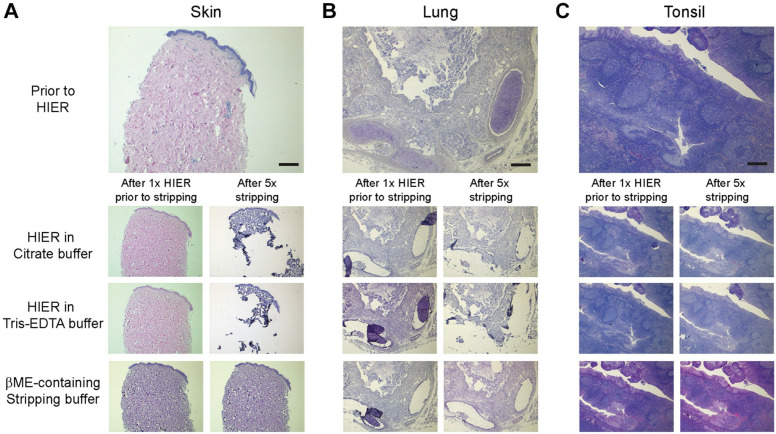
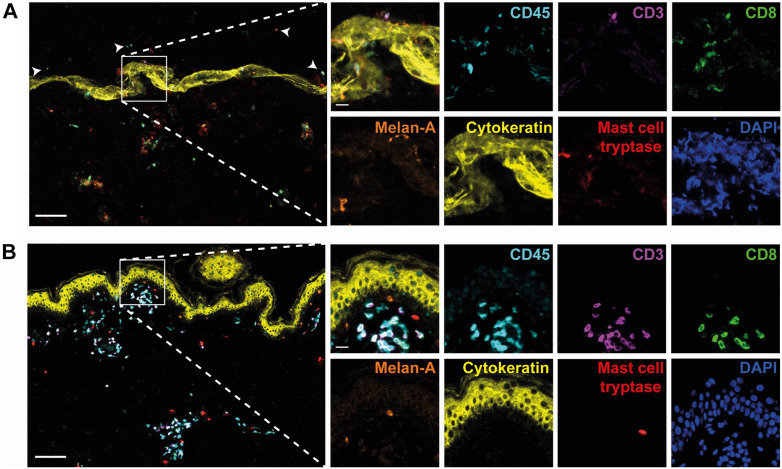
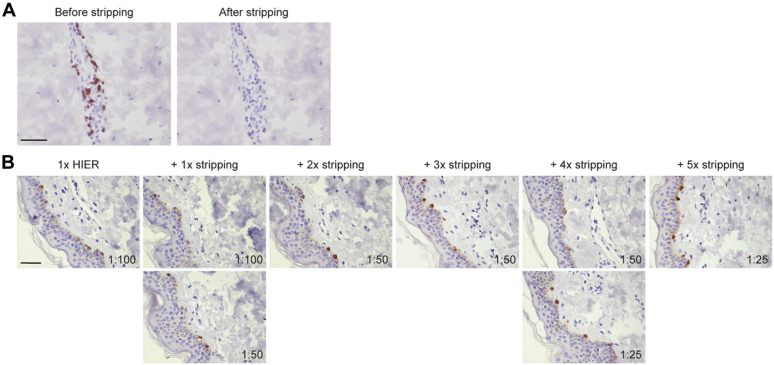
The Opal multiplex technique is an established methodology for the detection of multiple biomarkers in one section. The protocol encompasses iterative single stainings and heating-mediated removal of the primary and secondary antibodies after each staining round, leaving untouched the Opal fluorophores which are deposited onto the antigen of interest. According to our experience, repetitive heating of skin sections often results in tissue damage, indicating an urgent need for milder alternatives to strip immunoglobulins. In this study, we demonstrate that considerable heating-related damage was found not only in skin but also in tissues of different origin, mostly characterized by low cell density. Importantly, the morphology remained fully intact when sections were repetitively exposed to β-mercaptoethanol-containing stripping buffer instead of multiple heating cycles. However, target epitopes appeared sensitive at a differential degree to multiple treatments with stripping buffer, as shown by loss in staining intensity, but in all cases, the staining intensity could be restored by increment of the primary antibody concentrations. Application of β-mercaptoethanol-containing stripping buffer instead of heating for antibody removal markedly improved the quality of the Opal multiplex technique, as a substantial higher number of differently colored cells could be visualized within a well-conserved morphological context.
Opal 多重标记技术是一种成熟的方法,可用于在一个切片中检测多种生物标志物。该方案包括迭代的单染色和加热介导的在每轮染色后去除一抗和二抗,从而保留沉积在感兴趣抗原上的 Opal 荧光团。根据我们的经验,皮肤切片的反复加热通常会导致组织损伤,这表明迫切需要更温和的替代方法来去除免疫球蛋白。在这项研究中,我们证明不仅在皮肤中,而且在不同来源的组织中也发现了与加热相关的大量损伤,这些组织主要以低细胞密度为特征。重要的是,当切片反复暴露于含有 β-巯基乙醇的洗脱缓冲液中而不是多次加热循环时,形态仍然保持完整。然而,靶抗原表位对洗脱缓冲液的多次处理表现出不同程度的敏感性,如染色强度的降低,但在所有情况下,通过增加一抗浓度都可以恢复染色强度。用含有 β-巯基乙醇的洗脱缓冲液代替加热去除抗体显著提高了 Opal 多重标记技术的质量,因为可以在形态保持良好的情况下观察到更多数量的不同颜色的细胞。