Forde Jonathan E, Ciupe Stanca M
Department of Mathematics and Computer Sciences, Hobart and William Smith Colleges, Geneva, NY 14456, USA.
Department of Mathematics, Virginia Tech, Blacksburg, VA 24060, USA.
Viruses. 2021 Mar 11;13(3):457. doi: 10.3390/v13030457.
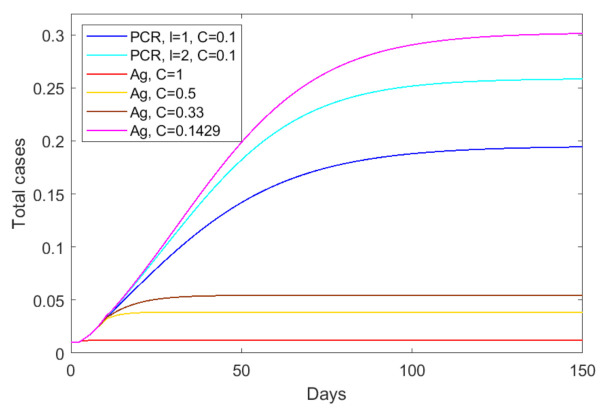
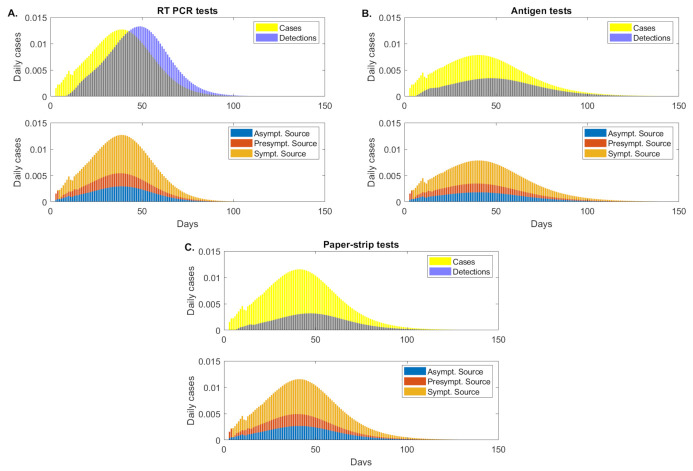
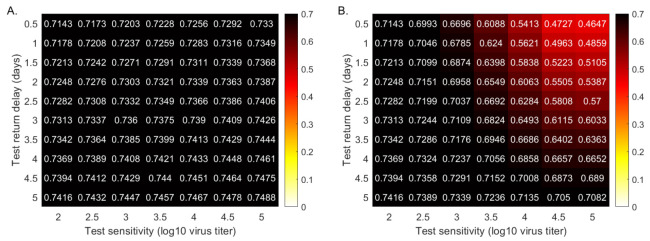
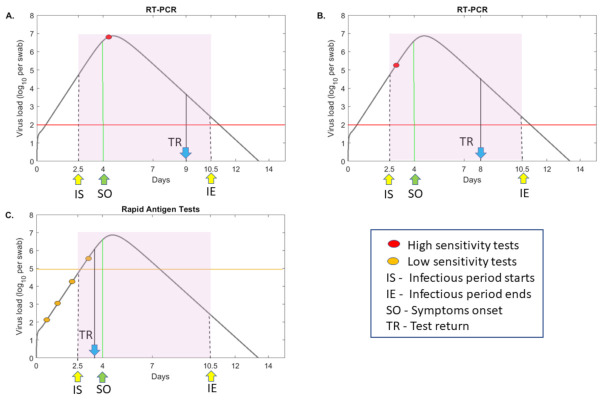
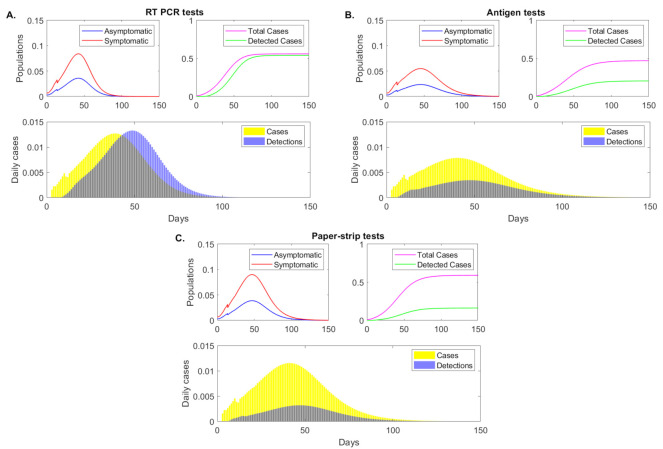
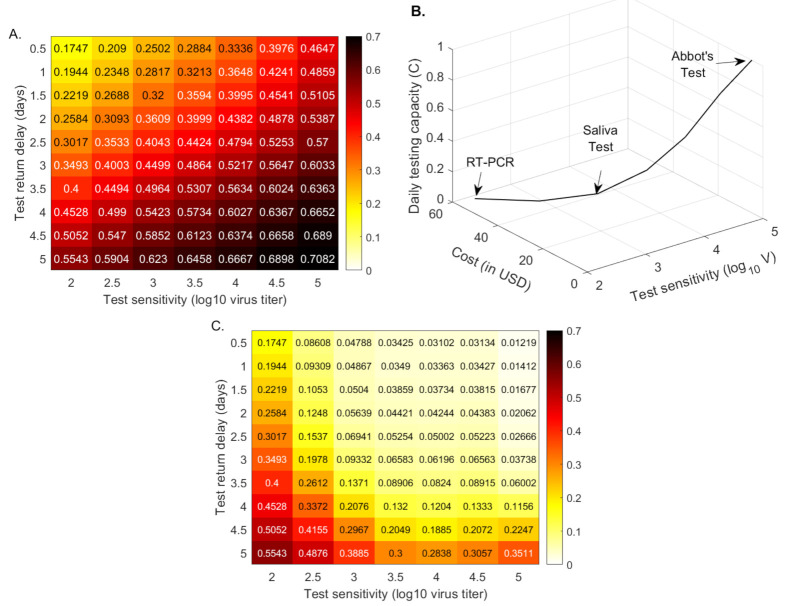
Control strategies that employ real time polymerase chain reaction (RT-PCR) tests for the diagnosis and surveillance of COVID-19 epidemic are inefficient in fighting the epidemic due to high cost, delays in obtaining results, and the need of specialized personnel and equipment for laboratory processing. Cheaper and faster alternatives, such as antigen and paper-strip tests, have been proposed. They return results rapidly, but have lower sensitivity thresholds for detecting virus. To quantify the effects of the tradeoffs between sensitivity, cost, testing frequency, and delay in test return on the overall course of an outbreak, we built a multi-scale immuno-epidemiological model that connects the virus profile of infected individuals with transmission and testing at the population level. We investigated various randomized testing strategies and found that, for fixed testing capacity, lower sensitivity tests with shorter return delays slightly flatten the daily incidence curve and delay the time to the peak daily incidence. However, compared with RT-PCR testing, they do not always reduce the cumulative case count at half a year into the outbreak. When testing frequency is increased to account for the lower cost of less sensitive tests, we observe a large reduction in cumulative case counts, from 55.4% to as low as 1.22% half a year into the outbreak. The improvement is preserved even when the testing budget is reduced by one half or one third. Our results predict that surveillance testing that employs low-sensitivity tests at high frequency is an effective tool for epidemic control.
采用实时聚合酶链反应(RT-PCR)检测来诊断和监测新冠疫情的防控策略,由于成本高昂、出结果延迟以及实验室检测需要专业人员和设备,在抗击疫情方面效率低下。已有人提出更便宜、更快速的替代方法,如抗原检测和纸条检测。它们能快速出结果,但检测病毒的灵敏度阈值较低。为了量化灵敏度、成本、检测频率和检测结果回报延迟之间的权衡对疫情总体进程的影响,我们构建了一个多尺度免疫流行病学模型,该模型将感染个体的病毒特征与人群层面的传播和检测联系起来。我们研究了各种随机检测策略,发现对于固定的检测能力,回报延迟较短但灵敏度较低的检测会使每日发病率曲线略有平缓,并延迟每日发病率峰值出现的时间。然而,与RT-PCR检测相比,在疫情爆发半年时,它们并不总能减少累计病例数。当检测频率提高以弥补低灵敏度检测成本较低的问题时,我们观察到累计病例数大幅减少,在疫情爆发半年时从55.4%降至低至1.22%。即使检测预算减少一半或三分之一,这种改善仍然存在。我们的结果预测,高频使用低灵敏度检测进行监测检测是一种有效的疫情防控工具。