Obata Yoshikuni, Kakutani Naoya, Kinugawa Shintaro, Fukushima Arata, Yokota Takashi, Takada Shingo, Ono Taisuke, Sota Takeshi, Kinugasa Yoshiharu, Takahashi Masashige, Matsuo Hisashi, Matsukawa Ryuichi, Yoshida Ichiro, Yokota Isao, Yamamoto Kazuhiro, Tsuchihashi-Makaya Miyuki
Department of Cardiovascular Medicine, Faculty of Medicine, Graduate School of Medicine, Hokkaido University, Sapporo 060-8638, Japan.
Department of Cardiovascular Medicine, Faculty of Medical Sciences, Kyusyu University, Fukuoka 812-8582, Japan.
Nutrients. 2021 Mar 8;13(3):874. doi: 10.3390/nu13030874.
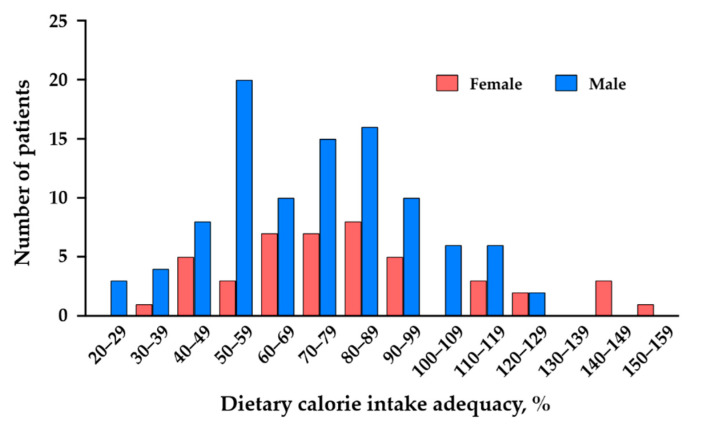
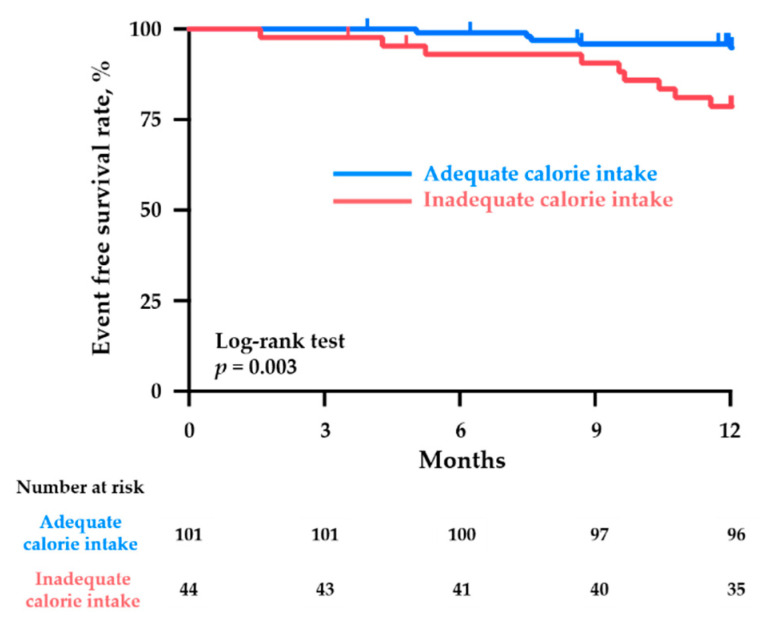
Malnutrition is highly prevalent in patients with heart failure (HF), but the precise impact of dietary energy deficiency on HF patients' clinical outcomes is not known. We investigated the associations between inadequate calorie intake and adverse clinical events in 145 stable outpatients with chronic HF who had a history of hospitalization due to worsening HF. To assess the patients' dietary pattern, we used a brief self-administered diet-history questionnaire (BDHQ). Inadequate calorie intake was defined as <60% of the estimated energy requirement. In the total chronic HF cohort, the median calorie intake was 1628 kcal/day. Forty-four patients (30%) were identified as having an inadequate calorie intake. A Kaplan-Meier analysis revealed that the patients with inadequate calorie intake had significantly worse clinical outcomes including all-cause death and HF-related hospitalization during the 1-year follow-up period versus those with adequate calorie intake (20% vs. 5%, < 0.01). A multivariate logistic regression analysis showed that inadequate calorie intake was an independent predictor of adverse clinical events after adjustment for various factors that may influence patients' calorie intake. Among patients with chronic HF, inadequate calorie intake was associated with an increased risk of all-cause mortality and rehospitalization due to worsening HF. However, our results are preliminary and larger studies with direct measurements of dietary calorie intake and total energy expenditure are needed to clarify the intrinsic nature of this relationship.
营养不良在心力衰竭(HF)患者中非常普遍,但饮食能量缺乏对HF患者临床结局的确切影响尚不清楚。我们调查了145例因HF恶化而住院的慢性HF稳定门诊患者中热量摄入不足与不良临床事件之间的关联。为了评估患者的饮食模式,我们使用了一份简短的自我管理饮食史问卷(BDHQ)。热量摄入不足定义为低于估计能量需求的60%。在整个慢性HF队列中,热量摄入中位数为1628千卡/天。44例患者(30%)被确定为热量摄入不足。Kaplan-Meier分析显示,在1年随访期内,热量摄入不足的患者与热量摄入充足的患者相比,包括全因死亡和HF相关住院在内的临床结局明显更差(20%对5%,<0.01)。多因素逻辑回归分析表明,在对可能影响患者热量摄入的各种因素进行调整后,热量摄入不足是不良临床事件的独立预测因素。在慢性HF患者中,热量摄入不足与全因死亡率增加以及因HF恶化再次住院有关。然而,我们的结果是初步的,需要进行更大规模的研究,直接测量饮食热量摄入和总能量消耗,以阐明这种关系的内在本质。