Portillo Aránzazu, Palomar Ana M, Santibáñez Paula, Oteo José A
Infectious Diseases Department, Center of Rickettsiosis and Arthropod-Borne Diseases (CRETAV), San Pedro University Hospital-Center of Biomedical Research from La Rioja (CIBIR), Piqueras, 98, 26006 Logroño, La Rioja, Spain.
Microorganisms. 2021 Mar 21;9(3):649. doi: 10.3390/microorganisms9030649.
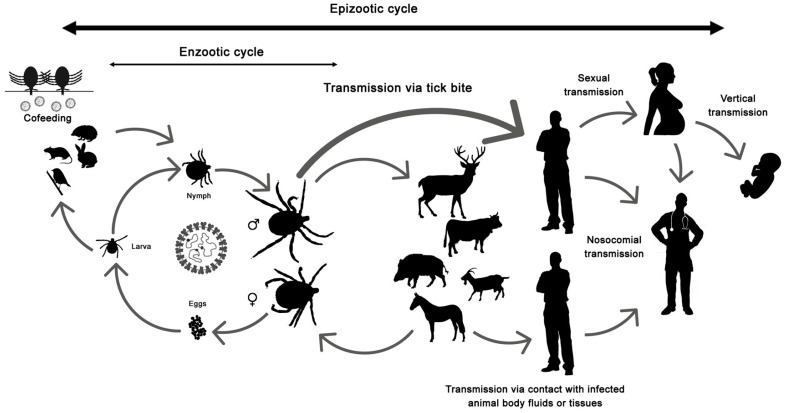
Crimean-Congo hemorrhagic fever virus (CCHFV) is an arthropod-borne virus (arbovirus), mainly transmitted by ticks, belonging to the genus (family , order ). CCHFV causes a potentially severe, or even fatal, human disease, and it is widely distributed in Africa, Asia, eastern Europe and, more recently, in South-western Europe. Until a few years ago, no cases of Crimean-Congo hemorrhagic fever (CCHF) had been reported in western Europe, with the exception of several travel-associated cases. In 2010, the CCHFV was reported for the first time in South-western Europe when viral RNA was obtained from ticks collected from deer in Cáceres (Spain). Migratory birds from Africa harboring CCHFV-infected ticks and flying to Spain appear to have contributed to the establishment of the virus (genotype III, Africa-3) in this country. In addition, the recent findings in a patient and in ticks from deer and wild boar of viral sequences similar to those from eastern Europe (genotype V, Europe-1), raise the possibility of the introduction of CCHFV into Spain through the animal trade, although the arrival by bird routes cannot be ruled out (Africa-4 has been also recently detected). The seropositive rates of animals detected in regions of South-western Spain suggest an established cycle of tick-host-tick in certain areas, and the segment reassortment detected in the sequenced virus from one patient evidences a high ability to adaptation of the virus. Different ixodid tick genera can be vectors and reservoirs of the virus, although spp. are particularly relevant for its maintenance. This tick genus is common in Mediterranean region but it is currently spreading to new areas, partly due to the climate change and movement of livestock or wild animals. Although to a lesser extent, travels with our pets (and their ticks) may be also a factor to be considered. As a consequence, the virus is expanding from the Balkan region to Central Europe and, more recently, to Western Europe where different genotypes are circulating. Thus, seven human cases confirmed by molecular methods have been reported in Spain from 2016 to August 2020, three of them with a fatal outcome. A One Health approach is essential for the surveillance of fauna and vector populations to assess the risk for humans and animals. We discuss the risk of CCHFV causing epidemic outbreaks in Western Europe.
克里米亚-刚果出血热病毒(CCHFV)是一种节肢动物传播病毒(虫媒病毒),主要通过蜱传播,属于 属( 科, 目)。CCHFV可引发一种潜在的严重甚至致命的人类疾病,广泛分布于非洲、亚洲、东欧,最近在西南欧也有发现。直到几年前,西欧除了几例与旅行相关的病例外,未报告过克里米亚-刚果出血热(CCHF)病例。2010年,西南欧首次报告了CCHFV,当时从西班牙卡塞雷斯采集的鹿身上的蜱中获得了病毒RNA。携带感染CCHFV蜱的非洲候鸟飞往西班牙,似乎促成了该病毒(III型基因型,非洲-3)在该国的传播。此外,最近在一名患者以及鹿和野猪身上的蜱中发现了与东欧(V型基因型,欧洲-1)相似的病毒序列,这增加了通过动物贸易将CCHFV引入西班牙的可能性,尽管不能排除通过鸟类路线传入的可能性(最近也检测到了非洲-4型)。在西班牙西南部地区检测到的动物血清阳性率表明,某些地区存在蜱-宿主-蜱的既定循环,从一名患者的测序病毒中检测到的片段重配证明了该病毒具有很高的适应能力。不同的硬蜱属可以是该病毒的传播媒介和储存宿主,尽管 属对其传播尤为重要。这种蜱属在地中海地区很常见,但目前正在向新的地区扩散,部分原因是气候变化以及牲畜或野生动物的移动。尽管程度较轻,但携带宠物(及其蜱)旅行也可能是一个需要考虑的因素。因此,该病毒正从巴尔干地区扩展到中欧,最近又扩展到西欧,不同的基因型正在那里传播。因此,2016年至2020年8月西班牙报告了7例经分子方法确诊的人类病例,其中3例死亡。采用“同一健康”方法对于监测动物群和媒介种群以评估对人类和动物的风险至关重要。我们讨论了CCHFV在西欧引发疫情爆发的风险。