Paqué Pune N, Herz Christopher, Wiedemeier Daniel B, Mitsakakis Konstantinos, Attin Thomas, Bao Kai, Belibasakis Georgios N, Hays John P, Jenzer Joël S, Kaman Wendy E, Karpíšek Michal, Körner Philipp, Peham Johannes R, Schmidlin Patrick R, Thurnheer Thomas, Wegehaupt Florian J, Bostanci Nagihan
Clinic of Conservative and Preventive Dentistry, Center of Dental Medicine, University of Zurich, Plattenstrasse 11, 8032 Zurich, Switzerland.
Austrian Institute of Technology, Molecular Diagnostics, Giefinggasse 4, 1210 Wien, Austria.
J Pers Med. 2021 Mar 23;11(3):235. doi: 10.3390/jpm11030235.
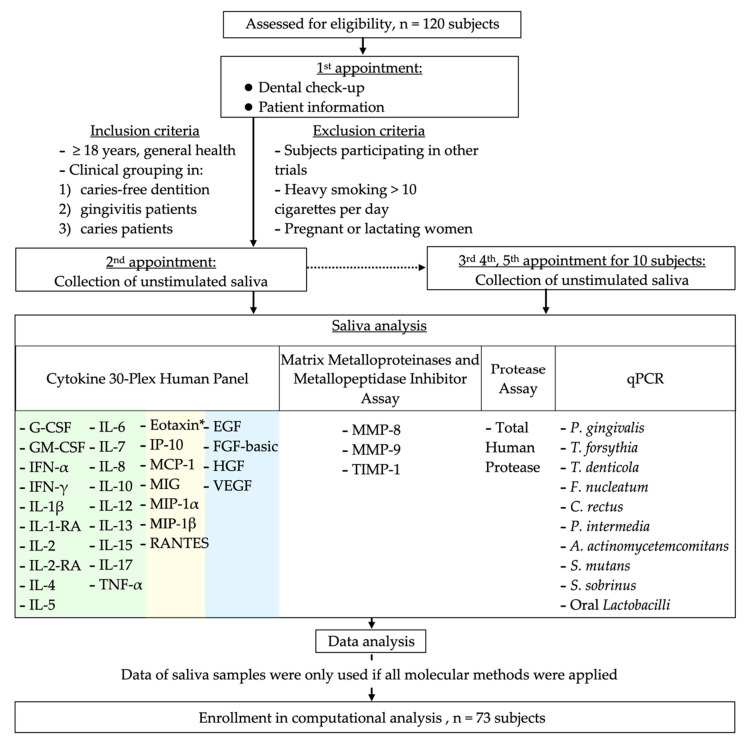
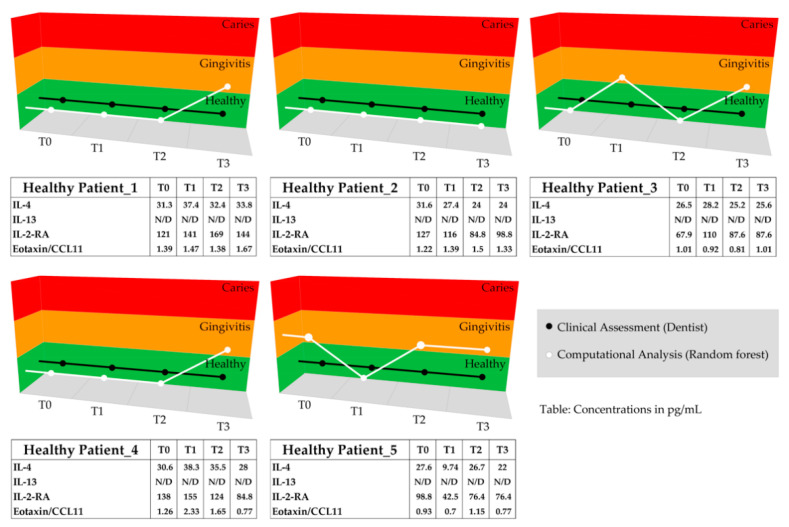
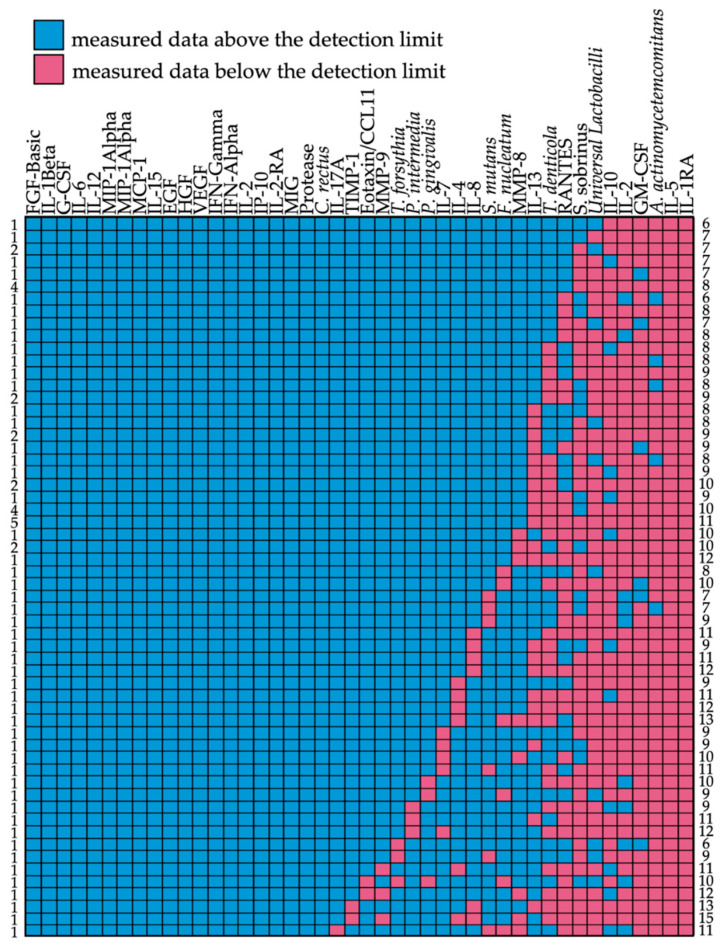
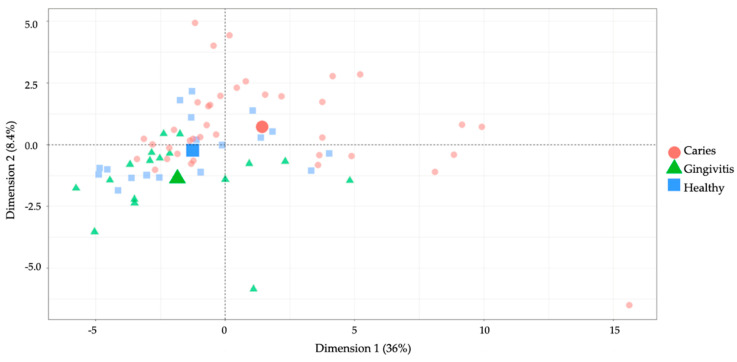
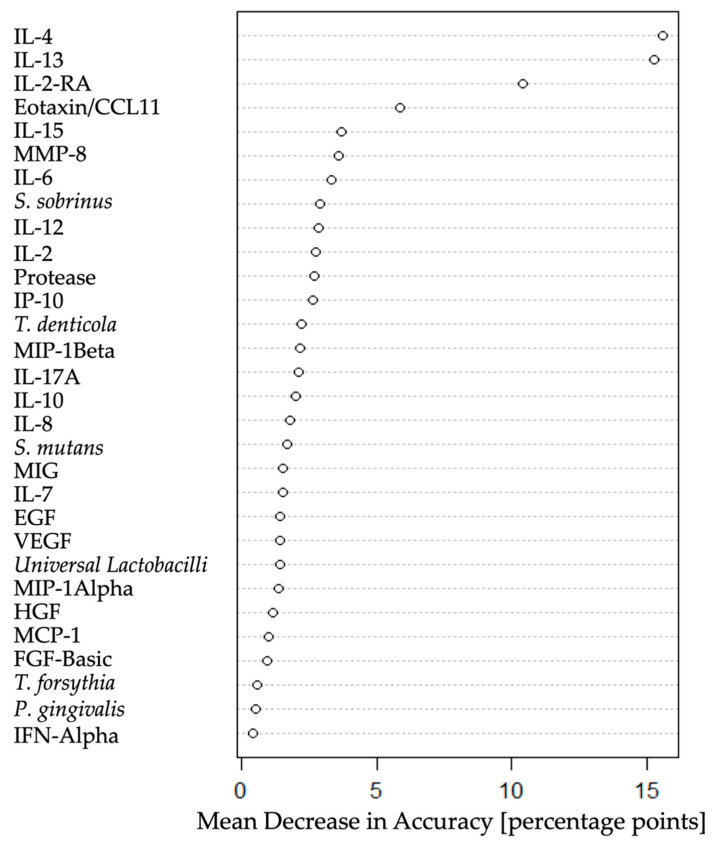
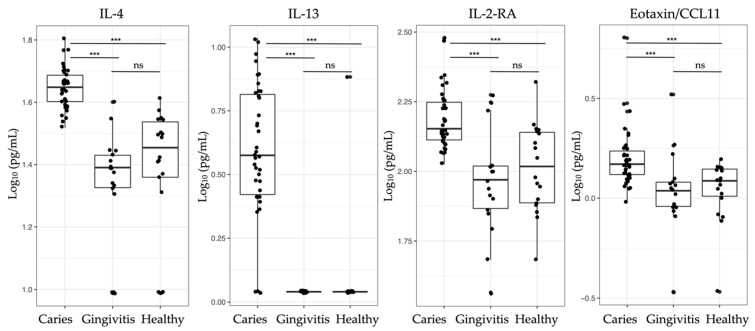
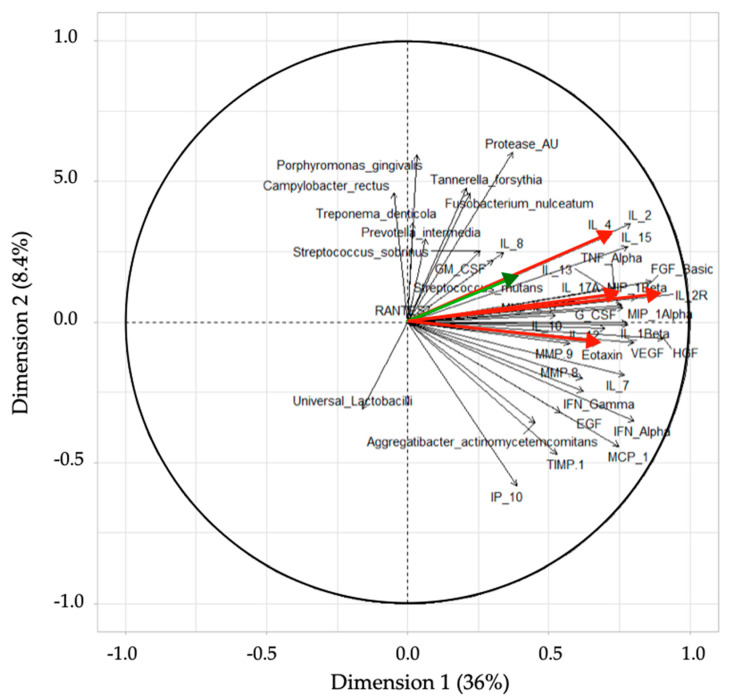
This study investigated the potential of salivary bacterial and protein markers for evaluating the disease status in healthy individuals or patients with gingivitis or caries. Saliva samples from caries- and gingivitis-free individuals ( = 18), patients with gingivitis ( = 17), or patients with deep caries lesions ( = 38) were collected and analyzed for 44 candidate biomarkers (cytokines, chemokines, growth factors, matrix metalloproteinases, a metallopeptidase inhibitor, proteolytic enzymes, and selected oral bacteria). The resulting data were subjected to principal component analysis and used as a training set for random forest (RF) modeling. This computational analysis revealed four biomarkers (IL-4, IL-13, IL-2-RA, and eotaxin/CCL11) to be of high importance for the correct depiction of caries in 37 of 38 patients. The RF model was then used to classify 10 subjects (five caries-/gingivitis-free and five with caries), who were followed over a period of six months. The results were compared to the clinical assessments of dental specialists, revealing a high correlation between the RF prediction and the clinical classification. Due to the superior sensitivity of the RF model, there was a divergence in the prediction of two caries and four caries-/gingivitis-free subjects. These findings suggest IL-4, IL-13, IL-2-RA, and eotaxin/CCL11 as potential salivary biomarkers for identifying noninvasive caries. Furthermore, we suggest a potential association between JAK/STAT signaling and dental caries onset and progression.
本研究调查了唾液细菌和蛋白质标志物在评估健康个体或牙龈炎或龋齿患者疾病状态方面的潜力。收集了无龋齿和牙龈炎个体(n = 18)、牙龈炎患者(n = 17)或深龋病变患者(n = 38)的唾液样本,并对44种候选生物标志物(细胞因子、趋化因子、生长因子、基质金属蛋白酶、金属肽酶抑制剂、蛋白水解酶和选定的口腔细菌)进行了分析。所得数据进行主成分分析,并用作随机森林(RF)建模的训练集。该计算分析表明,四种生物标志物(IL-4、IL-13、IL-2-RA和嗜酸性粒细胞趋化因子/CCL11)对于正确描述38例患者中的37例龋齿具有高度重要性。然后使用RF模型对10名受试者(5名无龋齿/牙龈炎和5名有龋齿)进行分类,并随访6个月。将结果与牙科专家的临床评估进行比较,发现RF预测与临床分类之间具有高度相关性。由于RF模型具有更高的敏感性,在预测两名有龋齿和四名无龋齿/牙龈炎受试者时出现了分歧。这些发现表明,IL-4、IL-13、IL-2-RA和嗜酸性粒细胞趋化因子/CCL11作为识别非侵入性龋齿的潜在唾液生物标志物。此外,我们提出JAK/STAT信号传导与龋齿的发生和进展之间可能存在关联。