Sallam Malik, Mahafzah Azmi
Department of Pathology, Microbiology and Forensic Medicine, School of Medicine, The University of Jordan, Amman 11942, Jordan.
Department of Clinical Laboratories and Forensic Medicine, Jordan University Hospital, Amman 11942, Jordan.
Pathogens. 2021 Mar 5;10(3):302. doi: 10.3390/pathogens10030302.
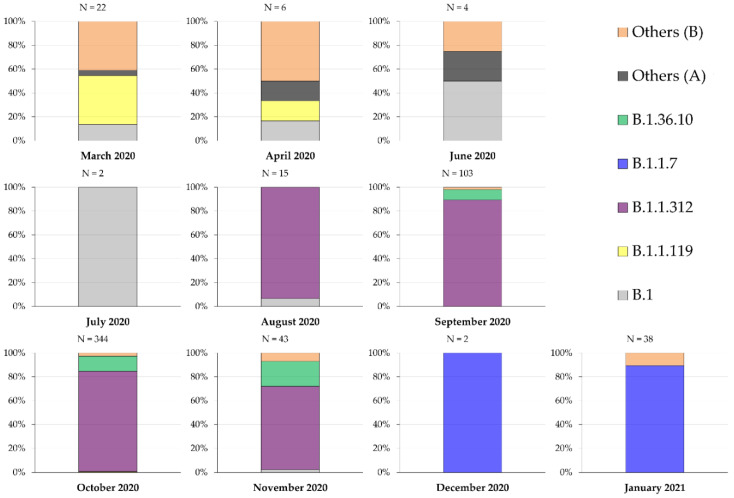
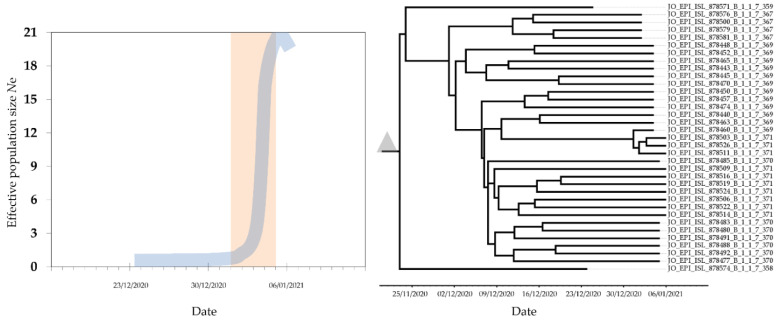
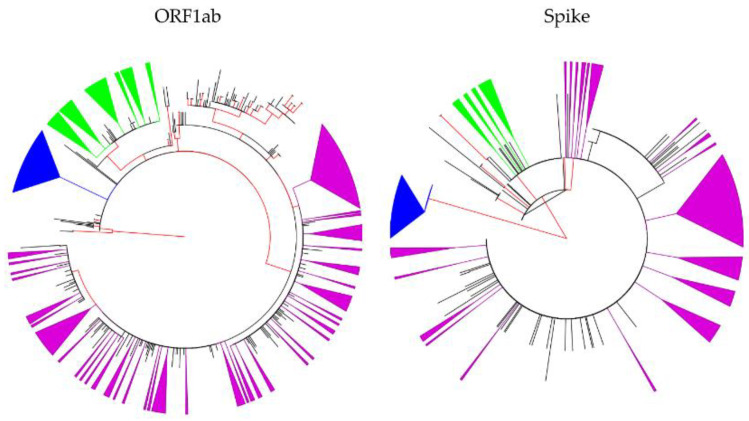
The rapid evolution of severe acute respiratory syndrome coronavirus 2 (SARS-CoV-2) is manifested by the emergence of an ever-growing pool of genetic lineages. The aim of this study was to analyze the genetic variability of SARS-CoV-2 in Jordan, with a special focus on the UK variant of concern. A total of 579 SARS-CoV-2 sequences collected in Jordan were subjected to maximum likelihood and Bayesian phylogenetic analysis. Genetic lineage assignment was undertaken using the Pango system. Amino acid substitutions were investigated using the Protein Variation Effect Analyzer (PROVEAN) tool. A total of 19 different SARS-CoV-2 genetic lineages were detected, with the most frequent being the first Jordan lineage (B.1.1.312), first detected in August 2020 ( = 424, 73.2%). This was followed by the second Jordan lineage (B.1.36.10), first detected in September 2020 ( = 62, 10.7%), and the UK variant of concern (B.1.1.7; = 36, 6.2%). In the spike gene region, the molecular signature for B.1.1.312 was the non-synonymous mutation A24432T resulting in a deleterious amino acid substitution (Q957L), while the molecular signature for B.1.36.10 was the synonymous mutation C22444T. Bayesian analysis revealed that the UK variant of concern (B.1.1.7) was introduced into Jordan in late November 2020 (mean estimate); four weeks earlier than its official reporting in the country. In Jordan, an exponential increase in COVID-19 cases due to B.1.1.7 lineage coincided with the new year 2021. The highest proportion of phylogenetic clustering was detected for the B.1.1.7 lineage. The amino acid substitution D614G in the spike glycoprotein was exclusively present in the country from July 2020 onwards. Two Jordanian lineages dominated infections in the country, with continuous introduction/emergence of new lineages. In Jordan, the rapid spread of the UK variant of concern should be monitored closely. The spread of SARS-CoV-2 mutants appeared to be related to the founder effect; nevertheless, the biological impact of certain mutations should be further investigated.
严重急性呼吸综合征冠状病毒2(SARS-CoV-2)的快速进化表现为不断涌现出越来越多的遗传谱系。本研究的目的是分析约旦境内SARS-CoV-2的遗传变异性,特别关注英国关注的变异株。对约旦收集的总共579条SARS-CoV-2序列进行了最大似然法和贝叶斯系统发育分析。使用Pango系统进行遗传谱系分类。使用蛋白质变异效应分析仪(PROVEAN)工具研究氨基酸替换情况。共检测到19种不同的SARS-CoV-2遗传谱系,其中最常见的是首个约旦谱系(B.1.1.312),于2020年8月首次检测到(n = 424,73.2%)。其次是第二个约旦谱系(B.1.36.10),于2020年9月首次检测到(n = 62,10.7%),以及英国关注的变异株(B.1.1.7;n = 36,6.2%)。在刺突基因区域,B.1.1.312的分子特征是非同义突变A24432T,导致有害的氨基酸替换(Q957L),而B.1.36.10的分子特征是同义突变C22444T。贝叶斯分析显示,英国关注的变异株(B.1.1.7)于2020年11月下旬(平均估计)传入约旦;比该国官方报告早四周。在约旦,由于B.1.1.7谱系导致的COVID-19病例在2021年新年期间呈指数增长。检测到B.1.1.7谱系的系统发育聚类比例最高。刺突糖蛋白中的氨基酸替换D614G自2020年7月起在该国仅存在。两个约旦谱系主导了该国的感染情况,同时新谱系不断传入/出现。在约旦,应密切监测英国关注变异株的快速传播。SARS-CoV-2突变体的传播似乎与奠基者效应有关;然而,某些突变的生物学影响应进一步研究。