Spiliopoulou Polyxeni, Gavriatopoulou Maria, Kastritis Efstathios, Dimopoulos Meletios Athanasios, Terzis Gerasimos
Sports Performance Laboratory, School of Physical Education and Sport Science, National and Kapodistrian University of Athens, 17237 Athens, Greece.
Department of Clinical Therapeutics, School of Medicine, Alexandra General Hospital, National and Kapodistrian University of Athens, 11528 Athens, Greece.
Sports (Basel). 2021 Mar 30;9(4):46. doi: 10.3390/sports9040046.
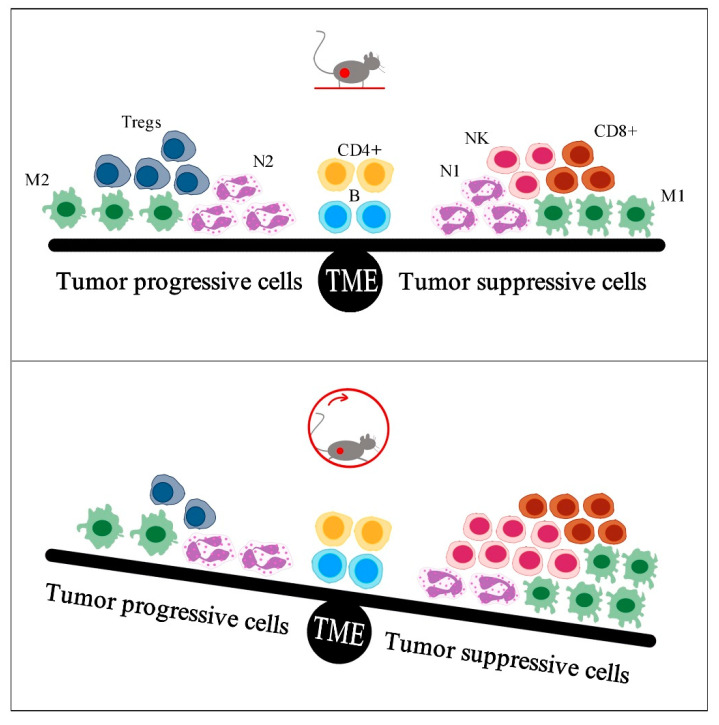
Immunity in the tumor microenvironment plays a central role in tumor development. Cytotoxic immune cells act against tumors, while tumors manage to trigger immunosuppressive mechanisms for defense. One bout of physical exercise acutely regulates the immune system inducing short-term redistribution of immune cells among body organs. Repeated acute immune cell mobilization with continuing exercise training results in long-term adaptations. These long-term exercise-induced changes in the immune system arise both in healthy and in diseased populations, including cancer patients. Recent preclinical studies indicate that physical exercise may have a positive impact on intra-tumoral immune cell processes, resulting in tumor suppression. This short narrative review describes the effect of physical exercise on tumor growth as detected via changes in tumor immunity. Research evidence shows that exercise may improve tumor-suppressive functions and may reduce tumor-progressive responses and mechanisms of immune cells, controlling tumor development. Specifically, it seems that exercise in rodents triggers shifts in tumor infiltration of macrophages, neutrophils, natural killer cells, cytotoxic and regulatory T lymphocytes, resulting in tumor suppression. These recent promising data suggest that physical exercise could be combined with anticancer immunotherapies, although exercise parameters like intensity, duration, and frequency need to be evaluated in more detail. More research is needed to investigate the effect of exercise in other immune cell subtypes and their possible connection with tumor growth, whilst information from human tumors is also required.
肿瘤微环境中的免疫在肿瘤发展中起核心作用。细胞毒性免疫细胞对抗肿瘤,而肿瘤则设法触发免疫抑制机制进行防御。一次体育锻炼会急性调节免疫系统,诱导免疫细胞在身体各器官间进行短期重新分布。持续的运动训练反复进行急性免疫细胞动员可导致长期适应性变化。这些长期的运动诱导的免疫系统变化在健康人群和患病群体(包括癌症患者)中都会出现。最近的临床前研究表明,体育锻炼可能对肿瘤内免疫细胞过程产生积极影响,从而导致肿瘤抑制。这篇简短的叙述性综述描述了通过肿瘤免疫变化检测到的体育锻炼对肿瘤生长的影响。研究证据表明,运动可能改善肿瘤抑制功能,并可能减少肿瘤进展反应和免疫细胞的作用机制,从而控制肿瘤发展。具体而言,在啮齿动物中,运动似乎会引发巨噬细胞、中性粒细胞、自然杀伤细胞、细胞毒性T淋巴细胞和调节性T淋巴细胞在肿瘤浸润中的变化,从而导致肿瘤抑制。这些近期有前景的数据表明,体育锻炼可与抗癌免疫疗法相结合,不过运动强度、持续时间和频率等参数需要更详细地评估。需要更多研究来调查运动对其他免疫细胞亚型的影响及其与肿瘤生长的可能联系,同时也需要来自人类肿瘤的信息。