Enokida Tomohiro, Tahara Makoto
Department of Head and Neck Medical Oncology, National Cancer Center Hospital East, 6-5-1 Kashiwanoha, Kashiwa 277-8577, Japan.
Cancers (Basel). 2021 Mar 19;13(6):1418. doi: 10.3390/cancers13061418.
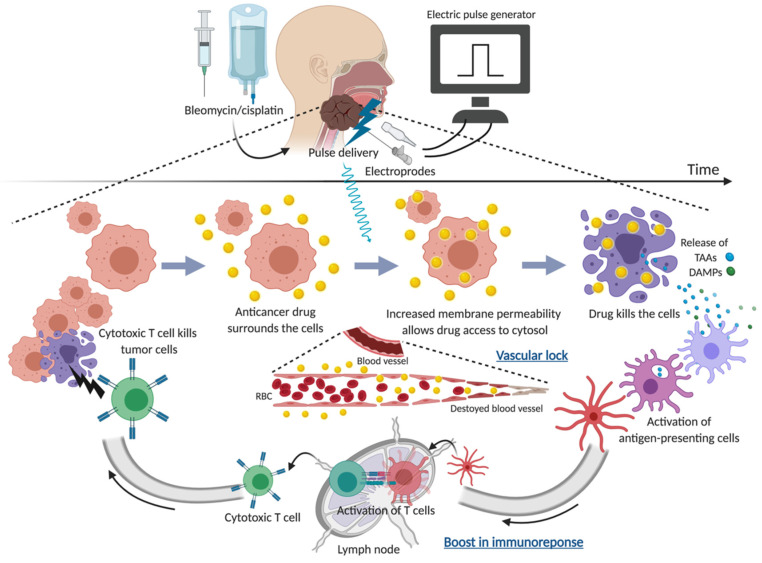
Despite recent advances in the development of chemotherapeutic drug, treatment for advanced cancer of the head and neck cancer (HNC) is still challenging. Options are limited by multiple factors, such as a prior history of irradiation to the tumor site as well as functional limitations. Against this background, electrochemotherapy (ECT) is a new modality which combines administration of an antineoplastic agent with locally applied electric pulses. These pulses allow the chemotherapeutic drug to penetrate the intracellular space of the tumor cells and thereby increase its cytotoxicity. ECT has shown encouraging efficacy and a tolerable safety profile in many clinical studies, including in heavily pre-treated HNC patients, and is considered a promising strategy. Efforts to improve its efficacy and broaden its application are now ongoing. Moreover, the combination of ECT with recently developed novel therapies, including immunotherapy, represented by immune checkpoint inhibitor (ICI)s, has attracted attention for its potent theoretical rationale. More extensive, well-organized clinical studies and timely updating of consensus guidelines will bring this hopeful treatment to HNC patients under challenging situations.
尽管近期化疗药物的研发取得了进展,但晚期头颈癌(HNC)的治疗仍然具有挑战性。治疗选择受到多种因素的限制,如肿瘤部位既往放疗史以及功能限制。在此背景下,电化学疗法(ECT)是一种将抗肿瘤药物与局部施加电脉冲相结合的新方法。这些脉冲使化疗药物能够穿透肿瘤细胞的细胞内空间,从而增强其细胞毒性。在许多临床研究中,包括在经过大量预处理的HNC患者中,ECT已显示出令人鼓舞的疗效和可耐受的安全性,被认为是一种有前景的策略。目前正在努力提高其疗效并扩大其应用范围。此外,ECT与最近开发的新型疗法(包括以免疫检查点抑制剂(ICI)为代表的免疫疗法)的联合应用,因其强大的理论依据而受到关注。更广泛、组织良好的临床研究以及共识指南的及时更新,将使这种有希望的治疗方法应用于处于挑战性情况下的HNC患者。