Matsumoto Natsuko, Park Jonguk, Tomizawa Rie, Kawashima Hitoshi, Hosomi Koji, Mizuguchi Kenji, Honda Chika, Ozaki Ritsuko, Iwatani Yoshinori, Watanabe Mikio, Kunisawa Jun
Department of Clinical Laboratory and Biomedical Sciences, Division of Health Sciences, Osaka University Graduate School of Medicine, Osaka 565-0871, Japan.
Laboratory of Bioinformatics, Artificial Intelligence Center for Health and Biomedical Research, National Institutes of Biomedical Innovation, Health and Nutrition, Osaka 567-0085, Japan.
Medicina (Kaunas). 2021 Mar 16;57(3):275. doi: 10.3390/medicina57030275.
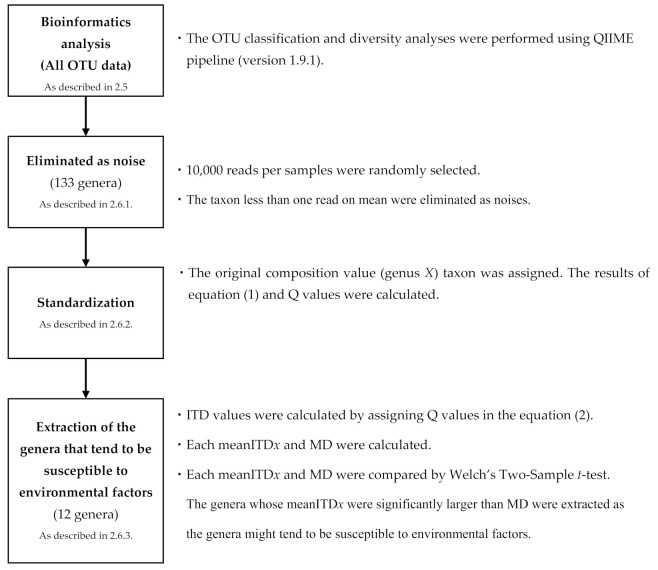
: The gut microbiota is associated with human health and dietary nutrition. Various studies have been reported in this regard, but it is difficult to clearly analyze human gut microbiota as individual differences are significant. The causes of these individual differences in intestinal microflora are genetic and/or environmental. In this study, we focused on differences between identical twins in Japan to clarify the effects of nutrients consumed on the entire gut microbiome, while excluding genetic differences. : We selected healthy Japanese monozygotic twins for the study and confirmed their zygosity by matching 15 short tandem repeat loci. Their fecal samples were subjected to 16S rRNA sequencing and bioinformatics analyses to identify and compare the fluctuations in intestinal bacteria. : We identified 12 genera sensitive to environmental factors, and found that was relatively unaffected by environmental factors. Moreover, we identified protein, fat, and some nutrient intake that can affect 12 genera, which have been identified to be more sensitive to environmental factors. Among the 12 genera, had a positive correlation with retinol equivalent intake ( = 0.38), had a significantly negative correlation with protein, sodium, iron, vitamin D, vitamin B6, and vitamin B12 intake ( = -0.38, -0.41, -0.39, -0.63, -0.42, -0.49, respectively), ND3007 group had a positive correlation with fat intake ( = 0.39), and UCG-008 group had a negative correlation with the saturated fatty acid intake ( = -0.45). : Our study is the first to focus on the relationship between human gut microbiota and nutrient intake using samples from Japanese twins to exclude the effects of genetic factors. These findings will broaden our understanding of the more intuitive relationship between nutrient intake and the gut microbiota and can be a useful basis for finding useful biomarkers that contribute to human health.
肠道微生物群与人类健康和饮食营养相关。关于这方面已有诸多研究报道,但由于个体差异显著,难以清晰地分析人类肠道微生物群。肠道微生物群这些个体差异的原因是遗传和/或环境因素。在本研究中,我们聚焦于日本同卵双胞胎之间的差异,以阐明所摄入营养物质对整个肠道微生物组的影响,同时排除遗传差异。
我们选择健康的日本同卵双胞胎进行研究,并通过匹配15个短串联重复位点来确认他们的同卵性。对他们的粪便样本进行16S rRNA测序和生物信息学分析,以识别和比较肠道细菌的波动情况。
我们鉴定出12个对环境因素敏感的属,发现[具体属名]相对不受环境因素影响。此外,我们确定了可影响这12个对环境因素更敏感的属的蛋白质、脂肪和一些营养物质摄入量。在这12个属中,[具体属名1]与视黄醇当量摄入量呈正相关(r = 0.38),[具体属名2]与蛋白质、钠、铁、维生素D、维生素B6和维生素B12摄入量呈显著负相关(分别为r = -0.38、-0.41、-0.39、-0.63、-0.42、-0.49),ND3007组与脂肪摄入量呈正相关(r = 0.39),UCG - 008组与饱和脂肪酸摄入量呈负相关(r = -0.45)。
我们的研究首次使用来自日本双胞胎的样本聚焦于人类肠道微生物群与营养物质摄入之间的关系,以排除遗传因素的影响。这些发现将拓宽我们对营养物质摄入与肠道微生物群之间更直观关系的理解,并可为寻找有助于人类健康的有用生物标志物提供有用依据。