Center for Gender-Specific Medicine, Gender Specific Prevention and Health Unit, Istituto Superiore di Sanità, Viale Regina Elena 299, 00161 Rome, Italy.
Nutrients. 2021 Mar 22;13(3):1021. doi: 10.3390/nu13031021.
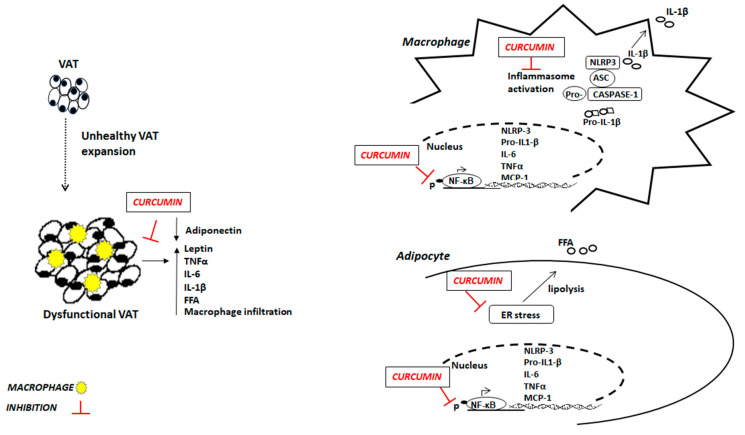
Curcumin is a lipophilic polyphenol, isolated from the plant turmeric of Curcuma longa. Curcuma longa has always been used in traditional medicine in Asian countries because it is believed to have numerous health benefits. Nowadays it is widely used as spice component and in emerging nutraceutical food worldwide. Numerous studies have shown that curcumin possesses, among others, potential anti-inflammatory properties. Obesity represents a main risk factor for several chronic diseases, including type 2 diabetes, cardiovascular disease, and some types of cancer. The establishment of a low-grade chronic inflammation, both systemically and locally in adipose tissue, occurring in obesity most likely represents a main factor in the pathogenesis of chronic diseases. The molecular mechanisms responsible for the onset of the obesity-associated inflammation are different from those involved in the classic inflammatory response caused by infections and involves different signaling pathways. The inflammatory process in obese people is triggered by an inadequate intake of nutrients that produces quantitative and qualitative alterations of adipose tissue lipid content, as well as of various molecules that act as endogenous ligands to activate immune cells. In particular, dysfunctional adipocytes secrete inflammatory cytokines and chemokines, the adipocytokines, able to recruit immune cells into adipose tissue, amplifying the inflammatory response also at systemic level. This review summarizes the most recent studies focused at elucidating the molecular targets of curcumin activity responsible for its anti-inflammatory properties in obesity-associated inflammation and related pathologies.
姜黄素是一种亲脂性多酚,从姜黄植物姜黄中分离得到。姜黄在亚洲传统医学中一直被使用,因为它被认为具有许多健康益处。如今,它在全球范围内被广泛用作香料成分和新兴的营养食品。许多研究表明,姜黄素具有潜在的抗炎特性。肥胖是多种慢性疾病的主要危险因素,包括 2 型糖尿病、心血管疾病和某些类型的癌症。在肥胖中发生的全身性和局部脂肪组织中低度慢性炎症的建立,很可能是慢性疾病发病机制中的主要因素。与感染引起的经典炎症反应相关的肥胖相关炎症的分子机制与不同的信号通路不同。肥胖人群的炎症过程是由营养摄入不足引起的,这会导致脂肪组织脂质含量以及各种作为内源性配体激活免疫细胞的分子发生数量和质量的改变。特别是,功能失调的脂肪细胞分泌炎症细胞因子和趋化因子,即脂肪细胞因子,能够将免疫细胞招募到脂肪组织中,在全身水平上放大炎症反应。这篇综述总结了最近的研究,这些研究集中于阐明姜黄素活性的分子靶点,这些靶点负责其在肥胖相关炎症和相关病理中的抗炎特性。