Université de Rennes, CHU Rennes, Inserm, EHESP, Irset (Institut de Recherche en Santé Environnement Travail), UMRS 1085, 35000 Rennes, France.
Parasite. 2021;28:33. doi: 10.1051/parasite/2021034. Epub 2021 Apr 2.
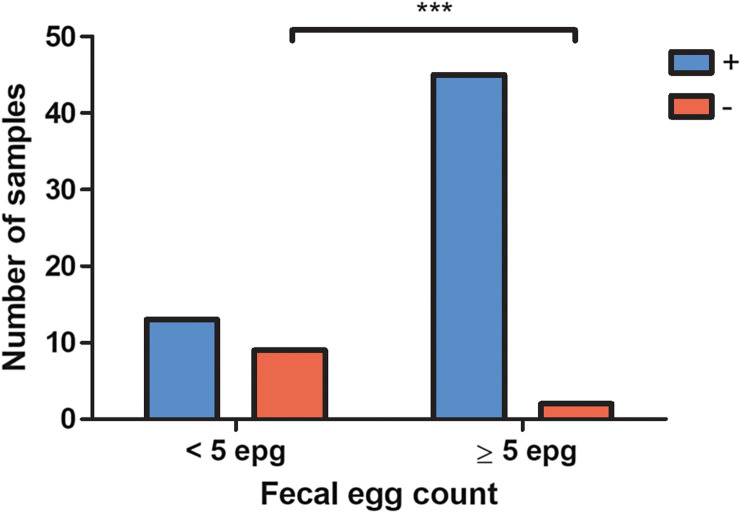
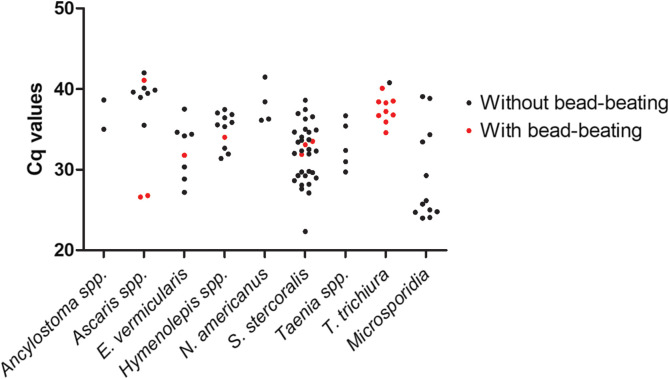
Molecular biology has been gaining more importance in parasitology. Recently, a commercial multiplex PCR assay detecting helminths was marketed: the Allplex™ GI-Helminth(I) Assay. It targets Ancylostoma spp., Ascaris spp., Enterobius vermicularis, Hymenolepis spp., Necator americanus, Strongyloides spp., Taenia spp. and Trichuris trichiura, but also the two most common microsporidia genera in human health, i.e. Enterocytozoon spp. and Encephalitozoon spp. This study aimed to evaluate and compare the Allplex™ GI-Helminth(I) Assay to classical diagnostic methods, based on a cohort of 110 stool samples positive for helminths (microscopy) or for microsporidia (PCR). Samples were stored at -80 °C until analysis by the Allplex™ GI-Helminth(I) Assay. False-negatives were re-tested with bead-beating pretreatment. Without mechanical lysis, concordance and agreement between microscopy and Allplex™ GI-Helminth(I) Assay ranged from 91% to 100% and from 0.15 to 1.00, respectively depending on the target. Concordance was perfect for Taenia spp. (n = 5) and microsporidia (n = 10). False-negative results were observed in 54% (6/13), 34% (4/11) and 20% (7/35) of cases, for hookworms, E. vermicularis and Strongyloides spp. detection, respectively. For these targets, pretreatment improved the results, but only slightly. Trichuris trichiura detection was critically low without pretreatment, as only 9% (1/11) of the samples were positive, but detection reached 91% (10/11) with bead-beating pretreatment. Mechanical lysis was also needed for Ascaris spp. and Hymenolepis spp. to reduce false-negative results from 1/8 to 1/21, respectively, to none for both. Overall, with an optimized extraction process, the Allplex™ GI-Helminth(I) Assay allows the detection of numerous parasites with roughly equivalent performance to that of microscopy, except for hookworms.
分子生物学在寄生虫学中的重要性日益增加。最近,一种用于检测蠕虫的商业多重 PCR 检测试剂盒上市:Allplex™ GI-寄生虫(I)检测试剂盒。它针对的是Ancylostoma spp.、Ascaris spp.、Enterobius vermicularis、Hymenolepis spp.、Necator americanus、Strongyloides spp.、Taenia spp. 和 Trichuris trichiura,但也针对人类健康中最常见的两种微孢子虫属,即 Enterocytozoon spp. 和 Encephalitozoon spp.。本研究旨在评估和比较 Allplex™ GI-寄生虫(I)检测试剂盒与经典诊断方法,基于一组 110 份粪便样本,这些样本经显微镜检查或 PCR 检查显示为寄生虫(显微镜)或微孢子虫(PCR)阳性。样本在 -80°C 下储存,直到用 Allplex™ GI-寄生虫(I)检测试剂盒进行分析。对假阴性样本进行珠磨预处理后再检测。未经机械裂解,显微镜和 Allplex™ GI-寄生虫(I)检测试剂盒之间的一致性和符合率分别在 0.91 到 1.00 之间,取决于检测的目标。对于 Taenia spp.(n=5)和微孢子虫(n=10),一致性是完美的。在钩虫(n=13)、E. vermicularis(n=11)和 Strongyloides spp.(n=35)的检测中,分别观察到 54%(6/13)、34%(4/11)和 20%(7/35)的假阴性结果。对于这些目标,预处理虽然可以提高结果,但效果甚微。未经预处理时,Trichuris trichiura 的检测率非常低,仅 11%(1/11)的样本呈阳性,但经珠磨预处理后,检测率达到 91%(10/11)。对于 Ascaris spp. 和 Hymenolepis spp.,也需要进行机械裂解,以分别将假阴性结果从 1/8 降低到 1/21,甚至完全消除。总体而言,通过优化提取过程,Allplex™ GI-寄生虫(I)检测试剂盒可以检测到许多寄生虫,其性能与显微镜检查大致相当,除了钩虫。