Department of Public Health, Clinical Pharmacology, Pharmacy, and Environmental Medicine, University of Southern Denmark, Odense, Denmark.
Mental Health Services Region of Southern Denmark, Department of Psychiatry Aabenraa, Aabenraa, Denmark.
Epidemiol Psychiatr Sci. 2021 Apr 6;30:e28. doi: 10.1017/S2045796021000159.
Antipsychotics are primarily labelled for the treatment of severe mental illness and have documented clinical utility in certain neurological disorders or palliative care. However, off-label use of antipsychotics is common and increasing, and prior studies on antipsychotic utilisation have not specifically assessed users in neurology, palliative care or general practice. We aimed to explore diagnoses associated with antipsychotic use, treatment patterns and characteristics of users without diagnoses relevant to antipsychotic treatment.
Population-based study identifiying all users of antipsychotics in Denmark (pop 5.7 mio.) 1997-2018 in the Danish National Prescription Register (DNPR). Possible indications for antipsychotic therapy were evaluated using in- and outpatient contacts from the DNPR. Users were divided hierarchically into six groups: severe mental disorders (schizophrenia, bipolar-spectrum disorders), chronic mental disorders (dementias, mental retardation, autism), other mental disorders (depression-spectrum, anxiety and personality disorders, etc.), selected neurological diseases, cancer and antipsychotic users without any of these diagnoses. This last group was characterised regarding demographics, antipsychotic use, health care utilisation and likely antipsychotic treatment initiator in 2018.
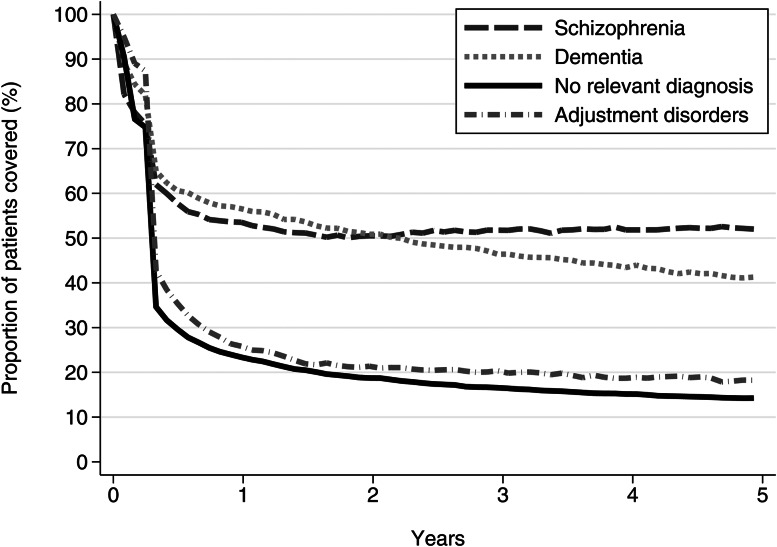
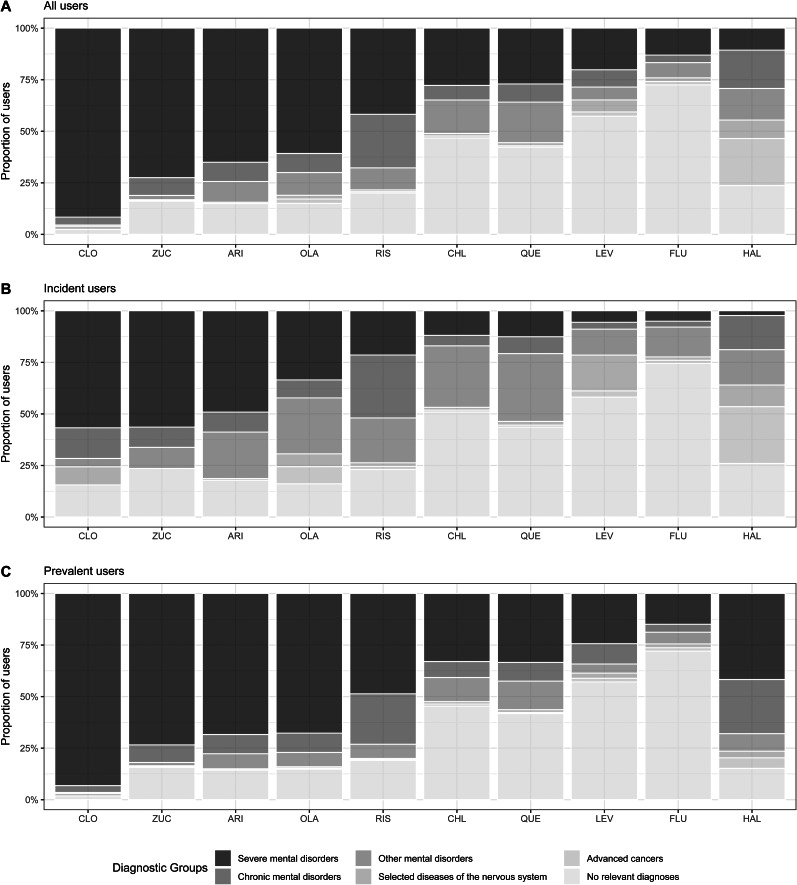
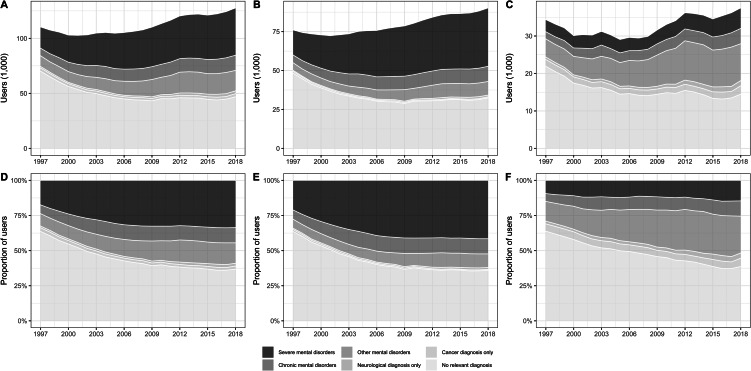
Altogether, 630 307 antipsychotic users were identified, of whom 127 649 had filled prescriptions during 2018. Users without diagnoses relevant to antipsychotic treatment comprised of the largest group (37%), followed by schizophrenia and bipolar-spectrum disorders (34%), other mental disorders (15%), dementia, autism and mental retardation (11%), cancer (2.2%) and neurological diagnoses (2.0%). Of 37 478 incident users in 2018, 39% had no diagnosis relevant to antipsychotic treatment, 7.9% had major depression, 7.7% neurotic/stress-related disorders and 7.5% dementia. Quetiapine was most commonly used, both overall (51%) and among users without diagnoses relevant to antipsychotic treatment (58%). Of 14 474 incident users in 2018 without diagnoses relevant to antipsychotic treatment, treatment was most likely initiated by a general practitioner (65%), with only 17% seeing a psychiatrist during the following year. As many as 18% of patients with adjustment disorders and 14% of those without relevant diagnoses for antipsychotic use, remained on antipsychotic treatment 5 years after their first prescription.
Over one-third of antipsychotic users in Denmark did not have psychiatric, neurological or cancer diagnoses as possible indications for antipsychotic therapy. Many antipsychotics are initiated or prescribed in general practice, and a concerningly large subgroup without documented diagnoses relevant for antipsychotics continued to receive them. Rational prescribing, adequate side effect monitoring and further research into reasons for the observed antipsychotic use patterns and their risk-benefit ratio are needed.
抗精神病药主要用于治疗严重精神疾病,并在某些神经疾病或姑息治疗中具有已证实的临床效用。然而,抗精神病药的超适应证使用很常见且呈上升趋势,之前关于抗精神病药使用的研究并未特别评估神经病学、姑息治疗或一般实践中的使用者。我们旨在探讨与抗精神病药使用相关的诊断、治疗模式以及无相关抗精神病药治疗诊断的使用者的特征。
本研究为一项基于人群的研究,在丹麦国家处方登记处(DNPR)中确定了 1997 年至 2018 年期间丹麦所有使用抗精神病药的患者(人口 570 万)。使用 DNPR 的门诊和住院接触情况评估抗精神病药治疗的可能适应证。根据 2018 年的门诊和住院接触情况,使用者分为六个层次:严重精神障碍(精神分裂症、双相谱系障碍)、慢性精神障碍(痴呆、精神发育迟滞、自闭症)、其他精神障碍(抑郁谱系、焦虑和人格障碍等)、选定的神经疾病、癌症和无任何这些诊断的抗精神病药使用者。最后一组的特征包括人口统计学特征、抗精神病药使用、医疗保健利用情况以及 2018 年可能的抗精神病药治疗启动者。
共确定了 630307 名抗精神病药使用者,其中 127649 名在 2018 年期间有处方。无相关诊断的抗精神病药使用者构成了最大的群体(37%),其次是精神分裂症和双相谱系障碍(34%)、其他精神障碍(15%)、痴呆、自闭症和精神发育迟滞(11%)、癌症(2.2%)和神经疾病诊断(2.0%)。在 2018 年新诊断的 37478 名使用者中,39%没有与抗精神病药治疗相关的诊断,7.9%患有重度抑郁症,7.7%患有神经症/应激相关障碍,7.5%患有痴呆。喹硫平是最常用的药物,总体上(51%)和无相关诊断的使用者中(58%)均如此。在 2018 年新诊断的 14474 名无相关诊断的使用者中,最有可能由全科医生启动治疗(65%),随后一年内只有 17%的患者看了精神科医生。调整障碍患者中有 18%,无相关抗精神病药使用诊断的患者中有 14%,在首次处方后 5 年内仍继续接受抗精神病药治疗。
丹麦超过三分之一的抗精神病药使用者没有可能需要抗精神病药治疗的精神、神经或癌症诊断。许多抗精神病药是在全科医生处启动或处方的,大量无明确诊断但与抗精神病药相关的使用者继续接受抗精神病药治疗。需要合理处方、充分监测副作用,并进一步研究观察到的抗精神病药使用模式及其风险-效益比的原因。