Key Lab of Urban Environment and Health, Institute of Urban Environment, Chinese Academy of Sciences, Xiamen, China.
Sustainability in Manufacturing and Life Cycle Engineering Research Group, School of Mechanical and Manufacturing Engineering, The University of New South Wales, Sydney, Australia.
Nat Commun. 2021 Apr 6;12(1):2066. doi: 10.1038/s41467-021-22245-6.
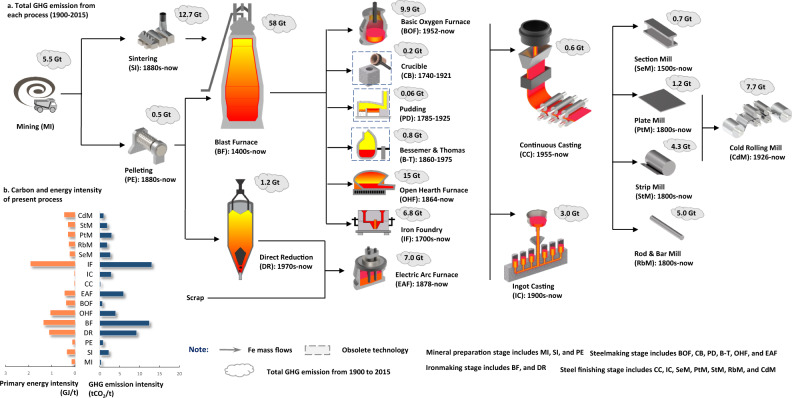
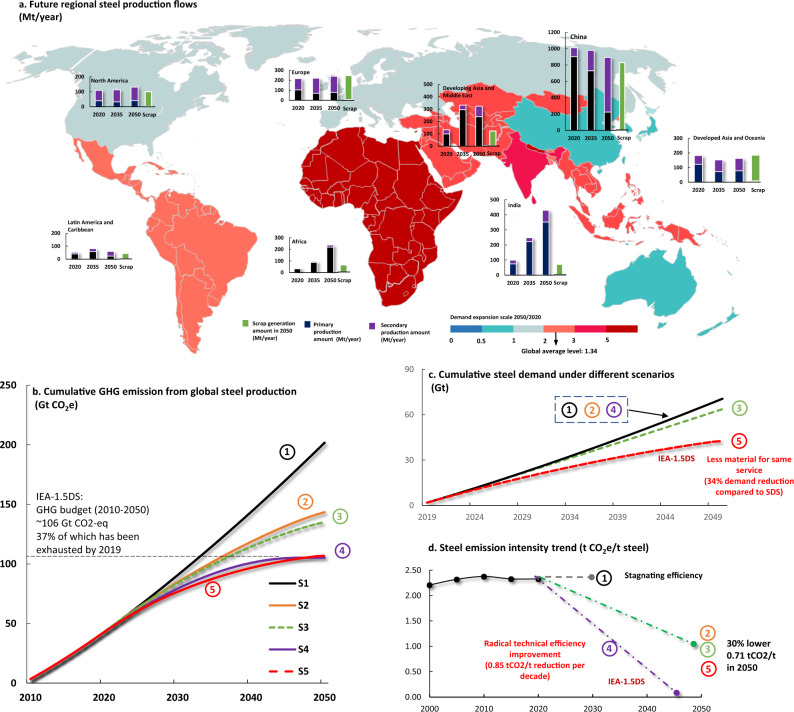
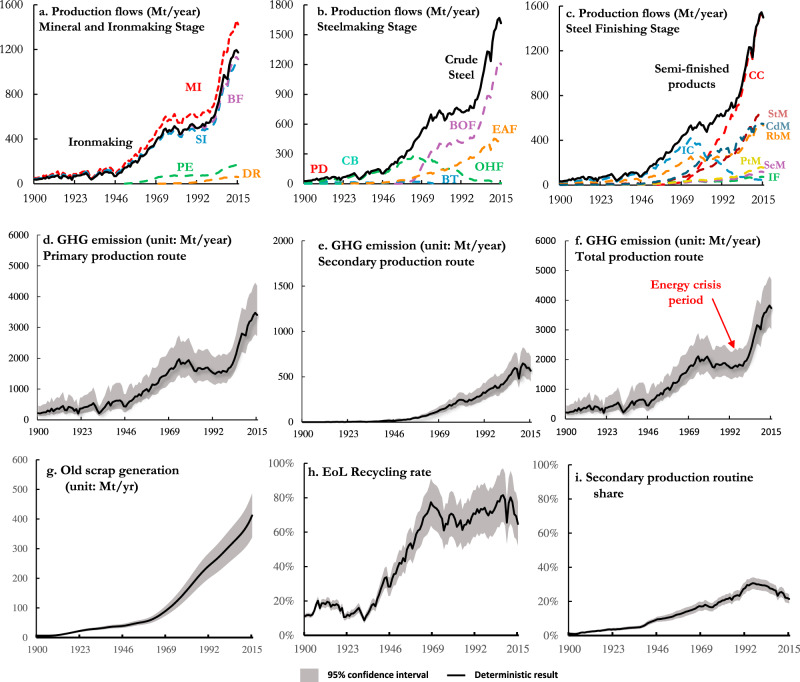
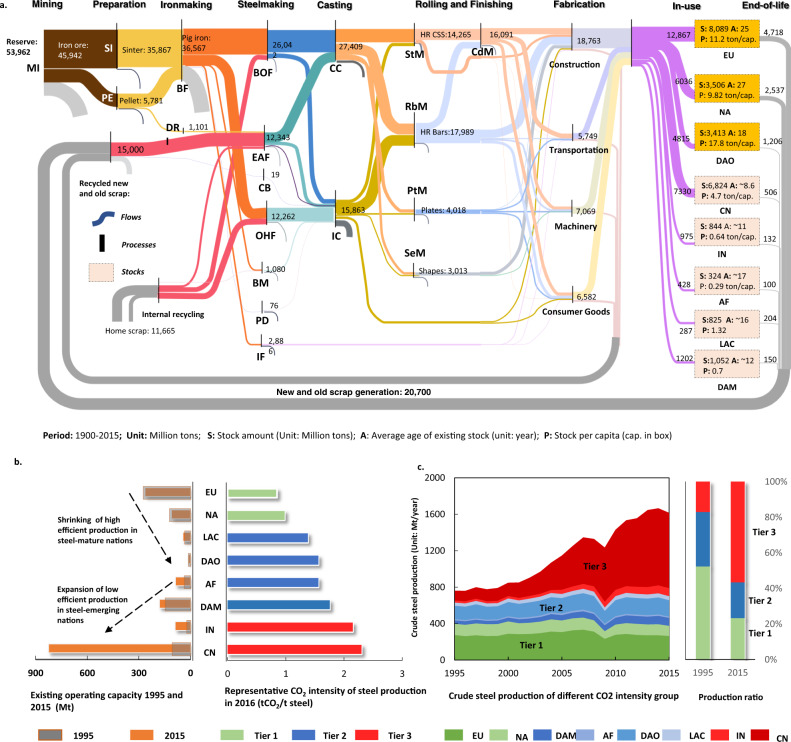
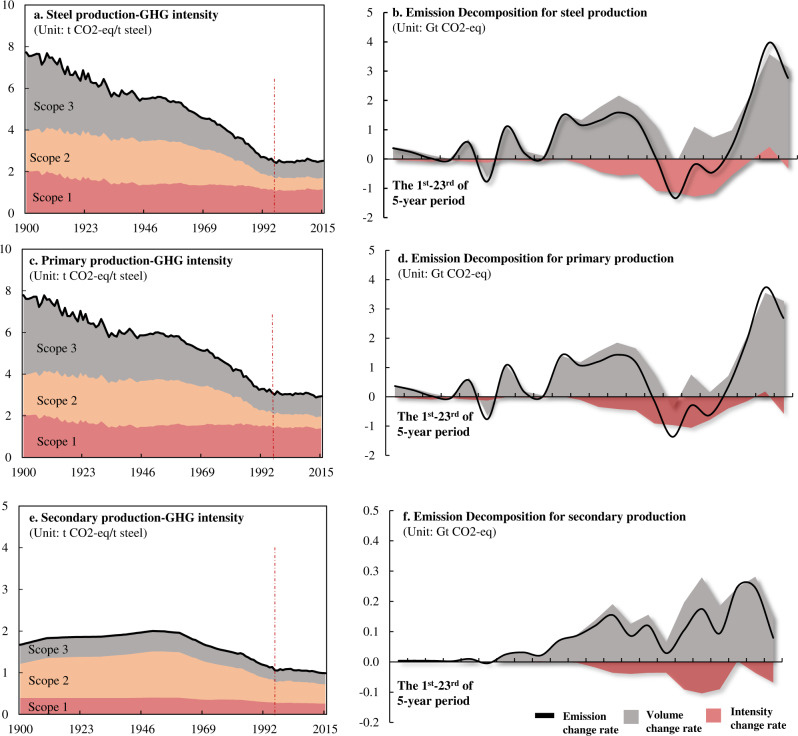
Steel production is a difficult-to-mitigate sector that challenges climate mitigation commitments. Efforts for future decarbonization can benefit from understanding its progress to date. Here we report on greenhouse gas emissions from global steel production over the past century (1900-2015) by combining material flow analysis and life cycle assessment. We find that 45 Gt steel was produced in this period leading to emissions of ~147 Gt CO-eq. Significant improvement in process efficiency (67%) was achieved, but was offset by a 44-fold increase in annual steel production, resulting in a 17-fold net increase in annual emissions. Despite some regional technical improvements, the industry's decarbonization progress at the global scale has largely stagnated since 1995 mainly due to expanded production in emerging countries with high carbon intensity. Our analysis of future scenarios indicates that the expected demand expansion in these countries may jeopardize steel industry's prospects for following 1.5 °C emission reduction pathways. To achieve the Paris climate goals, there is an urgent need for rapid implementation of joint supply- and demand-side mitigation measures around the world in consideration of regional conditions.
钢铁生产是一个难以减排的行业,对气候减排承诺构成挑战。未来脱碳的努力可以从了解其迄今为止的进展中受益。在这里,我们通过结合物质流分析和生命周期评估,报告了过去一个世纪(1900-2015 年)全球钢铁生产的温室气体排放情况。我们发现,在此期间生产了约 45 亿吨钢,导致约 147 亿吨 CO-eq 的排放。工艺效率有了显著提高(约 67%),但被年度钢铁产量增加 44 倍所抵消,导致年度排放量净增加 17 倍。尽管一些地区在技术上有所改进,但自 1995 年以来,全球范围内该行业的脱碳进展基本停滞不前,主要原因是高碳强度的新兴国家的产量扩大。我们对未来情景的分析表明,这些国家预计的需求增长可能危及钢铁行业遵循 1.5°C 减排途径的前景。为了实现巴黎气候目标,需要在全球范围内根据区域条件,紧急实施联合供需缓解措施。