Department of Ophthalmology, Seoul National University College of Medicine, 103 Daehak-ro, Jongno-gu, Seoul, 03080, Republic of Korea.
Department of Ophthalmology, Seoul National University Hospital, 101 Daehak-ro, Jongno-gu, Seoul, 03080, Republic of Korea.
BMC Microbiol. 2021 Apr 9;21(1):106. doi: 10.1186/s12866-021-02173-7.
While aging is a potent risk factor of dry eye disease, age-related gut dysbiosis is associated with inflammation and chronic geriatric diseases. Emerging evidence have demonstrated that gut dysbiosis contributes to the pathophysiology or exacerbation of ocular diseases including dry eye disease. However, the relationship between aging-related changes in gut microbiota and dry eye disease has not been elucidated. In this pilot study, we investigated the association between aging-dependent microbiome changes and dry eye severity in C57BL/6 male mice.
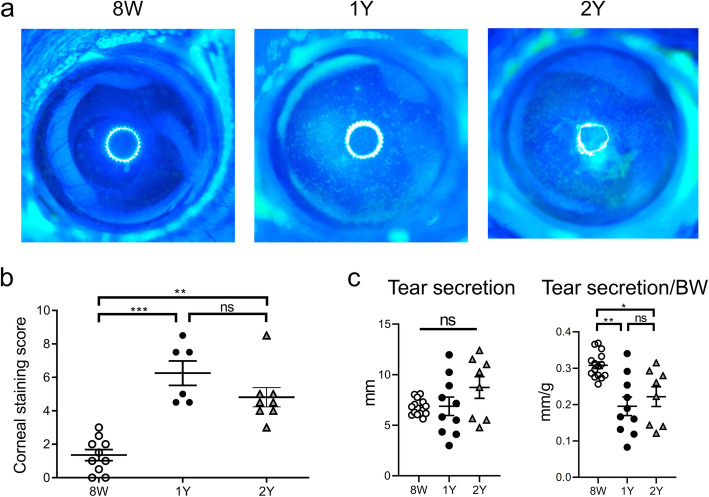
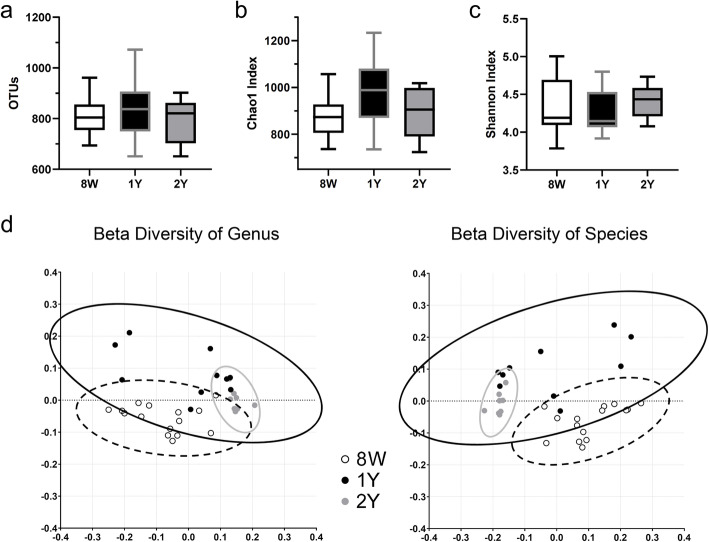
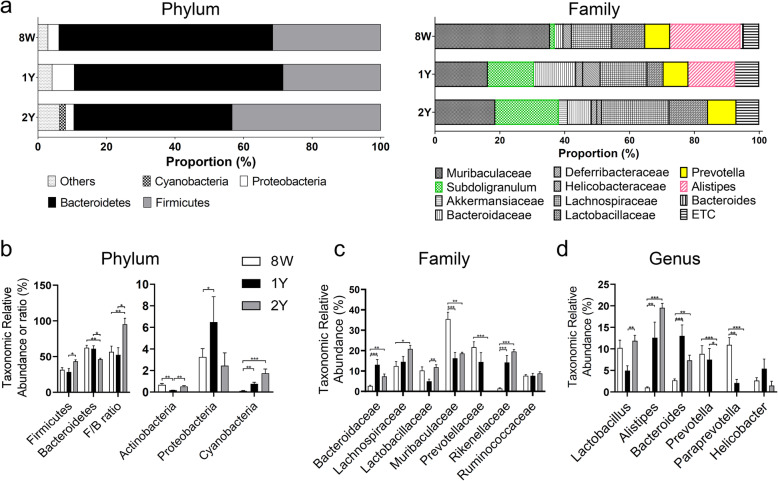
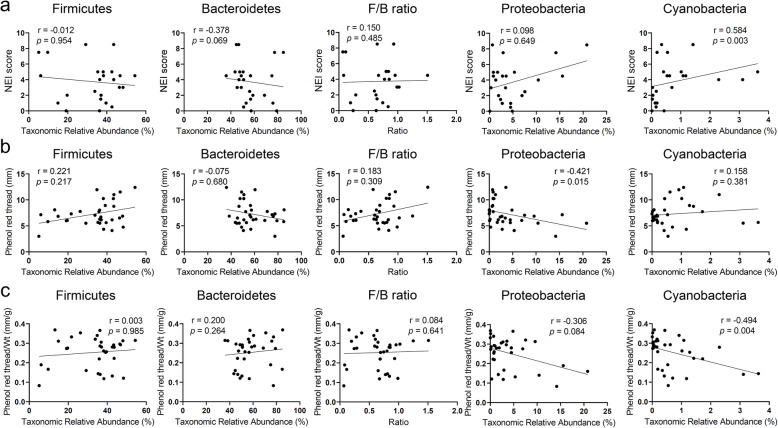
Eight-week-old (8 W, n = 15), one-year-old (1Y, n = 10), and two-year-old (2Y, n = 8) C57BL/6 male mice were used. Dry eye severity was assessed by corneal staining scores and tear secretion. Bacterial genomic 16 s rRNA from feces was analyzed. Main outcomes were microbiome compositional differences among the groups and their correlation to dry eye severity. In aged mice (1Y and 2Y), corneal staining increased and tear secretion decreased with statistical significance. Gut microbiome α-diversity was not different among the groups. However, β-diversity was significantly different among the groups. In univariate analysis, phylum Firmicutes, Proteobacteria, and Cyanobacteria, Firmicutes/Bacteroidetes ratio, and genus Alistipes, Bacteroides, Prevotella, Paraprevotella, and Helicobacter were significantly related to dry eye severity. After adjustment of age, multivariate analysis revealed phylum Proteobacteria, Firmicutes/Bacteroidetes ratio, and genus Lactobacillus, Alistipes, Prevotella, Paraprevotella, and Helicobacter to be significantly associated with dry eye severity.
Our pilot study suggests that aging-dependent changes in microbiome composition are related to severity of dry eye signs in C57BL/6 male mice.
虽然衰老时发生干眼症的一个重要危险因素,但与年龄相关的肠道菌群失调与炎症和慢性老年疾病有关。新出现的证据表明,肠道菌群失调会导致包括干眼症在内的眼部疾病的病理生理学或恶化。然而,与衰老相关的肠道微生物组变化和干眼症之间的关系尚未阐明。在这项初步研究中,我们研究了 C57BL/6 雄性小鼠中与衰老相关的微生物组变化与干眼症严重程度之间的关系。
使用了 8 周龄(8W,n=15)、1 岁(1Y,n=10)和 2 岁(2Y,n=8)的 C57BL/6 雄性小鼠。通过角膜染色评分和泪液分泌评估干眼症严重程度。分析粪便中的细菌基因组 16s rRNA。主要结果是组间微生物组组成差异及其与干眼症严重程度的相关性。在老年小鼠(1Y 和 2Y)中,角膜染色增加,泪液分泌减少,差异具有统计学意义。组间肠道微生物组α多样性无差异。然而,β多样性在组间有显著差异。在单变量分析中,门Firmicutes、Proteobacteria 和 Cyanobacteria、Firmicutes/Bacteroidetes 比值以及属 Alistipes、Bacteroides、Prevotella、Paraprevotella 和 Helicobacter 与干眼症严重程度显著相关。在调整年龄后,多变量分析显示门 Proteobacteria、Firmicutes/Bacteroidetes 比值以及属 Lactobacillus、Alistipes、Prevotella、Paraprevotella 和 Helicobacter 与干眼症严重程度显著相关。
我们的初步研究表明,微生物组组成随年龄的变化与 C57BL/6 雄性小鼠干眼症体征的严重程度有关。