The George Washington University Cancer Center, School of Medicine and Health Sciences, George Washington University, Washington, DC, United States.
Front Immunol. 2021 Mar 23;12:600659. doi: 10.3389/fimmu.2021.600659. eCollection 2021.
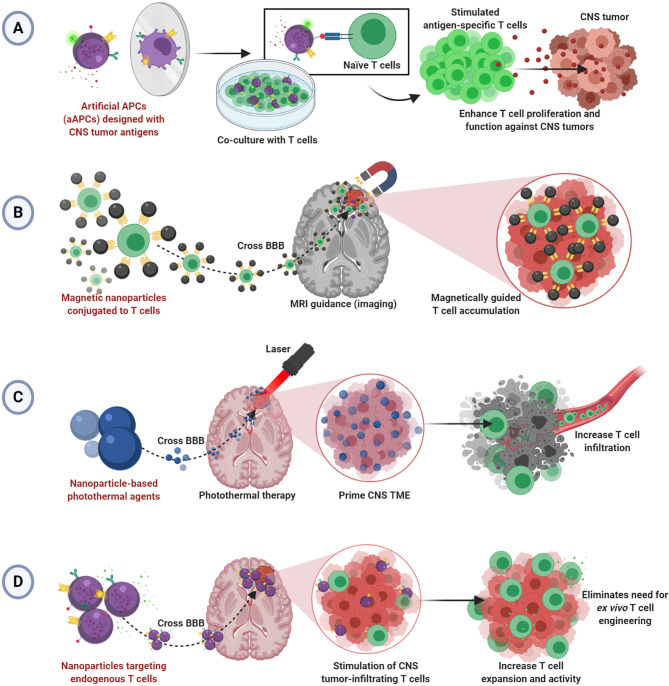
Adoptive T cell therapy has emerged as a revolutionary immunotherapy for treating cancer. Despite immense promise and clinical success in some hematologic malignancies, limitations remain that thwart its efficacy in solid tumors. Particularly in tumors of the central nervous system (CNS), T cell therapy is often restricted by the difficulty in intratumoral delivery across anatomical niches, suboptimal T cell specificity or activation, and intratumoral T cell dysfunction due to immunosuppressive tumor microenvironments (TMEs). Nanoparticles may offer several advantages to overcome these limitations of T cell therapy, as they can be designed to robustly and specifically activate T cells prior to adoptive transfer, to encapsulate T cell stimulating agents for co-localized stimulation, and to be conjugated onto T cells for added functionality. This perspective highlights recent preclinical advances in using nanoparticles to enhance T cell therapy, and discusses the potential applicability and constraints of nanoparticle-enhanced T cells as a new platform for treating CNS tumors.
过继性 T 细胞疗法已成为治疗癌症的一种革命性免疫疗法。尽管在某些血液恶性肿瘤中具有巨大的潜力和临床成功,但仍存在一些限制,阻碍了其在实体肿瘤中的疗效。特别是在中枢神经系统 (CNS) 的肿瘤中,T 细胞疗法通常受到肿瘤内递送到解剖龛位的困难、T 细胞特异性或激活的不理想以及肿瘤内免疫抑制肿瘤微环境 (TME) 导致的 T 细胞功能障碍的限制。纳米颗粒可能具有克服 T 细胞疗法这些限制的几个优势,因为它们可以设计为在过继转移前强大且特异性地激活 T 细胞,封装 T 细胞刺激剂以进行局部刺激,并连接到 T 细胞上以增加功能。本观点重点介绍了使用纳米颗粒增强 T 细胞疗法的最新临床前进展,并讨论了纳米颗粒增强 T 细胞作为治疗 CNS 肿瘤的新平台的潜在适用性和限制。