Department of Socio-Medical Sciences, Erasmus School of Health Policy & Management, Erasmus University Rotterdam, Rotterdam, the Netherlands.
BMC Fam Pract. 2021 Apr 9;22(1):70. doi: 10.1186/s12875-021-01420-0.
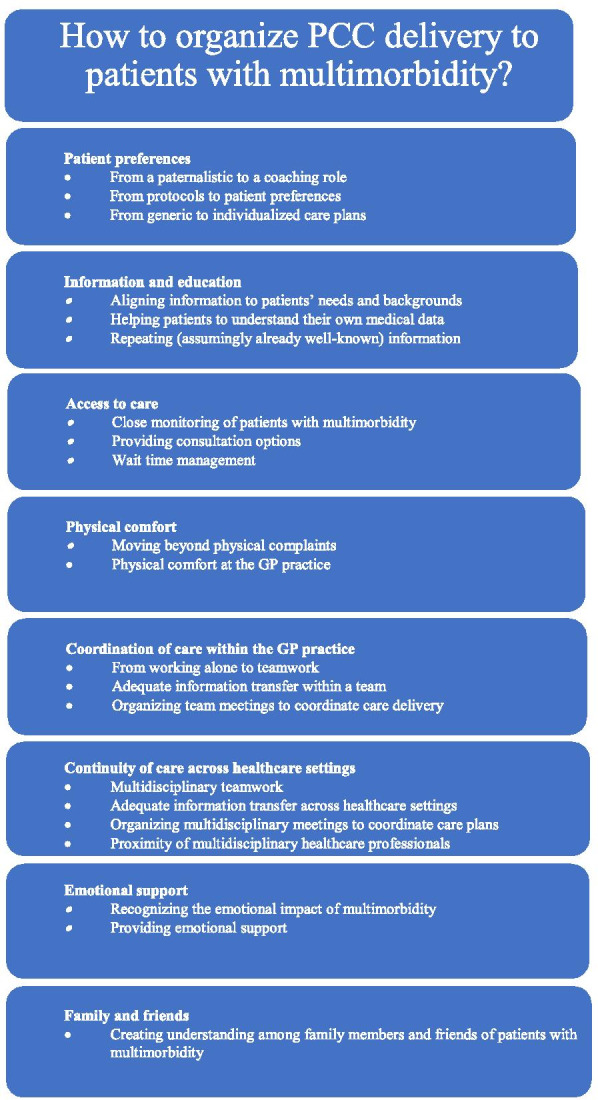
The present study describes how primary care can be improved for patients with multimorbidity, based on the evaluation of a patient-centered care (PCC) improvement program designed to foster the eight PCC dimensions (patient preferences, information and education, access to care, physical comfort, coordination of care, continuity and transition, emotional support, and family and friends). This study characterizes the interventions implemented in practice as part of the PCC improvement program and describes the experiences of healthcare professionals and patients with the resulting PCC delivery.
This study employed a mixed-methods design. Semi-structured interviews were conducted with nine general practitioners and nurse practitioners from seven primary care practices in Noord-Brabant, the Netherlands, that participated in the program (which included interventions and workshops). The qualitative interview data were examined using thematic analysis. A longitudinal survey was conducted with 138 patients with multimorbidity from these practices to assess perceived improvements in PCC and its underlying dimensions. Paired sample t tests were performed to compare survey responses obtained at a 1-year interval corresponding to program implementation.
The PCC improvement program is described, and themes necessary for PCC improvement according to healthcare professionals were generated [e.g. Aligning information to patients' needs and backgrounds, adapting a coaching role]. PCC experiences of patients with multimorbidity improved significantly during the year in which the PCC interventions were implemented (t = 2.66, p = 0.005).
This study revealed how primary PCC can be improved for patients with multimorbidity. It emphasizes the importance of investing in PCC improvement programs to tailor care delivery to heterogenous patients with multimorbidity with diverse care needs. This study generates new perspectives on care delivery and highlights opportunities for its improvement according to the eight dimensions of PCC for patients with multimorbidity in a primary care setting.
本研究描述了如何改进初级保健,以满足患有多种疾病的患者的需求,其基础是评估一项以患者为中心的护理(PCC)改进计划,该计划旨在促进 PCC 的八个维度(患者偏好、信息和教育、获得护理的机会、身体舒适度、护理协调、连续性和过渡、情感支持以及家人和朋友)。本研究描述了实践中实施的干预措施,并描述了医疗保健专业人员和患者对由此产生的 PCC 服务的体验。
本研究采用混合方法设计。对来自荷兰北布拉班特省的 7 个初级保健实践中的 9 名全科医生和护士从业者进行了半结构式访谈,他们参与了该计划(包括干预措施和讲习班)。使用主题分析方法对定性访谈数据进行了检查。对这些实践中的 138 名患有多种疾病的患者进行了纵向调查,以评估对 PCC 及其基本维度的感知改善。对在对应于计划实施的 1 年间隔获得的调查答复进行了配对样本 t 检验。
描述了 PCC 改进计划,并生成了根据医疗保健专业人员确定的 PCC 改进主题[例如,将信息与患者的需求和背景相匹配,调整辅导角色]。患有多种疾病的患者的 PCC 体验在实施 PCC 干预的那一年中显著改善(t=2.66,p=0.005)。
本研究揭示了如何为患有多种疾病的患者改进初级保健中的 PCC。它强调了投资于 PCC 改进计划的重要性,以根据不同的护理需求,为具有不同需求的患有多种疾病的异质患者定制护理服务。本研究根据初级保健环境中患有多种疾病的患者的 PCC 的八个维度,为患者的护理服务提供了新的视角,并突出了改善护理服务的机会。