Quiroga Borja, Sánchez-Álvarez Emilio, Ortiz Alberto, de Sequera Patricia
Nephrology Department, Hospital Universitario de La Princesa, Madrid, Spain.
Nephrology Department, Hospital Universitario de Cabueñes, Gijón, Spain.
Clin Kidney J. 2021 Jan 18;14(4):1216-1221. doi: 10.1093/ckj/sfab009. eCollection 2021 Apr.
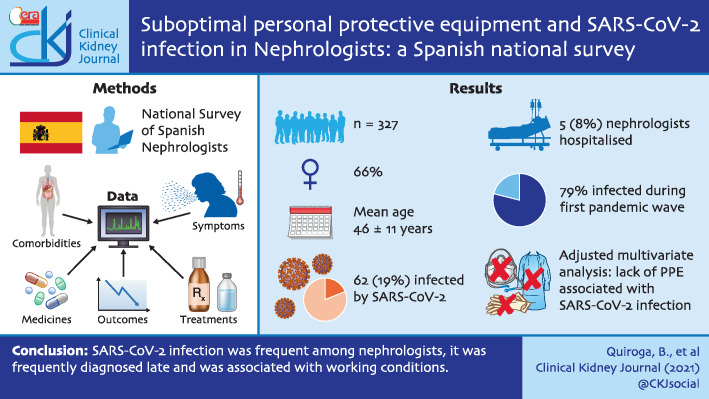
Healthcare workers have been overexposed to severe acute respiratory syndrome coronavirus 2 (SARS-CoV-2) during the current pandemic, but there is little information on the impact of SARS-CoV-2 on nephrologists. The aim of this study was to assess SARS-CoV-2 infections in nephrologists in the first and second pandemic waves, describing risk factors and clinical features.
This national survey was sent to Spanish nephrologists. Epidemiological data, comorbidities and medications were collected and compared between infected and non-infected nephrologists. Symptoms, prescribed treatments and outcomes are described for infected nephrologists.
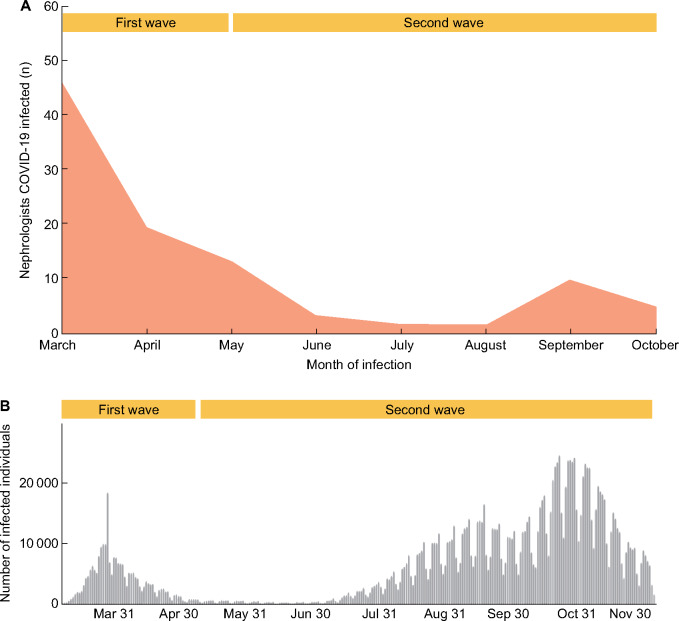
Three hundred and twenty-seven nephrologists (66% female, age 46 ± 11 years) completed the survey. Of them, 62 (19%) were infected by SARS-CoV-2. Infection was detected by real-time reverse transcription-polymerase chain reaction in the 37 symptomatic patients (62%) and by serological tests in 25 (38%) asymptomatic individuals. Five (8%) of the infected nephrologists were hospitalized. Contrary to the general population, most infections occurred during the first pandemic wave and, specifically, during the first month, when personal protective equipment (PPE) shortages were more severe. Factors associated with infection in univariate analysis were younger age (P = 0.004), work in non-nephrology departments (P = 0.045), higher exposure to coronavirus disease 2019 patients (P < 0.001), lack of appropriate PPE (P < 0.001) and non-O ABO blood group. In an adjusted multivariate model, only lack of appropriate PPE remained predictive of infection [hazard ratio 3.5 (95% confidence interval 1.9-6.8), P < 0.0001].
SARS-CoV-2 infection was frequent among nephrologists, was frequently diagnosed late and was associated with working conditions.
在当前疫情期间,医护人员过度暴露于严重急性呼吸综合征冠状病毒2(SARS-CoV-2)之下,但关于SARS-CoV-2对肾病学家的影响的信息却很少。本研究的目的是评估第一波和第二波疫情期间肾病学家中的SARS-CoV-2感染情况,描述危险因素和临床特征。
这项全国性调查发送给了西班牙的肾病学家。收集了流行病学数据、合并症和用药情况,并在感染和未感染的肾病学家之间进行比较。对感染的肾病学家的症状、规定的治疗方法和结果进行了描述。
327名肾病学家(66%为女性,年龄46±11岁)完成了调查。其中,62人(19%)感染了SARS-CoV-2。37名有症状的患者(62%)通过实时逆转录-聚合酶链反应检测到感染,25名(38%)无症状个体通过血清学检测发现感染。5名(8%)感染的肾病学家住院治疗。与普通人群相反,大多数感染发生在第一波疫情期间,特别是在第一个月,当时个人防护装备(PPE)短缺更为严重。单因素分析中与感染相关的因素包括年龄较小(P = 0.004)、在非肾病科室工作(P = 0.045)、接触2019冠状病毒病患者的机会较多(P < 0.001)、缺乏合适的PPE(P < 0.001)和非O型ABO血型。在调整后的多变量模型中,只有缺乏合适的PPE仍然是感染的预测因素[风险比3.5(95%置信区间1.9 - 6.8),P < 0.0001]。
SARS-CoV-2感染在肾病学家中很常见,经常诊断较晚,且与工作条件有关。