Cardiac Electrophysiology Research and Training Center, Faculty of Medicine, Chiang Mai University, Chiang Mai 50200, Thailand.
Center of Excellence in Cardiac Electrophysiology Research, Chiang Mai University, Chiang Mai 50200, Thailand.
J Adv Res. 2020 Sep 28;29:33-44. doi: 10.1016/j.jare.2020.09.007. eCollection 2021 Mar.
Previous studies reported the beneficial effects of pretreatment with melatonin on the heart during cardiac ischemia/reperfusion (I/R) injury. However, the effects of melatonin given after cardiac ischemia, as well as its comparative temporal effects are unknown. These include pretreatment, during ischemia, and at the onset of reperfusion. Also, the association between melatonin receptors and cardiac arrhythmias, mitochondrial function and dynamics, autophagy, and mitophagy during cardiac I/R have not been investigated.
We tested two major hypotheses in this study. Firstly, the temporal effect of melatonin administration exerts different cardioprotective efficacy during cardiac I/R. Secondly, melatonin provides cardioprotective effects via MT2 activation, leading to improvement in cardiac mitochondrial function and dynamics, reduced excessive mitophagy and autophagy, and decreased cardiac arrhythmias, resulting in improved LV function.
Male rats were subjected to cardiac I/R, and divided into 4 intervention groups: vehicle, pretreatment with melatonin, melatonin given during ischemia, and melatonin given at the onset of reperfusion. In addition, either a non-specific melatonin receptor (MT) blocker or specific MT2 blocker was given to rats.
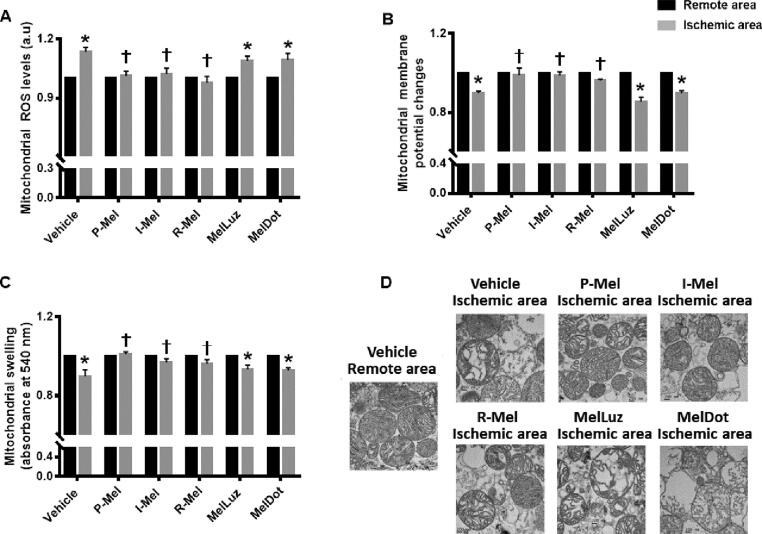
Treatment with melatonin at all time points alleviated cardiac I/R injury to a similar extent, quantified by reduction in infarct size, arrhythmia score, LV dysfunction, cardiac mitochondrial dysfunction, imbalance of mitochondrial dynamics, excessive mitophagy, and a decreased Bax/Bcl2 ratio. In H9C2 cells, melatonin increased %cell viability by reducing mitochondrial dynamic imbalance and a decrease in Bax protein expression. The cardioprotective effects of melatonin were dependent on MT2 activation.
Melatonin given before or after ischemia exerted equal levels of cardioprotection on the heart with I/R injury, and its beneficial effects on cardiac arrhythmias, cardiac mitochondrial function and dynamics were dependent upon the activation of MT2.
先前的研究报告称,在心脏缺血/再灌注(I/R)损伤期间,预先给予褪黑素对心脏有益。然而,心脏缺血后给予褪黑素的效果以及其比较的时间效果尚不清楚。这些包括预处理、缺血期间和再灌注开始时。此外,在心脏 I/R 期间,褪黑素受体与心律失常、线粒体功能和动力学、自噬和线粒体自噬之间的关系尚未得到研究。
本研究检验了两个主要假设。首先,褪黑素给药的时间效应在心脏 I/R 期间产生不同的心脏保护作用。其次,褪黑素通过 MT2 激活提供心脏保护作用,导致心脏线粒体功能和动力学改善,减少过度的线粒体自噬和自噬,并减少心律失常,从而改善 LV 功能。
雄性大鼠进行心脏 I/R,并分为 4 个干预组:载体、褪黑素预处理、缺血期间给予褪黑素和再灌注开始时给予褪黑素。此外,给大鼠给予非特异性褪黑素受体(MT)阻滞剂或特异性 MT2 阻滞剂。
在所有时间点给予褪黑素治疗均能在类似程度上减轻心脏 I/R 损伤,通过减少梗死面积、心律失常评分、LV 功能障碍、心脏线粒体功能障碍、线粒体动力学失衡、过度的线粒体自噬和 Bax/Bcl2 比值降低来量化。在 H9C2 细胞中,褪黑素通过减少线粒体动力学失衡和 Bax 蛋白表达的降低来增加细胞存活率的百分比。褪黑素的心脏保护作用依赖于 MT2 的激活。
在 I/R 损伤的心脏中,缺血前或缺血后给予褪黑素对心脏具有同等水平的保护作用,其对心脏心律失常、心脏线粒体功能和动力学的有益作用取决于 MT2 的激活。