Universidad Científica del Sur, Lima, Peru.
Universidad Privada Norbert Wiener, Lima, Peru; Red Internacional en Salud Colectiva y Salud Intercultural, México, Mexico.
Travel Med Infect Dis. 2021 May-Jun;41:102059. doi: 10.1016/j.tmaid.2021.102059. Epub 2021 Apr 16.
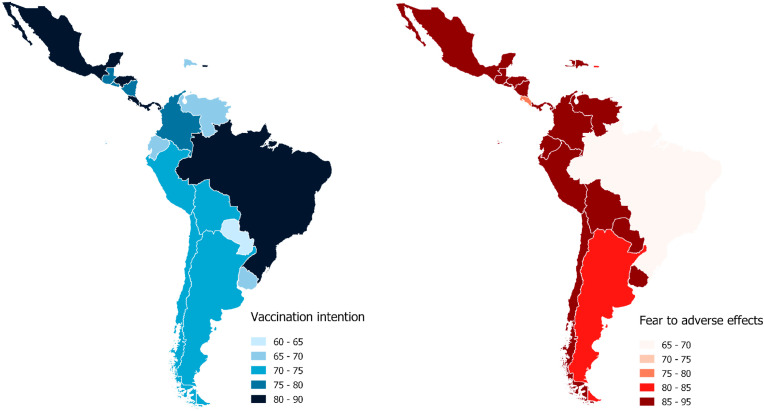
Determinants of vaccine acceptance are multifactorial, complex, and in most cases, context-dependent. We determined the prevalence of COVID-19 vaccination intention (VI) and fear of its adverse effects (FAE) as well as their associated factors in Latin America and the Caribbean (LAC).
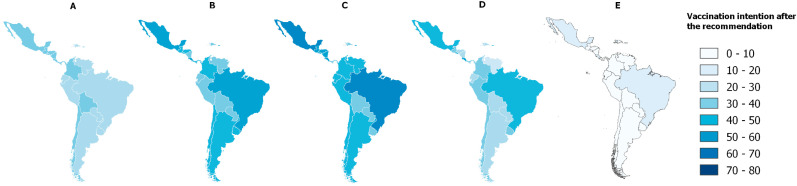
We conducted a secondary cross-sectional analysis of a database collected by the University of Maryland and Facebook. We included participants aged 18 and over from LAC surveyed, January 15 to February 1, 2021. We evaluated VI, FAE, sociodemographic characteristics, COVID-19 symptomatology, compliance with community mitigation strategies, food and economic insecurity, mental health evaluation and the influence in VI when recommended by different stakeholders. We calculated crude and adjusted prevalence ratios with their 95%CIs.
We analyzed 472,521 responses by Latin American adults, finding a VI and FAE prevalence of 80.0% and 81.2%, respectively. We found that female and non-binary genders were associated with a lower probability of VI and a higher probability of FAE. Besides, living in a town, village or rural area and economic insecurity was associated with a higher FAE probability. The fears of becoming seriously ill, a family member becoming seriously ill from COVID-19 and having depressive symptoms were associated with a higher probability of VI and FAE.
Eight out of 10 adults in LAC have VI and FAE. The factors identified are useful for the development of communication strategies to reduce FAE frequency. It is necessary to guarantee mass vaccination and support the return of economic activities.
疫苗接种的决定因素是多方面的、复杂的,而且在大多数情况下是依赖于背景的。我们确定了拉丁美洲和加勒比地区(LAC)对 COVID-19 疫苗接种意向(VI)和对其不良反应的恐惧(FAE)的流行率及其相关因素。
我们对马里兰大学和 Facebook 收集的数据库进行了二次横断面分析。我们纳入了 2021 年 1 月 15 日至 2 月 1 日期间来自 LAC 的年龄在 18 岁及以上的参与者。我们评估了 VI、FAE、社会人口特征、COVID-19 症状、对社区缓解策略的遵守情况、食物和经济不安全、心理健康评估以及不同利益相关者推荐对 VI 的影响。我们计算了粗患病率比及其 95%置信区间(CI)。
我们分析了来自拉丁美洲成年人的 472,521 份回复,发现 VI 和 FAE 的流行率分别为 80.0%和 81.2%。我们发现女性和非二元性别与 VI 概率降低和 FAE 概率升高相关。此外,居住在城镇、村庄或农村地区和经济不安全与 FAE 概率升高相关。担心自己重病、家人因 COVID-19 重病和出现抑郁症状与 VI 和 FAE 概率升高相关。
LAC 地区 8 成人对 COVID-19 疫苗有 VI 和 FAE。确定的因素对于制定减少 FAE 频率的沟通策略是有用的。有必要保证大规模接种疫苗并支持经济活动的恢复。