Mahefarisoa K L, Simon Delso N, Zaninotto V, Colin M E, Bonmatin J M
Catholic University of Louvain, Faculty of bioscience engineering, Place Croix du Sud 2, 1348 Ottignies-Louvain-la-Neuve, Belgium.
Beekeeping Center of Research and Information (CARI asbl), BeeLife European Beekeeping Coordination, Place Croix du Sud 1, 1348 Louvain la Neuve, Belgium.
One Health. 2021 Mar 18;12:100237. doi: 10.1016/j.onehlt.2021.100237. eCollection 2021 Jun.
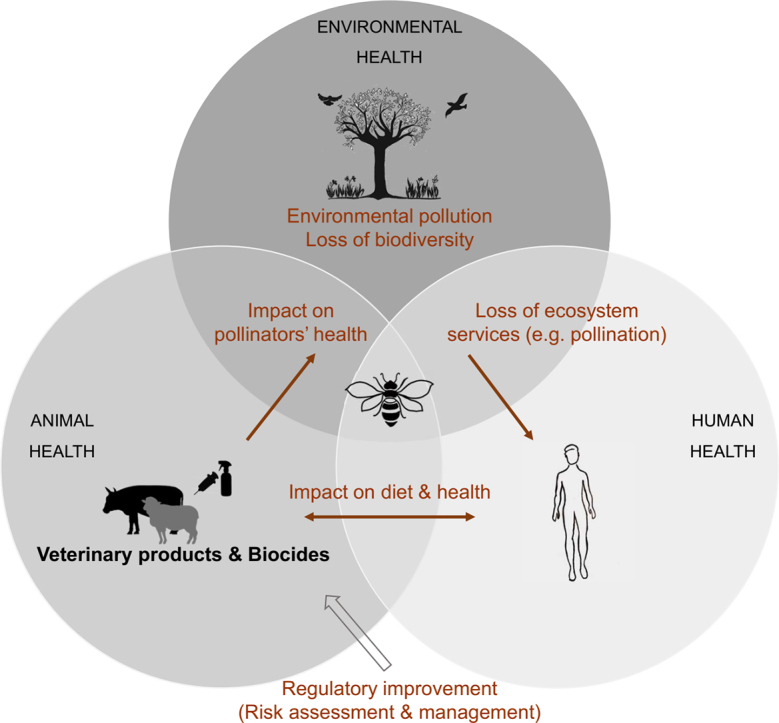
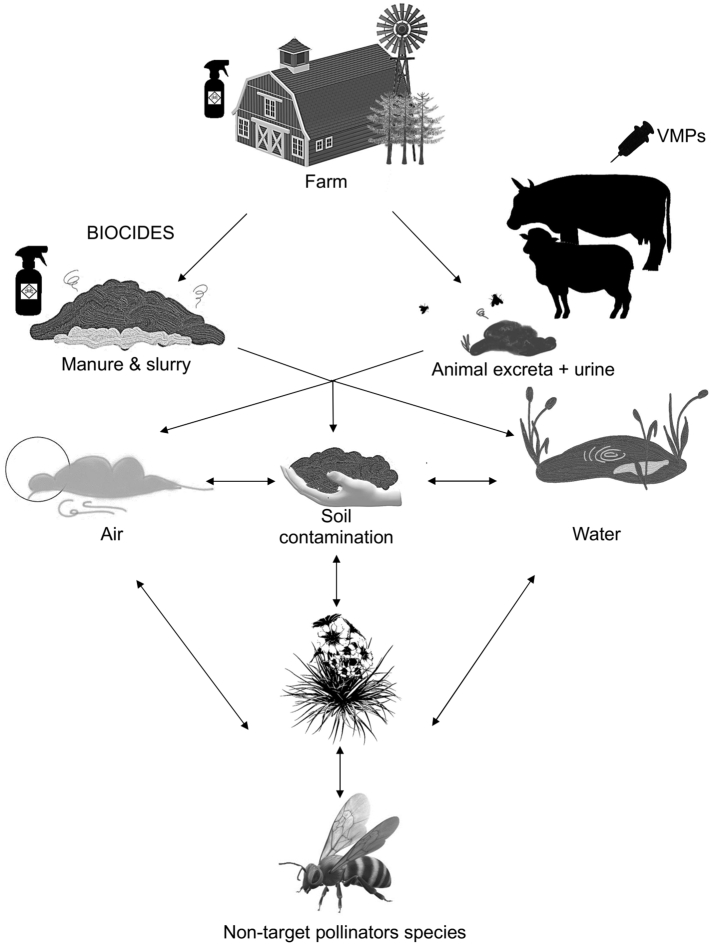
The One Health approach acknowledges that human health is firmly linked to animal and environmental health. It involves using animals such as bees and other pollinators as sentinels for environmental contamination or biological indicators. Beekeepers noticed intoxications of apiaries located in the vicinity of sheep and cattle farms, which led to the suspicion of bees' intoxication by the products used for livestock: veterinary medicinal products (VMPs) and Biocides, confirmed by laboratory analysis. We review the legal context of VMPs and Biocidal products considering Europe as a case study, and identify shortcomings at the environmental level. We describe the possible ways these products could intoxicate bees in the vicinity of livestock farms. We also illustrate the way they may impact non-target species. The cases of ivermectin and abamectin as VMPs, deltamethrin and permethrin as Biocides are considered as case studies. We show bees can be exposed to new and unrecognized routes of exposure to these chemicals, and demonstrate that their application in livestock farming can affect the survival of pollinators, such as bees. We conclude that: (1) figures on the marketing/use of these chemicals should be harmonized, centralized and publicly available, (2) research should be devoted to clarifying how pollinators are exposed to VMPs and Biocides, (3) toxicity studies on bees should be carried out, and (4) pollinators should be considered as non-targeted species concerning the environmental risk assessment before their marketing authorization. We propose the term "Multi-use substances" for active ingredients with versatile use.
“同一健康”方法承认人类健康与动物和环境健康紧密相连。它涉及将蜜蜂和其他传粉者等动物用作环境污染的哨兵或生物指标。养蜂人注意到位于绵羊和奶牛场附近的蜂箱出现中毒情况,这引发了对蜜蜂因用于牲畜的产品(兽药和杀生物剂)而中毒的怀疑,实验室分析证实了这一点。我们以欧洲为例,审视兽药和杀生物剂产品的法律背景,并找出环境层面的不足之处。我们描述了这些产品可能使畜牧场附近蜜蜂中毒的方式。我们还阐述了它们可能对非目标物种产生影响的方式。以伊维菌素和阿维菌素作为兽药、溴氰菊酯和氯菊酯作为杀生物剂的案例进行研究。我们表明蜜蜂可能会通过新的、未被认识到的途径接触这些化学物质,并证明它们在畜牧业中的应用会影响传粉者(如蜜蜂)的生存。我们得出以下结论:(1)应统一、集中并公开这些化学品的市场销售/使用数据;(2)应致力于研究传粉者如何接触兽药和杀生物剂;(3)应对蜜蜂进行毒性研究;(4)在对传粉者进行市场授权之前,应将其视为环境风险评估中的非目标物种。我们建议用“多用途物质”来指代具有多种用途的活性成分。